



In this guide, you’ll learn what AI keyword research tools actually do, what to use in 2026, and a practical framework to choose the right keywords faster (without turning your process into guesswork).
Yes, AI can generate hundreds of keyword ideas in seconds. But agencies and marketing teams are now dealing with new realities:
- Search results are more crowded, more volatile, and more “blended” (forums, videos, AI answers, brand pages).
- Clients and stakeholders ask “why this keyword?” earlier in the process—and they expect a defensible, data-backed answer.
- Most teams don’t just need a list of keywords. They need a prioritized plan that connects keywords to intent, content formats, and business outcomes.
That’s why AI keyword research tools matter.
The best tools in 2026 don’t just spit out ideas—they help you:
- understand intent and competition
- cluster topics into content plans
- move from “research” to “brief” without losing context
- validate decisions with real performance data
What are AI keyword research tools?
AI keyword research tools are platforms that use machine learning or large language models (LLMs) to speed up parts of keyword research—typically:
- generating keyword ideas and variations
- clustering keywords into topics and subtopics
- identifying search intent
- summarizing SERPs (search results) and competitor angles
- suggesting content briefs or outlines
The important nuance: AI is best at pattern recognition and speed.
But keyword research still needs fundamentals:
- real search demand (volume, trends)
- competitiveness signals (difficulty, authority)
- business relevance (ICP, offering, funnel stage)
- prioritization (what’s worth doing now)
So the best teams in 2026 use AI to accelerate the work—then apply strategy to make the right decisions.
Why AI keyword research tools matter more in 2026
In 2026, keyword research isn’t just about ranking.
It’s about creating content that is:
- discoverable in Google
- helpful enough to earn clicks (and conversions)
- structured well enough to be cited in AI answers
- consistent across channels (blog, landing pages, social, email)
For agencies, there’s another layer: keyword choices must be explainable.
If your client asks why you’re prioritizing “marketing workflow automation” instead of “campaign planning automation,” you need more than a hunch. You need:
- evidence of demand
- a clear intent match
- a realistic path to ranking
- and a plan for turning that keyword into a campaign
AI keyword research tools can help—if you choose the right ones.
The 6 types of AI keyword research tools (and when to use each)
Most “AI keyword tools” fall into one of these buckets. Knowing which bucket you need prevents overbuying.
| Tool type | Best for | Where it usually falls short |
|---|---|---|
| All-in-one SEO suites (AI-assisted) | Volume, difficulty, competitor research, SERP analysis | Can be expensive; AI features vary |
| Keyword generators (AI-first) | Fast idea generation and long-tail expansion | Often weak on validation and prioritization |
| Question/topic discovery tools | Capturing informational intent and content angles | Less useful for commercial and BOFU intent |
| SERP/briefing tools (AI content research) | Turning SERPs into outlines and briefs | Not always strong on keyword discovery |
| Internal data tools (GSC + analytics) | Finding quick wins and refresh opportunities | Limited to what your site already ranks for |
| Workflow tools that connect research → briefs → production | Speed and consistency across the content pipeline | Requires process adoption across the team |
What AI keyword research tools to use in 2026: a practical shortlist
Below is a pragmatic way to think about tooling without turning this into a giant listicle.
1) For defensible keyword research (agency + enterprise)
You need tools that combine AI with reliable metrics and competitor context.
Look for:
- keyword volume and trend signals
- keyword difficulty (or competitiveness proxy)
- SERP snapshots (who ranks, what formats dominate)
- competitor gap analysis
- clustering support
Many teams do this with an SEO suite and then add AI for summarization and clustering.
2) For fast long-tail expansion (lean teams)
If you already know your niche and you’re building topical depth, an AI keyword generator can accelerate ideation.
Look for:
- “seed keyword → hundreds of variations”
- intent labeling (informational/commercial)
- keyword clustering
- exportable lists
Just remember: you still need to validate demand and difficulty.
3) For turning keywords into briefs faster (everyone)
Keyword research is only “done” when it becomes a brief that someone can execute.
Look for:
- SERP summaries
- suggested outlines
- content angles
- missing subtopics
- internal linking suggestions
This is where tools that connect research directly to production create the biggest time savings.
How to choose the right keywords with confidence (a 7-step framework)
AI can speed up keyword selection, but it can’t decide your strategy for you.
Use this framework to pick keywords quickly—while staying data-driven.
Step 1: Start with a business-aligned seed keyword (not a random topic)
A good seed keyword is:
- close to what you sell
- aligned to a pain your ICP feels
- broad enough to expand, but specific enough to be relevant
Example: for StoryChief, “marketing workflow automation” is tightly aligned to campaign planning, briefs, approvals, and multi-channel execution.
Step 2: Expand with AI (but keep the output constrained)
Instead of asking AI: “Give me keyword ideas,” ask:
- “Give me keywords for agencies managing multi-channel campaigns”
- “Give me keywords for content approvals and client feedback loops”
- “Give me keywords for content brief templates and workflow automation”
Constrained prompts reduce fluff.
Step 3: Validate demand and feasibility
Every keyword you shortlist should have a reason to exist.
Validate:
- search volume (or at least a trend signal)
- competitiveness (difficulty/authority proxy)
- SERP intent match (do the top results match what you’d publish?)
For the target keyword of this article, “AI keyword research tools”, current US demand is modest but real: ~140 monthly searches, with low competition (0.08) and a CPC around $5.36—a strong sign it’s commercially relevant and not overly saturated.
Step 4: Identify intent (and choose the right content type)
Intent isn’t just informational vs commercial.
In practice, you’ll see:
- “what is” queries (definitions)
- “best tools” queries (comparisons)
- “how to choose” queries (frameworks)
- “template/checklist” queries (actionability)
This article targets: “what to use in 2026” + “how to choose faster.” That means the content needs both:
- a practical tool landscape
- a decision framework
Step 5: Cluster the topic into subtopics (so you cover the SERP)
In 2026, ranking usually requires topic coverage, not keyword repetition.
Build a cluster like:
- AI keyword research tool vs SEO suite
- keyword clustering and topical maps
- competitor keyword analysis
- long-tail keywords
- bottom-of-funnel keywords
- keyword monitoring and refresh workflows
Step 6: Prioritize keywords with a simple scoring model
To move fast, use a lightweight score (1–5) for each dimension:
- business relevance
- intent match
- ranking feasibility
- content leverage (can you repurpose it across channels?)
This prevents analysis paralysis and makes prioritization easy to explain to clients.
Step 7: Turn the keyword into a campaign, not just a post
The fastest way to increase ROI from keyword research is to plan multi-channel distribution at the same time.
A “tool comparison” article can become:
- a LinkedIn carousel (framework + checklist)
- a newsletter issue (shortlist + what to avoid)
- a landing page section (your approach)
- a webinar topic (keyword strategy for 2026)
This is where workflow matters.
Tip: StoryChief AI automates keyword and competitor research, so you can find high-value opportunities, create content, collaborate, publish, and optimize — without needing SEO expertise.

Where StoryChief fits: make confident keyword choices + streamline execution
Most teams don’t lose time because they can’t find keywords.
They lose time because keyword research sits in one tool, briefs sit in another, and the plan gets rebuilt three times before anything ships.
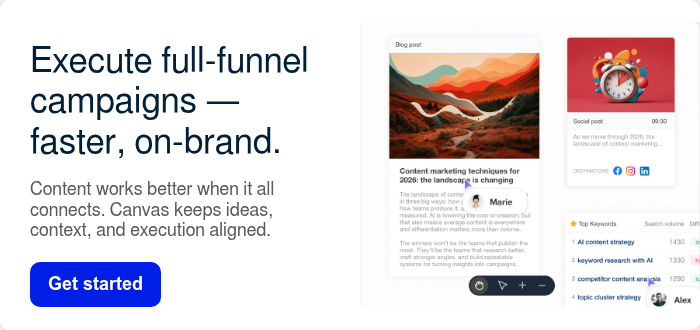
StoryChief AI Canvas is designed to connect:
- research and performance insights
- campaign planning
- briefs and outlines
- content creation and repurposing
- collaboration and approvals
- publishing and optimization


In other words: it helps you turn keyword research into a coordinated campaign faster, with less context switching.
If you’re building a workflow where research turns into execution (instead of getting stuck in spreadsheets), explore StoryChief AI Canvas.
A quick checklist: what to look for in AI keyword research tools
Use this checklist to evaluate AI keyword research tools quickly (and avoid shiny-feature traps).
Data and validation
- Does it provide reliable volume and trend signals?
- Does it provide competitiveness metrics or strong proxies?
- Can it show SERP composition (forums, videos, guides, tools)?
Workflow speed
- Can it cluster keywords automatically?
- Can it generate briefs/outlines from SERPs?
- Can it connect research to content production?
Collaboration and scale
- Can multiple people work from one source of truth?
- Can you standardize briefs/templates?
- Does it reduce approvals friction, or create more?
Real-world outputs
- Can you turn research into a content plan, not just a list?
- Can you repurpose the output across channels easily?
The best AI keyword research tools help you decide—and deliver
In 2026, “AI keyword research tools” should do more than generate ideas.
They should help you:
- choose keywords faster with real evidence
- cluster and prioritize into an actionable plan
- translate research into briefs quickly
- and execute consistently across channels
If you want a workflow that connects keyword research to campaign planning, content creation, collaboration, and optimization in one place, explore StoryChief AI Canvas.