



If you have ever looked at a competitor ranking above you and thought, “What are they doing that I am not?” that is where SEO competitor research starts.
This is not a research exercise for the sake of research. It is a way to stop guessing. When you study the pages already winning, you see what Google is rewarding, what the audience is responding to, and where the weak spots are. That matters because search is brutally concentrated now. around 94% of webpages receive no traffic from Google, and AI Overviews appeared on 15.69% of U.S. desktop searches. The bar is higher than it used to be.
That is why competitor research is so useful. It helps you build pages with intention instead of hope. And when the research is done well, the page you publish is not just “SEO-friendly.” It is more useful than the pages already ranking.
What is SEO competitor research?
SEO competitor research means studying the websites, pages, keywords, and backlink patterns that already rank for the terms you want. It is not only about direct business rivals. In search, your real competition is whoever is taking the clicks for that query.
In practical terms, it answers four things: who is ranking, why they rank, what they cover, and what they leave out. Once you know that, your next content decision gets much easier.
A business competitor sells something similar to you. An SEO competitor can be anyone ranking for your target keyword, even if they do not sell the same service at all.
For example, if you run a coworking brand, your business competitors might be other coworking brands. But your SEO competitors may also include list of articles, local guides, map packs, and comparison pages. That is why the SERP matters more than your assumptions.
Why SEO competitor research matters more than ever?
Competitor research helps you avoid building content in a vacuum. It shows you whether the SERP wants a guide, a comparison, a tool page, or a hybrid article. It also helps you see whether the opportunity is in depth, clarity, structure, or authority.
It matters commercially, too. If the top of the SERP is dominated by pages that are clearer, more useful, and better supported than yours, you are not really competing yet. You are just publishing.
There is also a business side to this. First Page Sage’s 2026 report says “Thought Leadership & SEO” campaigns can deliver 748% ROI on average, which is a strong reminder that strategic content can become a business asset, not just a blog post. That is the real win: traffic that supports leads, sales, and trust.
The 5-step SEO competitor research framework
This is the part where research becomes execution.
Step 1: Identify your real SEO competitors
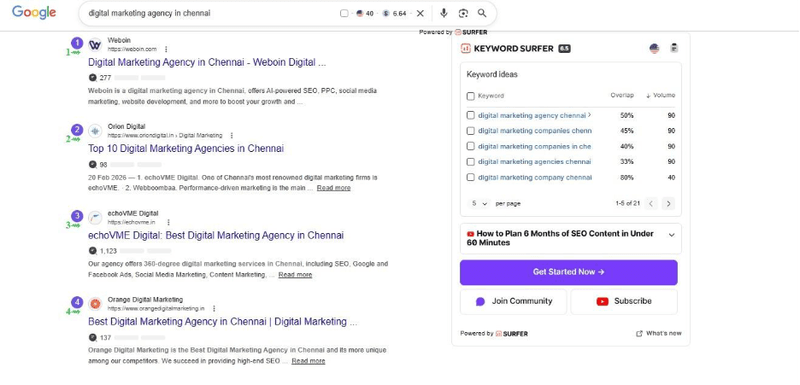
Start with Google. Search the target keyword and study the first page carefully. Do not assume you already know the competition. The domains showing up for the query are usually more important than the brands you already had in mind.
Here is the clean way to do it:
- Search the keyword in Google and note repeated domains.
- Check Semrush Keyword Overview for volume, difficulty, and SERP features.

- Open Semrush Organic Rankings to see which domains keep winning related traffic.

- Review Semrush Top Pages to find the pages driving visibility.

- Keep only the domains that consistently show up across related searches.
Step 2: Analyze competitor keywords
Once you know who is winning, find out what they are winning with.
I usually start with Semrush Keyword Gap.

That shows me the keywords competitors rank for that I do not. Then I use Semrush Keyword Magic to cluster the terms, and Semrush Keyword Strategy Builder to keep the useful ones organized.

This is where competitor keyword analysis becomes practical instead of theoretical. The goal is not to build a giant list. The goal is to see which keyword groups actually matter.
When I am doing this for Rankraze, I do not just look at broad terms like “SEO agency.” I look at the supporting terms around it. Location terms, service terms, and comparison terms often tell me more about ranking opportunities than the head term alone.
Step 3: Analyze competitor content strategy
This is where most articles stay shallow. They stop at keywords and never ask how the content itself is built.
When I study content, I look at the opening, the section order, the amount of depth, the examples, and the visual support. Is the page a guide, a comparison, a landing page, or a tool-led article? Does it explain the “why” or only the “how”?
That is why competitive content analysis matters. It helps you understand the structure behind the ranking, not just the topic.
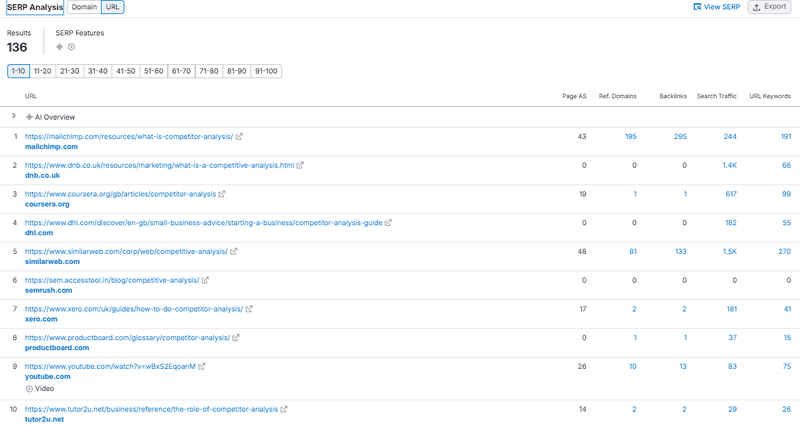
The screenshot above shows the top pages for the query “Competitor Analysis.”The top pages showed a strong pattern: the ranking pages are mostly long-form educational guides, tool-led pages, and hybrid articles. That means the SERP wants practical explanation, not vague commentary. It also means a thin article will probably lose.
Step 4: Analyze competitor backlinks
Backlinks still matter because authority still matters.
A strong page with weak authority can lose to a decent page with stronger trust signals. That is why backlink research belongs inside competitor research.
I begin with Semrush Backlink Gap and then move into Semrush Backlink Overview. If I need a second view, Ahrefs Site Explorer and Moz are useful too.

The point is not to count links. The point is to see what content earns links.
A guide earns links differently from a stats page. A comparison page earns links differently from a tool page. Once you understand that pattern, you can build content that deserves the same kind of attention.
Step 5: Identify gaps and opportunities
This is where research turns into strategy.
- I usually divide opportunities into three buckets: content gaps, keyword gaps, and authority gaps. Content gaps are missing subtopics or weak explanations.
- Keyword gaps are the terms competitors own that you do not.
- Authority gaps are places where the content is fine, but the trust signals are weaker than they look.
A useful gap is often smaller than people expect. Maybe the current pages explain the process but never explain the decision-making. Maybe they mention tools but never show how to use them properly. Maybe they cover the topic, but not in a way that feels grounded in real work.
That is where your own experience becomes the edge.
At Rankraze, we use this exact approach: we identify competitors, inspect keyword gaps, study top pages, and check backlinks before we decide what to build next. A digital marketing company that does this well does not just publish more content. It publishes smarter content.
Best tools for SEO competitor research
You do not need every tool. You need the right ones in the right order.
For keyword and SERP work, I use Semrush Keyword Overview, Semrush Keyword Gap, and Semrush Top Pages.
For backlinks, I use Semrush Backlink Gap and Semrush Backlink Analytics.
For validation, I check Google Search Console and Google Analytics (GA4).
If I want broader market context, Similarweb and SpyFu are helpful. If I want to move research into workflow, StoryChief is useful because it keeps the process collaborative instead of scattered.
Common SEO competitor research mistakes to avoid
The biggest mistake is copying the structure without understanding the logic behind it.
The second mistake is trusting tools too much. Tools show you the landscape, but they do not make the decision for you. If you do not know what the data means, you just end up with a more expensive spreadsheet.
The third mistake is ignoring intent. A keyword can look informational on paper and still behave like a comparison query in the SERP. That is why the search results matter more than the keyword label.
The fourth mistake is targeting the hardest keyword first. Sometimes the better move is to win the cluster, build topical trust, and then go after the bigger term later. That is not a compromise. That is sequencing.
How to turn competitor research into rankings?
Once the research is done, the content needs to feel like it came from real work, not from a template.
That means you should explain the concept, show why it matters, and then guide the reader through the action. It also means examples should sit inside the process, not in a disconnected block at the end. That feels more natural, and it reads more like how people actually learn.
If you are building a page around SEO competitor research, a strong internal path might include SEO marketing strategy example and rank higher on Google. That keeps the topic connected to execution instead of leaving the reader with a nice explanation and nowhere to go next.
How I would use this in a real workflow?
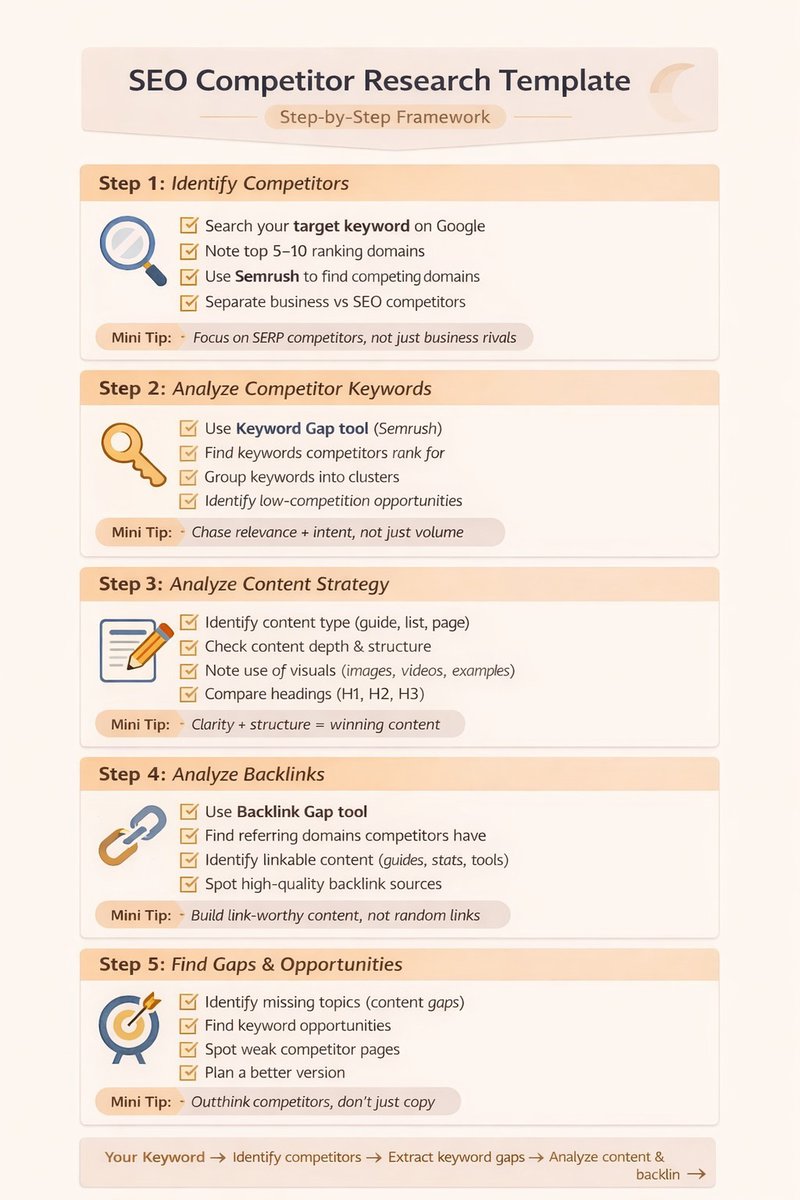
When I work through this process, I do not start by writing. I start by mapping the SERP and asking what kind of answer the page needs to be. If the query is informational, I look for the dominant educational angle. If the pages are thin, I look for a deeper explanation. If the pages are already strong, I look for a better structure or a more practical example. That is usually where the opening is.
Then I move from keyword data to page data. I check which terms competitors win, which pages carry the traffic, and whether those pages are winning because of authority or because the content is genuinely better. That distinction matters more than most people think. Sometimes a page ranks because the brand is powerful. Sometimes it ranks because the article is cleaner, clearer, and more directly useful. You need to know which one you are dealing with before you decide how to compete.
At Rankraze, this is the point where the research becomes editorial. We decide whether the next move is a better guide, a more focused page, or a cluster of supporting articles that can lift the whole topic. That kind of thinking is what keeps competitor research useful long after the first draft is published.
That is also why I like to link research to execution right away. A keyword gap report is only useful if it changes the brief, the outline, or the page you publish next. Otherwise it becomes a report that feels impressive but does nothing. Competitor research should always end with a choice, because choices are what turn analysis into rankings and rankings into business results. That is the point of it, always.
Free tool: Analyze your target audience, brand voice, content pillars and competitors. Try it now.

Final thoughts
SEO competitor research is not about staring at other websites and feeling behind. It is about seeing the market clearly enough to make better decisions.
When you know who is ranking, what they rank for, how they structure the page, and where they are weak, you stop writing blind. You start building content with a reason.
That is the real advantage. Not copying competitors. Learning from them well enough to do something better.