




Is your search engine optimization stagnant? Like many other businesses, you’ve tried every SEO strategy on the market, from link building to AI-driven search tactics, yet your results fail to improve.
The question is, have you considered your content workflows? Not only do broken workflows create SEO bottlenecks, but they are also difficult to spot, especially if your operations have been this way for a while.
Data from Search Engine Land revealed that 45% of marketing teams struggle to keep up with SEO/content demands in 2026, with inefficient, manual workflows reducing productivity by up to 40%.
This article jumps straight into the SEO impacts of broken content workflows, teaching you how to improve them and your search position in 2026.
Why Broken Workflows Are the Real SEO Bottleneck
Did you know that the vast majority of SEO bottlenecks are not caused by a misplaced link or a low-search-volume keyword? They are most commonly a product of inefficient, fragmented workflows.
If your content production relies on manual processes, senior management handoff, and an array of disconnected tools, it’s no surprise that you’re experiencing project delays and inconsistencies.
SEO teams that have unclear ownership of their work and poorly communicated project timelines struggle to stay consistent with SEO strategies that require exactly that.
These broken content workflows are not just inconvenient, they directly slow down your rankings if you’re not careful.
So what is the answer? In 2026, operational thinking is the key to driving SEO success. Teams that prioritize their workflow management first immediately eliminate the inefficiencies that stop powerful SEO strategies from driving real change.
The most successful marketing teams are moving towards automating their content workflows.
In SEO terms, this means no more content getting stuck in approval loops, faster updates across project dashboards, and less time spent on lengthy manual processes.
What Your Team is Doing Wrong (and How to Fix it)
Before we get into fixing your SEO strategy, let’s first take a look at where your team is going wrong.
Most broken content workflows are easily fixed, the key is identifying them early.
You’re Relying on Manual Workflows
The most common offender here is a reliance on manual workflows.
If your team is bombarded with lengthy manual tasks such as keyword research, outreaching, or screening historical blog content, you slow down production.
Worst still, if you’re relying on manual approvals, don’t be surprised if a piece of content sits in a manager’s inbox for days or weeks and misses its chance to hit the ground running with seasonal relevance.
The issue here is that manual content workflows are historically reactive. This means that SEO bottlenecks are not fixed until someone notices a gap or assigns a task to fix it.
How to Fix This
Manual content workflows can’t be erased overnight, but they can be enhanced by powerful tech.
The introduction of agentic AI systems in the SEO industry is helping busy teams better coordinate tasks and execute workflows with minimal manual input.
Think automated content audits, frictionless approvals, and AI-powered systems that instantly trigger updates if rankings dip.
Implementing smart AI-driven systems into the team structure is the key to creating cross-team workflows that can run independently, without the need for constant follow-ups.
For example, in a traditional SEO content creation process, teams undergo about 8 steps from ideation to final delivery.
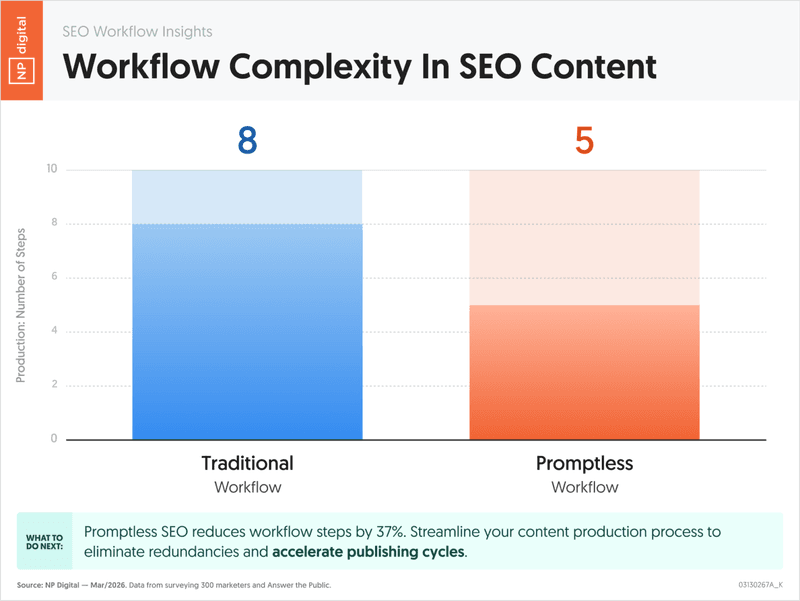
AI-optimized workflows can reduce this to just 5 steps, reducing workflow complexity by more than a third.
Your Team is a Hidden Source of Workflow Friction
The way that you structure your team could also be contributing to ranking dips and SEO bottlenecks.
If you’re dealing with a lack of coordination between your creative team (content writers) and your SEO strategists (technical developers), you’ll regularly experience delays and content that is incorrectly optimized for the search engine.
While one or two delays are harmless, siloed collaboration issues quietly multiply and have your team scrambling just before the deadline.
Studies show that remote teams are often victims of workflow friction. With employees working from different locations, poor access to information, lack of visibility into task progress, and miscommunication across lots of different chat tools can make it hard to stay on track.
As a result, content is either lost, duplicated, or doesn’t fit the brief, meaning that teams waste time going back to the drawing board.
How to Fix This?
If you’re working with a dispersed team, having an effective remote working strategy in place is crucial.
To fix recurring SEO bottlenecks, you need to have clear communication guidelines, centralized tools and dashboards that can be accessed by all employees, and a defined workflow structure before a project even starts.
This is key if you want to speed up those publishing cycles and start building compound SEO growth.
You’re Prioritizing the Wrong Tasks
Did you know that SEO teams that spend too much time on administrative tasks, rather than creative output, have a 40% lower productivity rate?
If your team spends more time on low-impact blog updates than they do on creating powerful, topical content or prioritizing high-value content refreshes, your SEO will tank as a result.
Worst still, your content may hit the mark, but your team continues to ignore technical issues that slow down rendering and vital indexing.
If your team is prioritizing all the wrong tasks, this could be the reason behind your dropping SERP position.
How to Fix This?
Learning to prioritize workload early is the key to avoiding SEO bottlenecks.
Start by asking each of your employees to create a structured task list that ensures tasks are completed in order of priority.
Encourage team members to focus on high-impact work first, such as a topical piece of content or fixing an indexing issue. While administrative tasks and content monitoring are still important, they shouldn’t dominate an employee’s daily workload.
How to Create a Content Workflow That Helps SEO Thrive
Creating a powerful SEO content workflow takes time and effort from every team member. The key to success is standardizing the process as quickly as possible.
Create easy-to-follow step-by-step guides, templates for content briefs, and invest in a centralized project dashboard to reduce manual administrative tasks.
Next, start automating any areas of the content workflow that you can. Whether you use AI-powered tools to handle keyword clustering, website structure optimisation, or to digitalize approval workflows. Each task you offset allows creatives to focus more on content.
Lastly, consider your communication. If you’re not using a central content calendar or an easily accessible project management tool to track workflows and deadlines, it’s time to invest.
For scattered teams and employees with multiple responsibilities, structure is the cure for any SEO bottleneck.
Taking time to reduce manual load helps creatives flourish, and technical SEO strategists spot mistakes before it’s too late.