




An AI presentation maker turns a topic, outline, or document into a full slide deck in minutes. PowerPoint still works. However, it burns half your day on manual layouts and filler text. Instead, modern AI slide tools research the topic, structure the narrative, and generate a draft you can actually present.
To find the best AI presentation maker in 2026, I tested 12 popular tools for design quality, speed, research depth, exports, and pricing. Every tool below is ranked for real client and team work, not homepage demos.
How we chose the best AI presentation makers
For each AI PowerPoint generator, we started with the exact same prompt:
“Create a 10-slide presentation on the benefits of content marketing”
As a result, we could directly compare how each AI tool handles topic research, content organization, visual design, and generation speed. Next, we evaluated every app across five criteria:
- Design style: Do the slides look professionally designed? Moreover, can you customize brand colors and fonts?
- Ease of use: How intuitive is the editor? For instance, can a beginner build a deck on the first try?
- Content quality: Does the copy make sense? Specifically, does it pull real data instead of generic AI filler?
- Export options: Can you download a clean PowerPoint (
.pptx), Google Slides, or PDF file? - Overall value: Finally, is the subscription worth the monthly price?
Best AI presentation maker comparison table (2026)
| Tool | Rating | Pricing | Review |
|---|---|---|---|
| GenPPT | 4.9 / 5 | $25/month ($99/yr) | Best AI presentation maker overall for research-backed copy and custom visual decks |
| Pitches.ai | 4.8 / 5 | Free to build ($49 export) | Best AI presentation maker for investor pitch decks & startup fundraising |
| Gamma | 4.7 / 5 | $10/month | Best for web-style, scrollable card presentations |
| Canva AI | 4.6 / 5 | $14.99/month | Best for drag-and-drop design freedom and a massive template library |
| Plus AI | 4.4 / 5 | $15/month | Best for working directly inside Google Slides & PowerPoint |
| Beautiful.ai | 4.2 / 5 | $12/month (annual) | Best for strict corporate brand consistency and smart templates |
| SlidesAI | 4.0 / 5 | $12/month | Fast text-to-slide extension for Google Slides and PowerPoint |
| Presentations.AI | 3.9 / 5 | $16.50/month ($198/yr) | Automated layout engine for data-heavy decks & timelines |
| Slidesgo | 3.8 / 5 | $4.99/month | Template catalog with basic AI slide generation |
| Decktopus | 3.7 / 5 | $24.99/month | Simple step-by-step presentation builder for beginners |
| Microsoft Copilot / Gemini | 3.5 / 5 | $14–$21/month | Built into PowerPoint and Google Slides for quick in-app drafts |
| Prezi AI | 3.4 / 5 | $19/month (annual) | Non-linear, zoomable canvas format for live storytelling |
1. GenPPT - Best AI presentation maker overall

**Best for:** Research-backed, agency-grade visual slide decks from prompts or PDFs.
GenPPT is the best AI presentation maker on this list because it turns prompts, PDFs, Word docs, or URLs into full-slide visual decks that look like a designer built them. By contrast, most rival tools simply stuff bullet points into rigid template boxes.
Unlike basic AI PowerPoint generators, GenPPT researches your topic, builds a slide-by-slide outline for you to approve, and shows a visual concept sheet before rendering the final slides. In addition, if you just need a quick conversion without signing up, it offers a free PDF to PowerPoint converter.
Our experience testing GenPPT
We tested GenPPT with our 10-slide content marketing prompt. First, it ran live web research to pull real ROI statistics. Next, it generated an editable slide outline and a visual concept preview sheet. Once we clicked generate, it produced 10 custom-designed slides in about two minutes.
Furthermore, the slide copy was sharp, data-backed, and visually consistent. Afterwards, the built-in AI chat agent let us regenerate individual slides in seconds before exporting cleanly to PowerPoint (.pptx) and PDF.

Pros:
- Deep topic research with optional live web search
- Slide-by-slide outline approval and visual concept preview before rendering
- High-impact, custom full-slide visual designs that never overflow text boxes
- Built-in AI chat agent for per-slide edits
- Imports PDFs, Word docs, spreadsheets, text, or website URLs
- Includes free tools for PDF to PowerPoint, LinkedIn Carousels, and Instagram Carousels
Cons:
- Multi-step outline and concept render takes 2–3 minutes (not sub-minute)
- Slides export as full-bleed visuals, so text edits happen in GenPPT chat before export
- No Google Slides sidebar add-on
Price: Free PDF to PowerPoint tool (3 conversions/day, no login). Full studio starts with a $1 3-day trial, then $25/month or $99/year for 20 decks/month. Start your $1 trial on GenPPT
Bottom line: Pick GenPPT if you want researched content, preserved document numbers, and bespoke slide design instead of cookie-cutter templates.
2. Pitches.ai - Best AI presentation maker for investor pitch decks
Best for: Founders, startups, and agencies raising Pre-Seed, Seed, or Series A rounds.
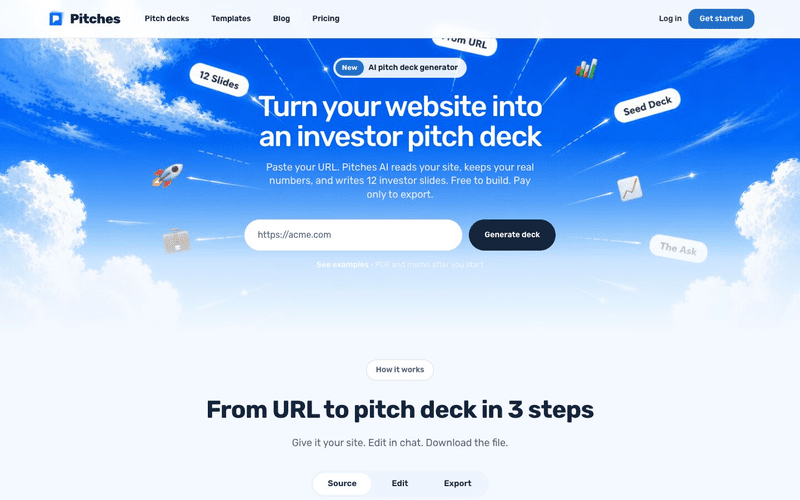
General slide tools struggle with fundraising because investor decks follow strict narrative rules. Pitches.ai is the best AI presentation maker built specifically for investor pitch decks.
Instead of asking you to design slides from scratch, Pitches.ai reads your company website URL, executive memo, PDF, or financial model. Then, it maps your real traction metrics into a 12-slide investor narrative: Problem, Solution, Product, Market Size, Business Model, Traction, Competition, Team, and The Ask.
Our experience testing Pitches.ai
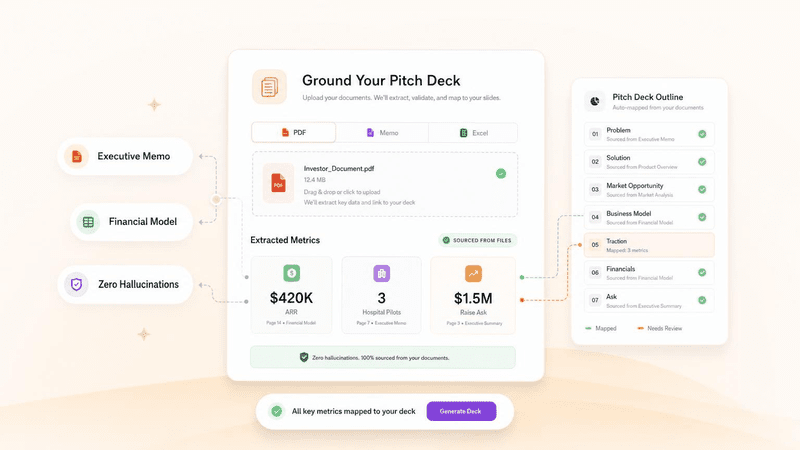
We tested Pitches.ai by pasting a startup URL and attaching a one-page traction memo. Immediately, the AI extracted the key revenue figures, customer counts, and raise amount without inventing a single number.
Next, it presented a 12-slide YC-style pitch outline where every headline stated a clear conclusion. After we approved the story and picked a visual direction, it rendered a complete investor deck that we could refine slide-by-slide in chat. Best of all, generating and editing the deck in chat is completely free, you only pay when you are ready to export the final PowerPoint or PDF.
Pros:
- Purpose-built 12-slide investor narrative (Problem, Traction, Market, Ask)
- Reads your live website URL, pitch memo, PDF, or spreadsheet
- Zero hallucinated metrics—grounds every slide in your uploaded numbers
- Free to generate and iterate in chat before paying a cent
- Exports investor-ready PowerPoint (
.pptx) and PDF files
Cons:
- Built strictly for investor pitch decks and fundraising, not classroom lectures
- Exporting
.pptxor PDF requires a one-time or annual pass
Price: Free to generate and edit in chat. Exporting costs $49 one-time per deck or $249/year for unlimited pitch decks. Try Pitches.ai for free.
Bottom line: If you are raising capital or pitching clients, skip generic template tools and use Pitches.ai so your narrative and traction numbers land on the right slides.
3. Plus AI

Best for: Google Slides and PowerPoint users
Plus AI adds an AI assistant directly into Google Slides and PowerPoint. You’ll need to install it in your Google workspace to get started, it will ask for a bunch of permissions.

But then it generates content, suggests layouts, and edits existing slides without leaving your familiar platform.
Our experience: We used Plus AI within Google Slides to transform our content marketing prompt into a structured deck. In Google slides, you open the extensions panel, enter the prompt and you get an outline (no research step was done, a bit basic).

It then created solid slides in about 2 minutes, one of the slowest AI presentation tools we tested, but we could edit them immediately in Google Slides.
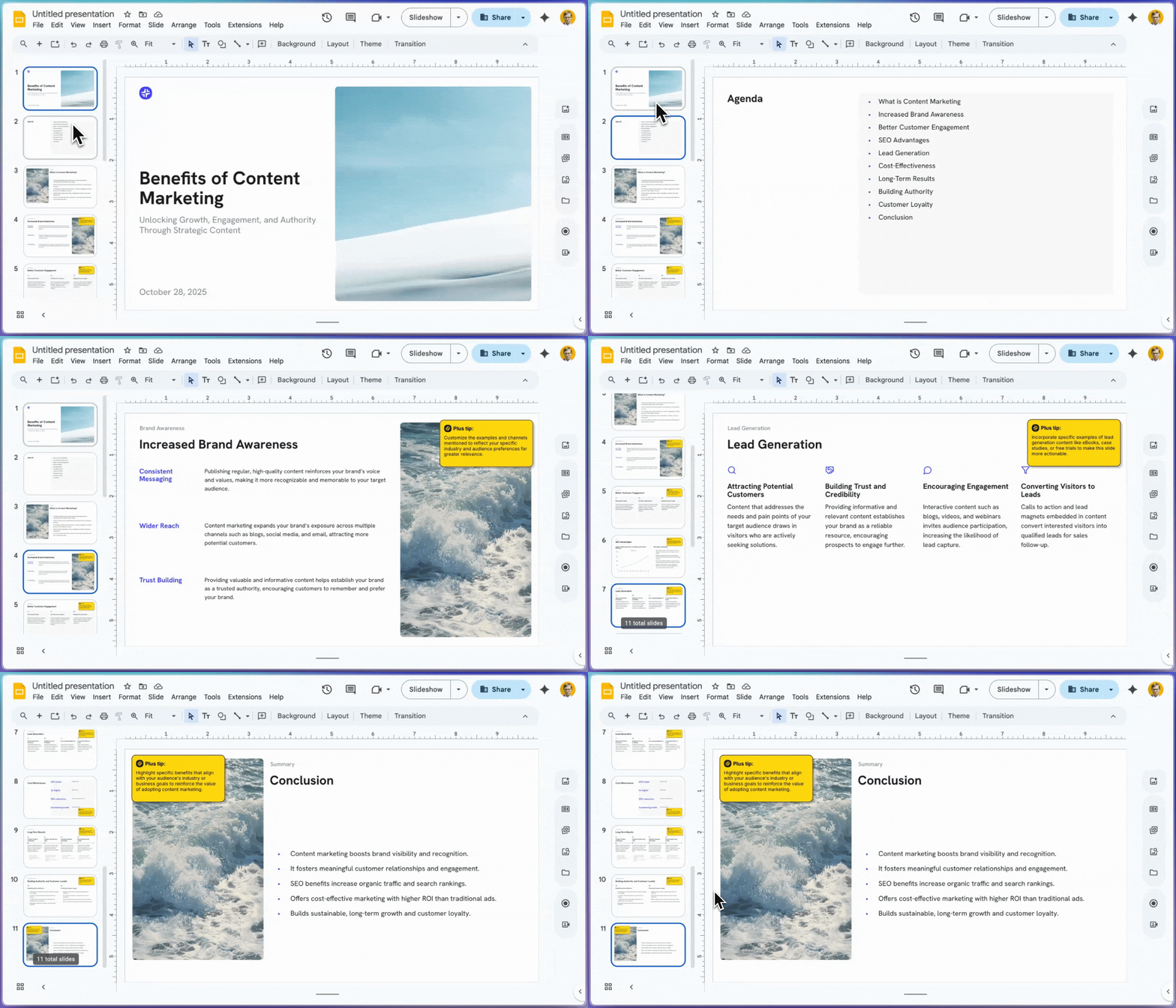
The AI rewrote sections and adjusted layouts as we asked. However, it felt less powerful than standalone tools and lacked advanced design features. The content quality was OK-ish as you can see in the example slides above.
Pros:
- Works inside familiar Google Slides and PowerPoint
- No platform switching required
- Decent first drafts quickly
- Can edit existing presentations with AI help
- Seamless integration with existing workflows
- Maintains your familiar editing environment
Cons:
- Tied to Google Slides as extension, I still had a bug where I had to use the site.
- Fewer design options than standalone AI tools
- Less AI power than dedicated platforms
- Gets expensive fast for high-quality output ($25/mo/user!)
Price: No free plan except a 7-day free trial. Basic plan starts at $15/month (unlimited AI generations, premium features). Pro plan is $25/user/mo for AI images, document upload and 100k+ prompts. Team plan is $40/user/mo for company branding, presets and company templates.
Bottom line: Use Plus AI if you're already comfortable with Google Slides or PowerPoint and want AI assistance without learning a new platform. Perfect for teams deeply invested in Google Workspace or Microsoft 365 who want to enhance existing workflows.
4. Beautiful.ai

Best for: Brand consistency
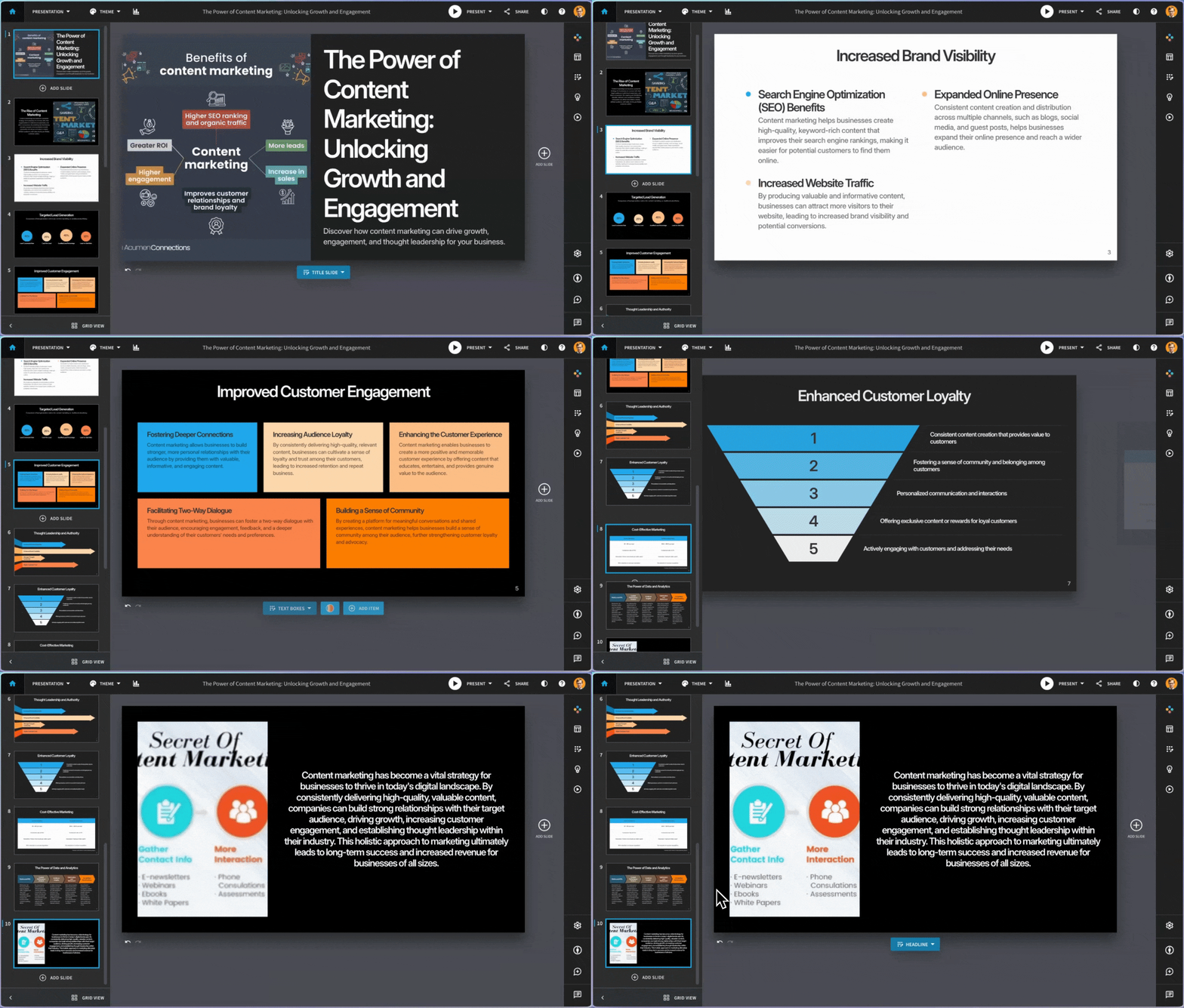
Beautiful.ai focuses on design and themes, you can use the tool without AI features, for free. But to actually use any of the AI features, you need to upgrade, unfortunately, all the plans start immediately with an annual plan at $144/year. The monthly plan is hidden away, and only starts at $45/month. And so I did (the page crashed once during testing).
Our experience: Look, for a tool called Beautiful AI, I was extremely underwhelmed with the quality of the design output. They look a bit sloppy, the copywriting and text is too verbose and doesn’t always fit the slides. The actual content is clearly AI slop and written with AI. I had high hopes, but this is a disappointment compared to the other AI tools here.
Pros:
- Polished layouts with minimal work
- Strong customization options for brand consistency
- Smart templates that adapt automatically to content
- Brand control features (colors, fonts, logos)
- Templates follow design principles (alignment, spacing)
Cons:
- No free plan available with AI features
- Steeper learning curve than simpler tools
- Overpriced for what it is, especially annual plans
- Less content generation focus—more design automation
- Requires investment to master features
Price: Pro plan at $45/month (individual use). Team plans at $144/user/year (collaboration, brand controls, analytics). Try Beautiful AI.
Bottom line: Choose Beautiful.ai for consistent brand-focused decks. Best for teams that need professional design with brand consistency across all presentations. Ideal for agencies, corporate teams, and businesses where brand alignment matters more than speed.
5. Canva AI

Best for: Design freedom
Canva AI adds AI to its familiar design editor. Choose a template and customize with drag-and-drop tools, fonts, colors, and images. Magic Design suggests layouts and creates slides based on your content.
Our experience: Canva generated an 10-slide deck in about a minute using Canva AI. You start with a prompt, then it asks a few follow-up questions (big fan here) and Canva continues to make an outline.

Then once you confirm, it generates the full presentation immediately. The only thing it missed compared to GenPPT, is that it didn’t do a deep research step to understand the subject matter.
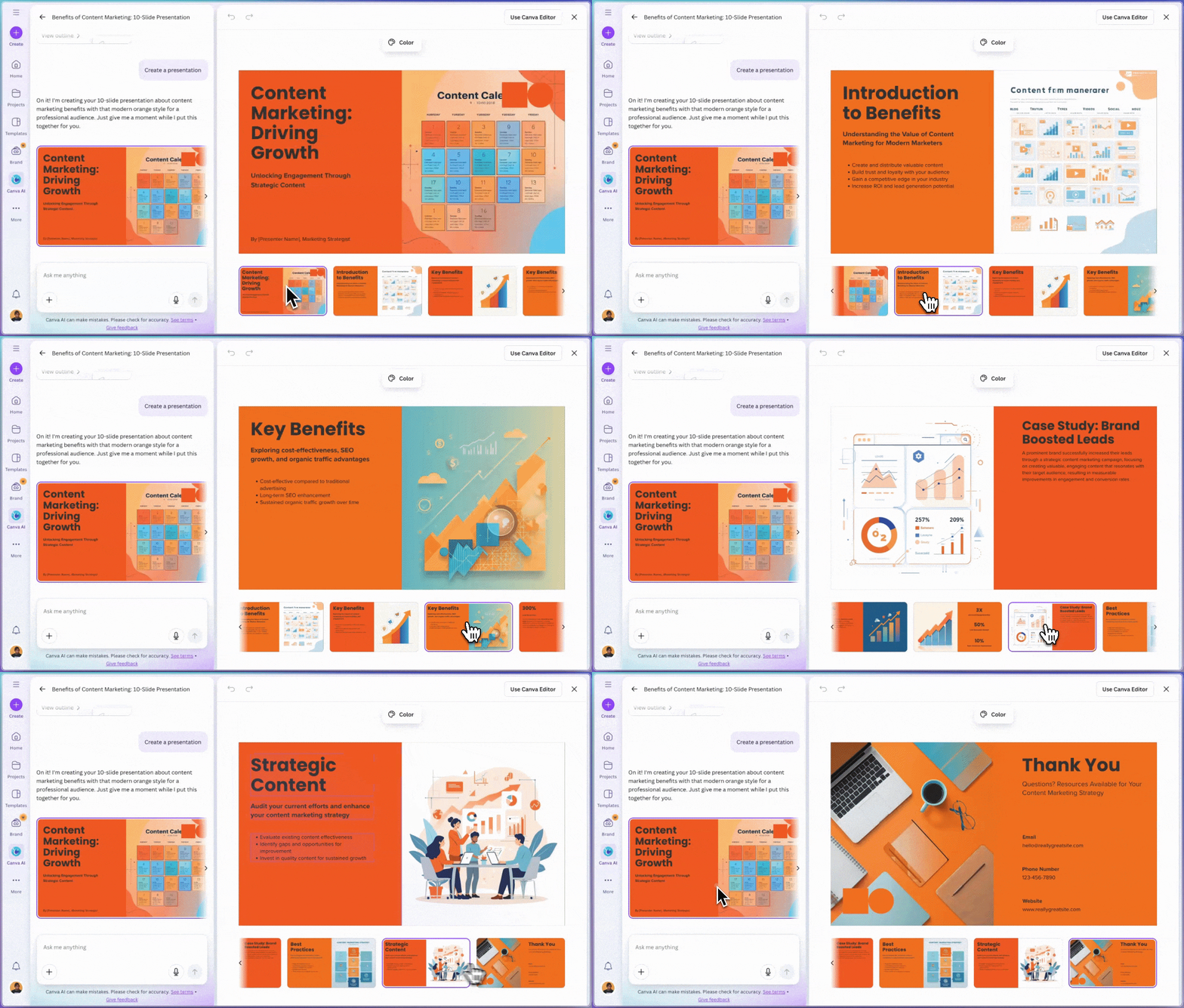
It went a bit too hard on my “orange” design style request, but you can tweak the design and content after it has been created as well as continuing to edit in the full Canva Magic Design Editor.

The template library was massive, thousands of options. We could easily tweak colors, fonts, and layouts with the familiar drag-and-drop interface. The AI writing assistant helped us refine copy. Export was clean to PowerPoint and PDF. Even MP4 is an option. Out of all the AI tools tested so far, this is likely the most robust one, especially if you already pay for Canva for graphic design or other tools.
Pros:
- Massive template library (thousands of options)
- Easy to tweak designs with drag-and-drop
- Familiar interface for Canva users
- More than just presentations, all in 1 subscription
- AI writing assistant for copy refinement
- Extensive design assets (photos, icons, graphics)
- Rich collaboration features for teams
- Multiple export formats (PowerPoint, PDF, video)
Cons:
- AI is part of a broader toolset, not the main focus
- Some advanced features require Pro subscription
- Doesn't integrate directly with Google Slides
- Can be overwhelming with too many options
- More design platform than AI generator
Price: Free plan available (basic templates, limited exports). Pro at $14.99/month (premium templates, brand kit, unlimited exports). Sign up to Canva.
Bottom line: Pick Canva for full design control. Best for users who want extensive customization and don't mind learning a design platform. Ideal for marketers, social media managers, and small businesses who need versatile design tools beyond presentations.
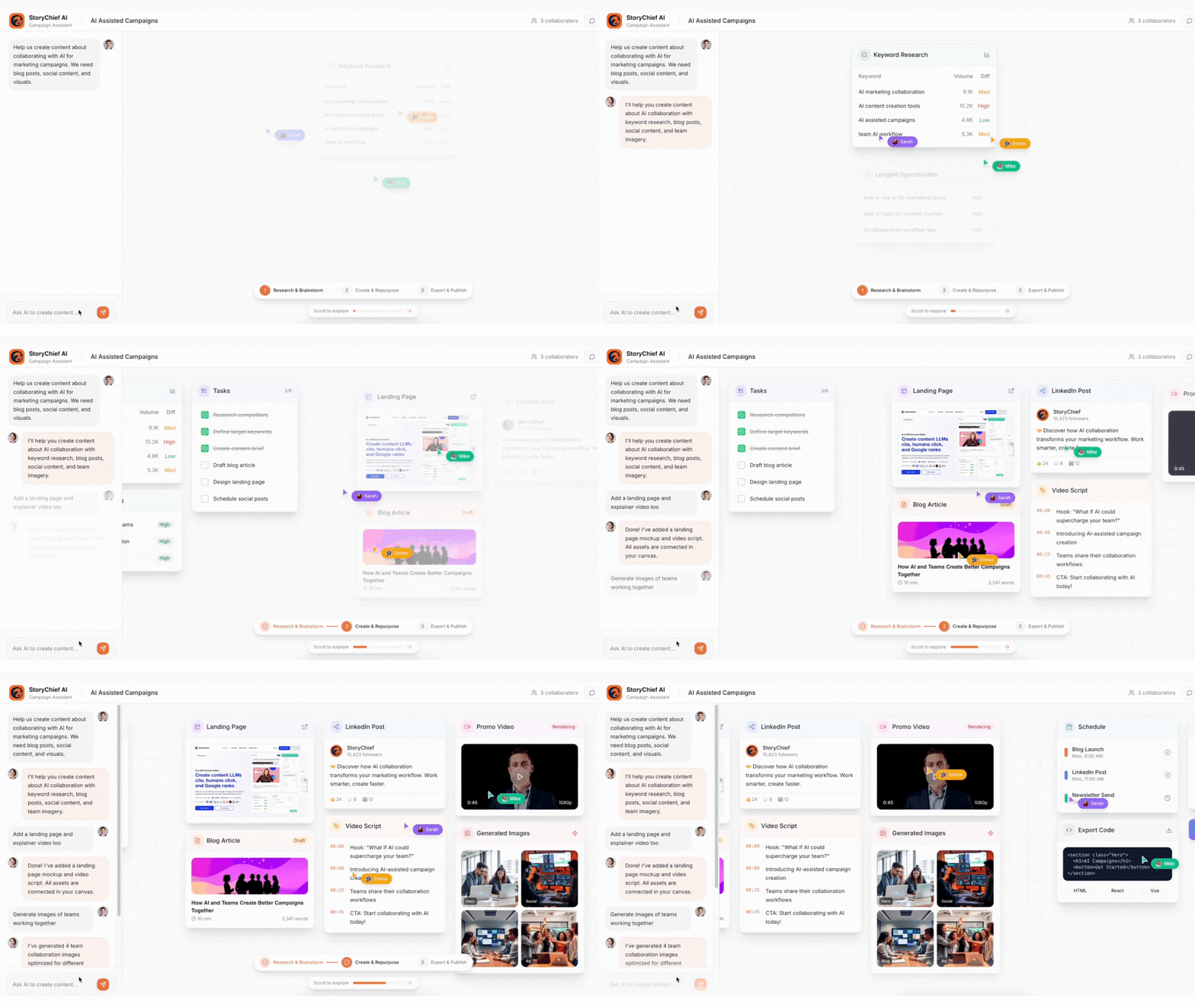
StoryChief AI Canvas enables marketers to plan, edit, and expand campaigns within a single visual workspace—automated, consistent with brand guidelines, and designed for practical marketing workflows. Try it free.

6. SlidesAI

Best for: Converting text to slides
SlidesAI is a Google Slides and Powerpoint extension. It specializes in turning long text into structured slide presentations. Paste content and get slides with visuals, outlines, and speaker notes. It supports AI-generated images and voice-over.
Our experience: We used the same prompt to generate a presentation about content marketing.

What I liked is that it asked about the type of presentation you want (educational, business pitch, etc), the audience (students, angel investors, etc) and the writing style (authoratitive, etc). This allows you to real nail down the exact content you want.

Then you confirm the outline, edit the content, and select a theme, finally, you select if you want real images or AI images. SlidesAI so far gave the best type of deep AI customization I’ve seen. Incredible. And everything done inside Google slides without any bugs.
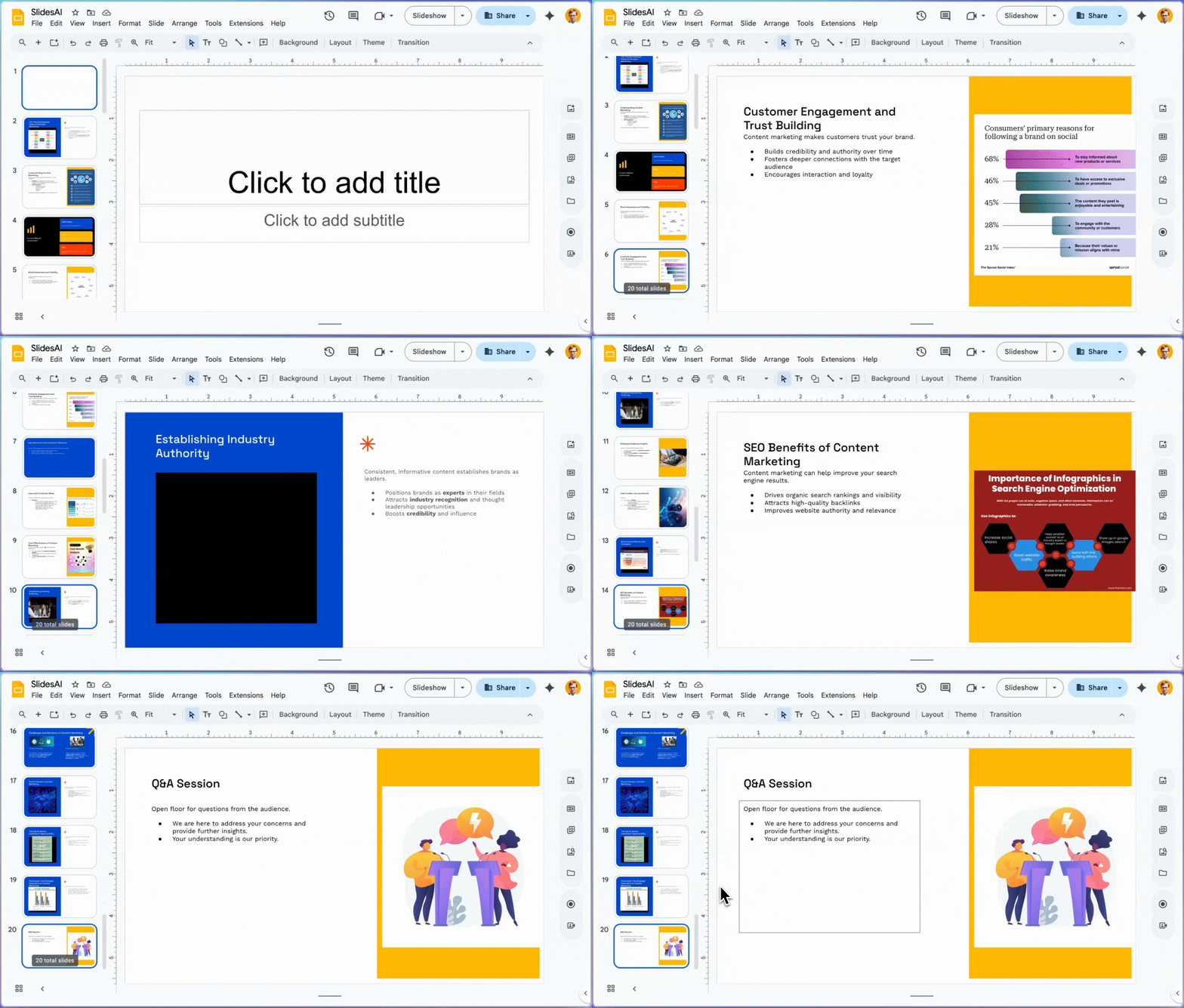
The slides were well-organized with bullet points and section headers. But AI-generated images were relevant but generic. Design output was a bit disappointing after filling in all the details. But this could be just Google slides. I wish it would have been better!
Pros:
- Fast text-to-slide conversion
- Supports AI-generated images
- Deep AI customization
- Pre-set design themes and layouts
- Works right inside Google Slides or PowerPoint
- High-quality input and personalization
Cons:
- Lower design quality
- Better for text-heavy content than creative presentations
- Generic AI-generated images
Price: Free plan available (3 presentations/month, basic features). Pro starts at $16/month (unlimited presentations, premium features, voice-over).
Bottom line: Choose SlidesAI to turn documents into slides quickly. Best for educators and professionals converting written content (reports, articles, papers) into presentations. Ideal for academic lectures, training materials, and content repurposing.

7. Decktopus AI

Best for: Beginners
Decktopus guides you step-by-step through presentation creation. Enter a topic, choose an audience, select a template, make an outline, and generate slides.

Our experience: Decktopus was the easiest tool to use. We entered our prompt as usual, the AI created an outline. It generated a basic presentation in under a minute. The slides were functional but basic. Customization was very limited, mostly just changing text. Output was fast but quality was basic. There was no actual research step or understanding of the content.
Pros:
- Straightforward and beginner-friendly
- Fast output (under a minute)
- No design skills required
- Free plan available
Cons:
- Very restricted customization options
- Basic design quality compared to competitors
- Limited content depth
- Gets expensive (you pay $25(!) per single presentation)
Price: No trial, no free plan. Pay once ($24.99 per presentation). Or $24.99/month for 25 decks per month.
Bottom line: Use Decktopus when you need quick results without design expertise. Best for beginners creating simple presentations, students, small business owners, or anyone new to presentation software who values ease over advanced features.
8. Presentations.AI

Best for: Automated design
Presentations.AI runs a conversational assistant that automates slide creation, infographics, charts, and timelines. Its adaptive templates adjust seamlessly to content changes while maintaining design consistency.
Our experience: Presentations.AI generated comprehensive slides with complex visuals like timelines and charts automatically.

You make a prompt, select the audience, writing style and the theme. The styles look great compared to other AI powerpoint tools.
When you start, the AI takes a few minutes to identify critical points, research latest insights and analyzes the context.
You can then see the slides being made.

The adaptive theme styles worked well, adding content didn't break the design. Brand synchronization was smooth.
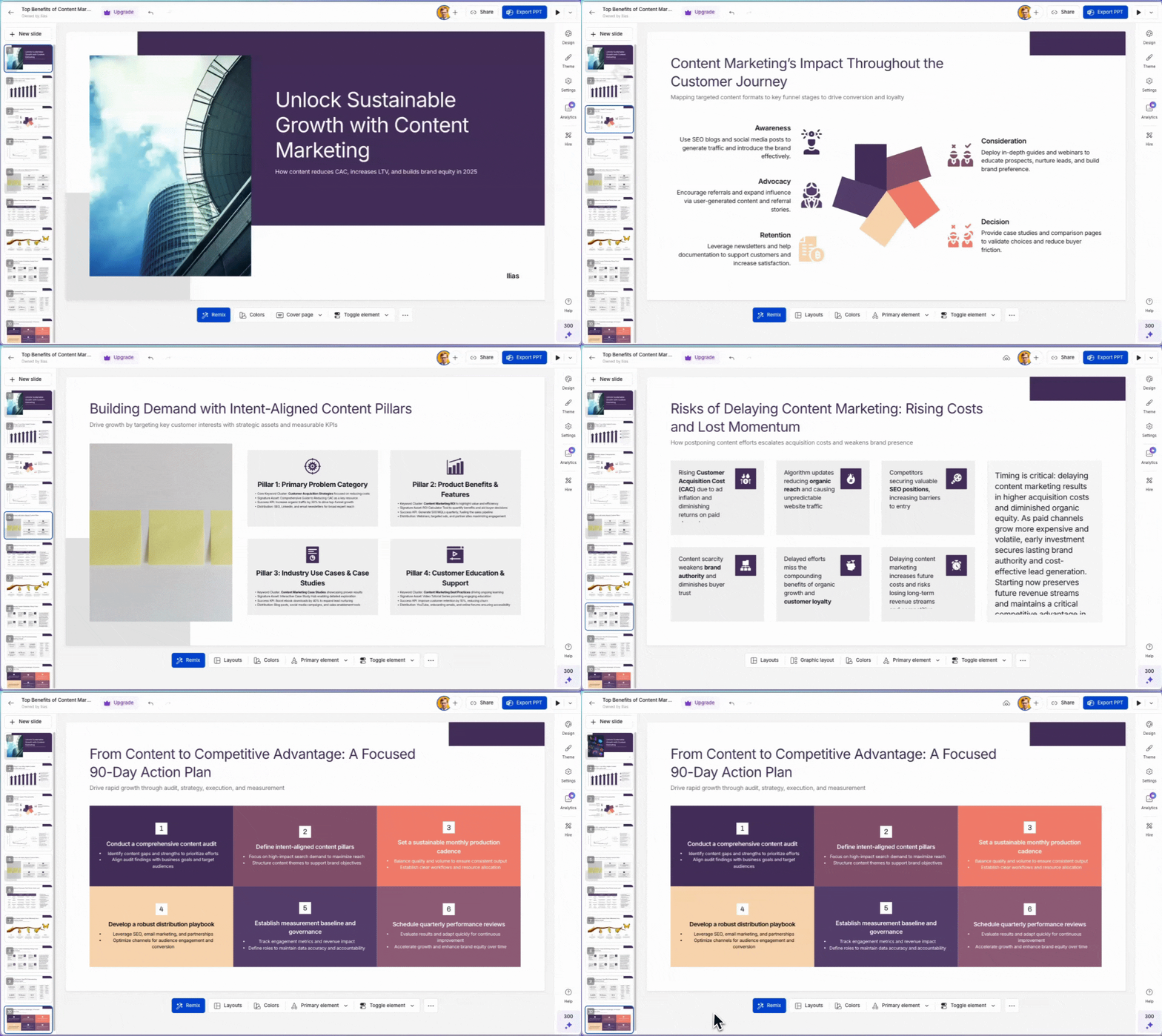
But you’re thrown into the editor, which can be clunky at times, but you can customize every detail. The interesting part is you’re able to add more slides with complex layouts easily.

Pros:
- Automated complex visuals from text input
- Adaptive templates that adjust to content
- Handles infographics and charts well
- Good for data-heavy presentations
- Maintains consistent design automatically
Cons:
- Clunky interface to edit quickly
- Missing AI chat features to edit
- You might be drag-and-dropping a lot to tweak specifics
- Only annual plans available.
Price: Only annual plans. Free (40 slides, 200 credits, no export). Pro plan at $198 annually per user (1000 slides, 5000 credits, advanced AI, brand controls, analytics). Gold plan at at $816/year with better AI models and 10k slides. Try Presentations AI
Bottom line: Pick Presentations.AI for maximum automation over control. Best for businesses that need automated design with brand consistency, especially those creating data-heavy presentations with charts, infographics, and complex visuals regularly.
9. Slidesgo

Best for: Quick PPTx file generation
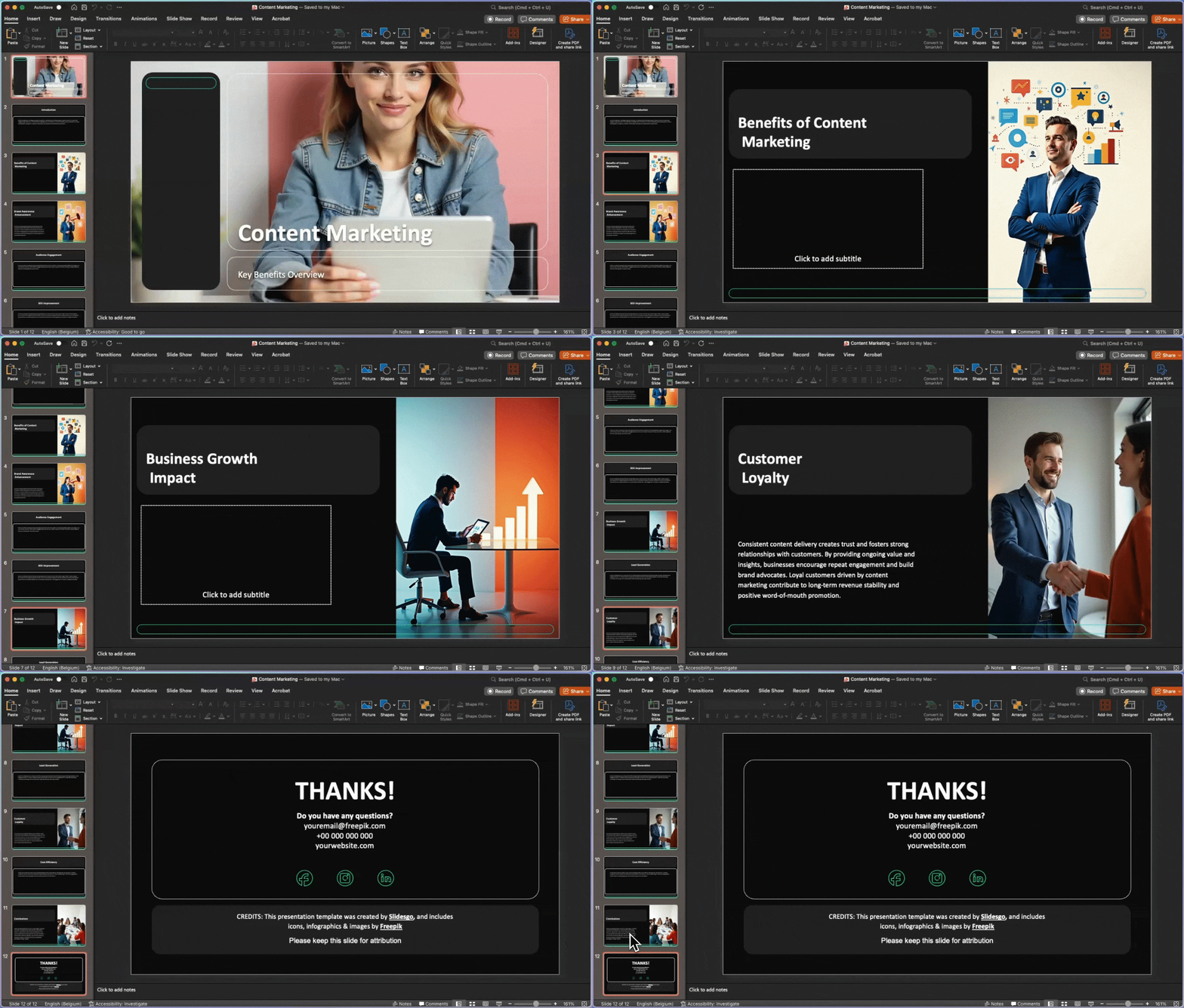
Slidesgo provides a massive library of free and paid creative templates for Google Slides and PowerPoint. The AI presentation maker uses their vast template collection as a base and applies them to your content.
Our experience: Slidesgo has thousands of beautiful templates (some paid though). This is their core value prop. You basically fill in a template, add your own content and generate AI images, then get an exportable file immediately.


What I liked is option to choose visual styles for generating images.
We selected one for educational content and the AI generated a short outline, the content is a bit generic and clearly written by AI.
The template was gorgeous, but the AI-generated content was generic and needed heavy editing. The AI features felt basic compared to dedicated platforms.
Great for getting inspired by designs, less so for AI content generation.

One big downside, is that there is no native editor. You can only download the PPTX and edit in Google Slides or Canva, here it is, using the same AI prompt as the other examples:
Pros:
- Massive template library (thousands of options)
- Simple user-friendly interface
- Free templates available
- Works with Google Slides and PowerPoint (and Canva)
- Great for design inspiration
- Multiple categories (business, education, marketing)
- Regular new template additions
Cons:
- Basic AI features compared to dedicated tools, no research step
- AI-generated content often needs significant editing
- Better as a template library than AI tool
- More manual work required
Price: Free plan available (3 templates only). Premium at $4.99/month/user (15,000+ premium templates).
Bottom line: Use Slidesgo for template options. Best for users who want beautiful, professionally-designed templates and don't mind writing content themselves. Ideal for those seeking design inspiration rather than AI-powered content generation.
10. Microsoft Copilot in PowerPoint / Gemini in Google Slides
You can use AI in PowerPoint directly in Microsoft Copilot:
- Start a new presentation in PowerPoint.
- Select the Create a presentation option in the Copilot menu above your slide.

And in Google Slides, you can chat with Gemini to insert a slide at a time, I just wish the AI was smarter and had more options. It doesn’t really work for researching, creating a full deck or doing more. It feels like talking to an old version of Siri or Alexa, it doesn’t really do what you want, yet.

11. Prezi AI

Best for: Non-linear presentations
Prezi AI creates zoomable, interactive presentations instead of traditional slides. Well-suited for unique presentation flows where you navigate between ideas dynamically. I used this myself as a student a long time ago before any AI features.
Our experience: Prezi AI created a non-traditional presentation with zoom effects and spatial relationships between ideas. I didn’t like this at all.
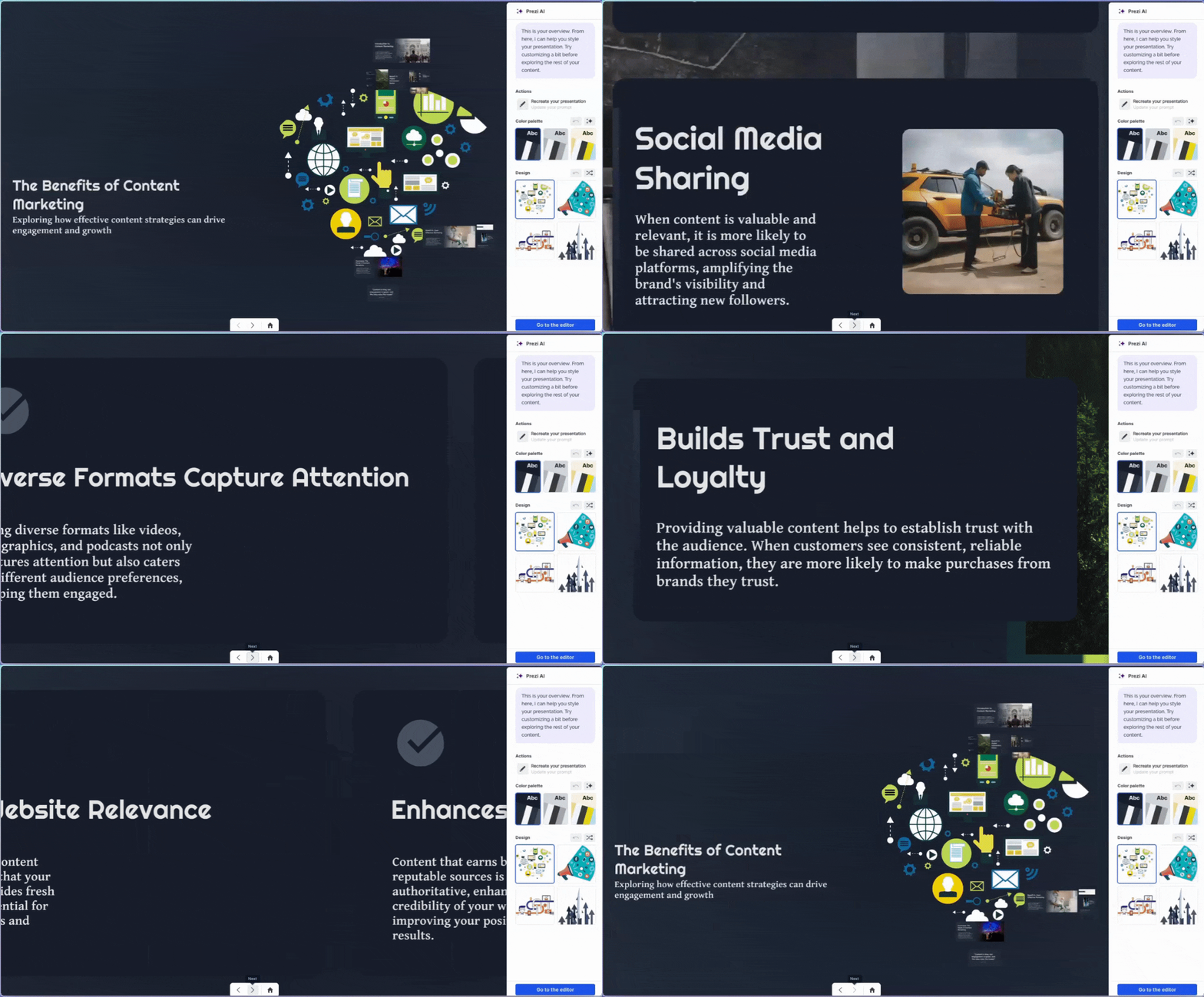
It creates a feeling of vertigo and motion sickness when you’re just trying to browse or edit the slides. You’re also locked into their format, you can export to PPTx, but then you might as well use another AI tool with better features and better pricing.
Pros:
- Distinctive zoomable format
- Highly engaging for audiences
- Interactive presentation style
- Good for storytelling and concept mapping
- Unique visual approach
Cons:
- Learning curve for creating and presenting
- Motion sickness
- Not suited for all use cases
- Less suitable for traditional business decks
- Harder to print or share static versions
- Better for live presentations than documentation
- Only annual prices
Price: All prices are only paid annually. Basic plan available (free, public presentations, limited AI). Standard at $228/year (privacy controls, offline access, Prezi AI without limits, importing slides). Premium at $348/year for businesses.
Bottom line: Try Prezi AI when traditional slides won't do. Best for educators and creative presenters who want unique, interactive presentations that engage audiences differently.
12. Gamma

Best for: Teams and enterprise
Gamma generates web-style presentations that look like modern websites. Enter a prompt, it does a bit of research and creates an outline. Press Generate and it builds slides with images, layouts, and content.

It has a built-in AI writer and deck builder that creates visually engaging, scrollable presentations.
Our experience: Gamma created a sleek 10-slide deck in about 45 seconds. The layout was modern and scrollable, like a webpage.

The design was polished out of the box. The export also works well to PDF, PowerPoint, Google Slides and PNGs.

Pros:
- Clean, modern web-style designs
- Little effort needed to create polished presentations
- Built-in AI writer for content generation
- Good starting point for storytelling presentations
- Free plan available with 400 credits
- Fast generation time
- Visually engaging scrollable format
Cons:
- Content, AI image and AI copywriting quality can be low at times, they use cheaper models
- And so less suitable for traditional business presentations
Price: Free plan available (400 credits). Plus plan at $8/month (billed annually). Pro plan at $15/month (billed annually).
Bottom line: Try Gamma if you want quick, visually striking decks without heavy customization. Best for startups and entrepreneurs who value modern, web-style presentation aesthetics over traditional slide formats.
Free workflow: From approved deck to campaign
Use this practical workflow when a webinar deck, client presentation, sales narrative, or internal strategy deck needs to become publishable content.
- Collect the source material: Add the final presentation, speaker notes, audience, and campaign goal.
- Find the story worth publishing: Identify the one message, proof point, and audience question that deserve deeper coverage.
- Create the campaign assets: Draft an SEO article, LinkedIn post, email, landing-page copy, and follow-up social posts from the same approved message. You can do this yourself, our create and repurpose any asset using our AI Canvas.
- Review without losing context: Give subject-matter experts and editors one place to comment, edit, and approve.
- Plan distribution and measure the result: Map every asset to channels, publish dates, owners, and performance.
StoryChief AI Canvas enables marketers to plan, edit, and expand campaigns within a single visual workspace—automated, consistent with brand guidelines, and designed for practical marketing workflows. Try it free.
Frequently asked questions: Best AI presentation maker (2026)
What is the best AI presentation maker in 2026?
For most business and educational decks, GenPPT is the best AI presentation maker overall. It researches your topic, lets you approve a slide-by-slide outline and visual concept sheet, and renders custom full-slide designs that export cleanly to PowerPoint (.pptx) and PDF. If you are building a startup fundraising deck, Pitches.ai is the best choice for investor pitch decks.
What is the best 100% free AI presentation maker?
If you need to convert a PDF report or handout into slides without creating an account, GenPPT's free PDF to PowerPoint converter gives you a full slide outline and 3 designed .pptx slides for free. For full web decks, Gamma gives 400 free signup credits, Canva offers a free tier, and Pitches.ai lets you generate and edit investor pitch decks in chat for free before exporting.
Can an AI presentation maker create slides from a PDF or Word document?
Yes. Tools like GenPPT, Pitches.ai, and Plus AI let you upload PDFs, Word documents, or spreadsheets to generate slides automatically. Importantly, GenPPT and Pitches.ai extract your exact figures into an editable outline first so the AI never hallucinates financial metrics.
Which AI presentation maker is fastest?
Gamma and Decktopus generate basic web or template drafts in under 60 seconds. By contrast, GenPPT takes 2 to 3 minutes because it performs live topic research, lets you lock the outline, and renders full custom-designed slide visuals rather than filling basic text boxes.
Do AI presentation makers export to Microsoft PowerPoint?
Yes. GenPPT, Pitches.ai, Gamma, Canva, and Slidesgo all export .pptx files that open in Microsoft PowerPoint and Google Slides. Meanwhile, Plus AI, SlidesAI, and Microsoft Copilot run as add-ins directly inside PowerPoint.
What happened to Tome AI?
Tome AI shut down its presentation product in 2025 and pivoted to a sales CRM called Lightfield. If you are looking for a Tome replacement, use GenPPT for full-slide PowerPoint exports or Gamma for scrollable web cards.
Your AI presentation tool creates the deck. StoryChief turns it into a campaign.
When the slides are ready, the real content work usually starts. StoryChief helps content teams turn one approved presentation into a coordinated publishing workflow.
| Step | What your team does in StoryChief | Outcome |
|---|---|---|
| 1. Brief the campaign | Add the deck, audience, topic, proof points, and business goal. | A shared starting point, instead of scattered notes and prompts. |
| 2. Build the content plan | Turn the presentation’s strongest message into a campaign brief and calendar. | A clear set of assets, owners, and deadlines. |
| 3. Create channel-ready content | Produce editable drafts for an article, social posts, email, and landing page using your brand context. | Consistent messaging without copying and pasting between tools. |
| 4. Review and approve | Invite your team or client to edit and approve work in the same workspace. | Faster feedback with the strategy and source material still visible. |
| 5. Distribute and improve | Adapt content for each channel, publish from one place, and track performance. | A repeatable workflow that shows which messages create results. |
Conclusion
Remember: these tools create drafts. Review content, adjust designs, and add your voice. They reduce workload but don't replace thinking.
Want more productivity tools? Check out our complete collection of AI and SEO tools we've reviewed to help founders scale faster.
StoryChief enables marketers to plan, edit, and generate AI content strategies and campaigns within a single visual workspace—automated, consistent with brand guidelines, and designed for practical marketing workflows. Try it free.