



You may already know that AI answers are shaping how buyers discover products. What is harder to see is whether they mention your brand, cite your website, or recommend a competitor instead.
An AI visibility tracker makes that visible. It shows how your brand appears across the buyer questions that matter, then turns the gaps into a content decision your team can act on.
That is why we built AI Visibility Tracker: a way to measure AI brand mentions, website citations, and provider coverage, then move from a missed answer to content your team can create, review, and publish in one connected workflow.

AI visibility is more than a single score
AI visibility is the share of relevant buyer questions where an AI answer mentions your brand, cites your website, or both. It is not the same as a traditional keyword ranking.
A ranking tells you where a page appears in a list of results. AI visibility tells you what the buyer actually sees when they ask a question such as “What are the best tools for this job?” or “How do I solve this problem?”
That distinction matters. Google explains that AI Overviews and AI Mode use its core ranking and quality systems to surface reliable web information, while ChatGPT Search can include citations to web sources. Your team needs to know whether the answer names your company and whether it gives buyers a credible path back to your site. Google’s guidance for generative AI features and OpenAI’s explanation of ChatGPT Search citations both make the source layer clear.
The useful questions are simple:
- Does the answer mention your brand?
- Does it cite one of your pages?
- Which competitors appear instead?
- Which source pages influenced the answer?
- What should we create or refresh next?
Most tools stop after the first three. The real value comes from the final question.
Stop monitoring the gap and start fixing it
Until now, tracking AI visibility often meant taking screenshots, checking prompts manually, and trying to guess what to do when a competitor appeared instead. The result was another dashboard that content teams had to translate into work.
StoryChief takes a different approach: the tracker is built to move from signal to action.
When you find a missed mention or citation, you can use the built-in AI to help you improve the opportunity. It can investigate the gap using your brand context and live marketing data, then help your team create or refresh the content that is most likely to address it. Every output remains a draft for your team to review, edit, and approve.
This keeps the work connected:
| Result | Action |
|---|---|
| Your brand is absent from a high-intent buyer question | Create a focused article, comparison, or guide that answers it clearly |
| A competitor is repeatedly cited | Review the cited source and identify the proof, detail, or format your page is missing |
| An older page is cited but gives an incomplete answer | Refresh it with current product information, examples, and a clearer direct answer |
| Your brand is mentioned but not cited | Strengthen the page that should support the claim and make the next visit more useful |
This is the same connected approach behind a stronger content strategy: find an evidence-backed opportunity, turn it into a clear brief, create the work, and measure what happens next.
What AI Visibility Tracker measures
AI Visibility Tracker brings the core signals into one view so your team can understand both the trend and the reason behind it.

Brand mentions
See whether an AI answer names your company for tracked buyer questions. A mention tells you that your brand has entered the conversation. It does not automatically mean the answer gave buyers enough information to choose you, which is why mentions should be reviewed in context.
Website citations
See when your website is used as a source. Citations matter because they show which pages an AI experience is willing to put behind an answer. They also help you identify which existing content is already earning visibility and which pages need clearer proof or a more direct explanation.
Provider coverage
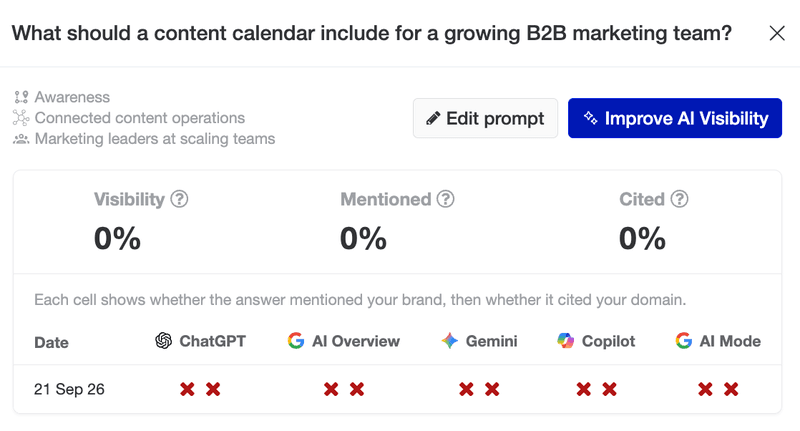
AI answers do not all behave in the same way. StoryChief currently tracks ChatGPT, Google AI Overviews, Gemini, Copilot, and Google AI Mode. Provider coverage shows whether your brand appears consistently across those experiences or only in one of them.
Competitor coverage
A score without context can send teams in the wrong direction. When competitors appear instead of you, you can inspect which questions they are winning and what sources are shaping the answer. That turns “we are losing visibility” into a specific editorial opportunity.

Google Search Console can now report how your site performs in supported generative AI features on Google Search, including AI Overviews and AI Mode. Google’s generative AI performance report is useful for measuring activity in Google. AI Visibility Tracker adds the buyer-question and competitor context your content team needs to decide what to do next.

See the answer behind the score
A rollup score is useful for following movement. It is not useful enough to guide a content team on its own.
That is why every tracked buyer question in AI Visibility Tracker can be opened for inspection. Instead of seeing only that a metric changed, your team can review the answer itself, the pages cited, and the competitors that appeared.
This matters because the same number can conceal very different situations:
- A low score may come from a small number of high-value comparison questions, which deserve immediate attention.
- A falling score may mean a competitor published a clearer answer to one recurring buyer problem.
- A brand mention without a citation may point to a gap in your supporting content, rather than a gap in awareness.
- A citation to an outdated page may be an opportunity to refresh a page that is already trusted.
The answer is the evidence. The score is the starting point.
Built around your buyers, not generic prompts
Generic prompts lead to generic conclusions. Your buyers do not search for “AI visibility.” They ask detailed questions about their problem, their options, and the outcome they want.
AI Visibility Tracker starts from your business context. It uses your company, audiences, topics, and competitors to suggest questions that are relevant to the market you want to win.
1. Start with your business context
Choose from questions suggested around your company, audience, topics, and competitors. This gives you a relevant starting set, rather than a long list of broad prompts that never inform a real decision.
2. Choose what to track
Keep the suggestions, edit them, or add the questions that matter most to your buyers. You know the conversations that shape your pipeline, so the tracker stays flexible enough to reflect them.
3. Follow the movement and act
Track what changes over time, inspect the sources behind the answers, and prioritize the content gap that is worth addressing now.
That workflow helps teams avoid publishing content because a vague score went down. Instead, they can build a content brief around a documented buyer question, a competitor gap, and a clear page to improve or create.
Turn missed visibility into better content
Improving AI visibility is not about chasing a new set of formatting tricks. Google’s guidance is direct: the foundations are still useful, original, people-first content and strong SEO practices, not artificial “GEO” shortcuts.
The content that earns a place in AI-assisted discovery should answer a real question better than the alternatives. That usually means:
- Giving a direct answer early, then showing the evidence behind it.
- Updating stale product details, claims, and examples.
- Explaining the practical trade-offs buyers need to evaluate.
- Adding first-hand expertise your competitors cannot copy.
- Connecting related pages so visitors can keep exploring once they land on your site.
For a closer look at this editorial standard, see how StoryChief uses AI for SEO. AI can speed up research and drafting, but the work still needs a clear point of view, trustworthy proof, and human review.
For agencies, the opportunity is even larger. An AI visibility gap can become a focused campaign, with a pillar page, supporting social posts, and a refresh plan for an existing asset. That is how agencies can scale AI content workflows without turning every prompt into disconnected output.
Make your next move clear
AI answers will keep changing. Your content workflow should not rely on guesswork every time they do.
With AI Visibility Tracker, you can see when AI mentions your brand, which pages it cites, where competitors show up instead, and what your team should do about it. Then you can turn that gap into content your team can plan, create, review, publish, and measure in StoryChief.
Start tracking your AI visibility with the buyer questions that matter to your business.