




AI automation can save content marketers a significant amount of time. It helps with research, content production, distribution, reporting, and dozens of repetitive tasks that would otherwise eat into your workday.
The problem starts when automation is treated as a shortcut for decision-making. Without clear goals or regular oversight, you can end up publishing content that misses the mark, relying on inaccurate outputs, or scaling processes that weren’t working in the first place.
More content in the pipeline doesn’t automatically mean stronger engagement.
Faster execution doesn’t guarantee better outcomes.
But most AI automation mistakes are preventable once you know where to look. Let’s see how.
7 AI Automation Mistakes Content Marketers Make
Here are seven mistakes that often limit the value content marketers get from AI automation.
1. Treat AI as a Replacement for Strategy
AI analyzes data, generates ideas, and automates tasks, but it can’t decide who your audience is or what your brand should stand for. One of the biggest mistakes content marketers make is expecting automation tools to handle strategic decisions that require market and business understanding.
For example, an ecommerce brand that uses AI to create product content still needs a clear view of customer demand. AI can review thousands of listings and highlight what is selling, while the best-selling products can show real demand. But choosing the opportunities that fit your audience and positioning is still up to you.
Avoid the AI automation trap by-
- Defining your target audience before building AI workflows
- Creating clear messaging guidelines for your AI-generated content
- Reviewing outputs against business goals over only efficiency metrics
2. Automate Broken Processes
A huge limitation with AI is that it can’t fix marketing workflows that are already inefficient. If content briefs lack direction or are vague, automation will only magnify those issues. Again, it won’t solve bottlenecks; it’ll only help you move faster. To add to it, a recent Adobe report shows that nearly 1/3rd respondents in their survey were “misaligned” on AI strategy, and 47% agreed on having “partial alignment” at best.
So, before investing in automation, take time to audit your existing process-
- Identify recurring delays and bottlenecks
- Map content workflows from creation to publication
- Remove unnecessary steps before automating them
3. Chase Efficiency at the Expense of Quality
The promise of AI automation is simple- produce more content in less time.
The problem then is that efficiency can sneakily become the only metric that matters. When your team focuses solely on output, quality may take a back seat.
Over-automated content tends to sound generic, repeat the same ideas, miss important context, or overlook brand nuances. These issues may seem minor in isolation, but they become much more noticeable when they appear across blog posts, emails, social media updates, and any customer-facing content.
The backlash to Coca-Cola’s AI-generated Secret Santa holiday campaign is a great example of this.
Despite being one of the world’s most recognizable brands with a long history of iconic ads, the campaign was widely criticized for feeling flat, generic, and emotionally disconnected. The video has 1,400+ comments, but not one mentioning anything positive.
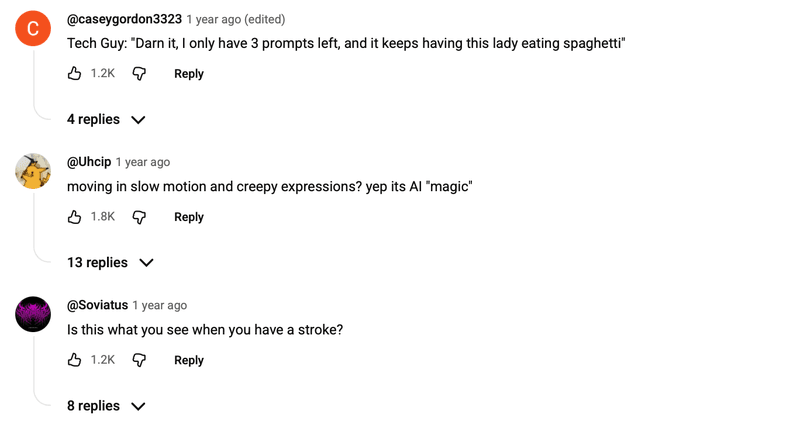
It felt creepy and soulless, prompting viewers to question whether the brand had sacrificed creativity for speed. The criticism wasn’t directed at AI alone. It shows what happens when automation takes priority, and the human element gets lost.
Even companies with massive budgets and decades of brand equity can damage audience trust when content feels rushed, uninspired, or out of touch with what people expect from them.
4. Publish Without Verifying
One of the quickest ways to tarnish your reputation is removing human review from the process. Mostly because it can introduce factual errors, inconsistencies, and details that simply don’t make sense. Plus, when you scale your content production, it becomes easier for these AI automation mistakes to go unnoticed.
For example, Danish publishing house — Carlsen faced criticism after publishing children’s books containing illustrations with obvious errors. There were issues such as animals with incorrect features and anatomical inconsistencies that should have been caught during review.

What began as criticism of a single title eventually raised broader questions about quality control and editorial oversight in their other publications.
That’s exactly why you need human intervention. A simple approval process, a fact-checking step, or an editorial review can catch issues before they reach your customers and help maintain the quality standards your audience expects.
5. Feed AI Poor-quality Data
We all know AI is only as useful as the information it receives. So, if your prompts lack context, your source material is outdated, or your internal documentation contains inaccuracies, those problems will show up in the output.
This becomes especially challenging when multiple teams contribute to content creation. Different processes, conflicting information, and inconsistent documentation can make it difficult to maintain quality at scale.
The numbers shown in Salesforce’s 2025 report back this up. Marketers mostly use AI for-
- Basic content creation =- 76%
- Writing copy- 76%
- Inspiring their creative thinking- 71%
- Analyzing market data- 63%
- Generating image assets- 62%
With so much of creation and thinking being outsourced to AI, concerns of accuracy will certainly be prevalent. In fact, their survey acknowledged that accuracy and quality are their primary issues (31%), followed by trust (20%), and job security (18%).
That’s why data hygiene and governance should be part of every AI adoption strategy. No exceptions. Regular audits, clear documentation, and ongoing employee training help ensure that teams work from accurate information. Training is an absolute non-negotiable because 7 in 10 marketers in the Salesforce survey shared that they hadn’t received generative AI training.
When your inputs improve, so will the outputs. More importantly, your team spends less time fixing avoidable errors and more time creating valuable content.
6. Measure Activity Instead of Outcomes
AI automation simplifies content production, which can create the illusion of progress. You may publish twice as many articles as before or dramatically increase content output in a quarter. That sounds impressive on paper. The challenge is figuring out whether those efforts are generating meaningful business results.
Instead of focusing only on output, track metrics that connect content to business goals-
- MQLs generated from content
- Conversion rates across campaigns
- Organic traffic growth for high-intent keywords
- Customer acquisition or revenue influenced by content
- Engagement metrics that indicate genuine audience interest
These metrics make it easier to identify which content is contributing to growth and where resources are being wasted. You’ll also be able to differentiate between real value and empty work.
7. Set it and Forget it
According to a Salesforce report, 75% of generative AI users want to automate work tasks and use it for work communications. But many content marketers treat automation as a one-time project. Once a workflow is live, they assume it will continue producing the same quality results indefinitely.
The reality is that audiences change, search behavior evolves, products get updated, and business priorities shift. An AI workflow that performed well 6 months ago may now be generating outdated or underperforming content.
Review your automations regularly to-
- Update prompts, guidelines, and source materials
- Identify declining performance trends
- Remove outdated information from workflows
- Test improvements and new use cases
A quick monthly review takes far less time than fixing months of content that’s drifted off course.
Conclusion
AI automation can make content teams more efficient, but the results you get depend heavily on how you use it. Without a clear strategy or reliable data, automation can create as many problems as it solves.
Fortunately, most of these AI automation mistakes are avoidable. A little planning, regular review, and a healthy dose of human judgment go a long way. Get your foundation right, and automation becomes an advantage instead of another problem to manage.