



Ever wondered how to align your content with every stage of your audience’s journey? Content mapping is the process of making sure you meet customers’ needs at the moment they need support most.
One of the biggest challenges marketers face is giving target customers the right information at the right time.
With around 90% of small businesses failing to see a positive ROI from their digital marketing strategies, it’s clear that content is difficult to get right.
Many marketers focus on producing large volumes of content without fully understanding which topics matter most. But an unfocused approach can lead to overlap, missed opportunities, and wasted time on content that does not deliver results.
The rise of artificial intelligence has made things even more complex, since the technology now rewards expertise, clarity, and depth more than old-school keyword stuffing.
As a result, thin or generic content often struggles to appear in AI summaries. If brands want to stay visible online in the age of AI, their content needs to answer questions directly and show authority in a way that genuinely helps users.
With a content map, your content marketing can become much more focused on your audience’s needs. That can improve relevance and support lead generation as well.
With that in mind, let’s take a closer look at what content mapping is, which templates can support a strong strategy, and how to align your content mapping with SEO for better results.
What is Content Mapping?
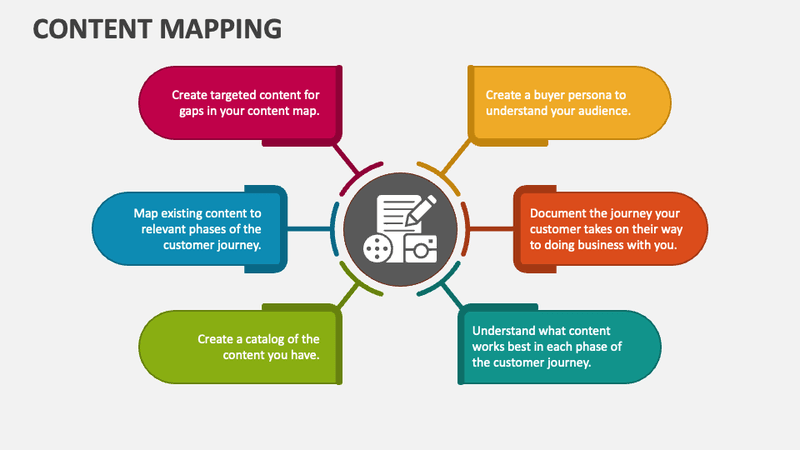
In a nutshell, content mapping describes the process of planning and creating content that meets specific needs at every stage of the customer journey.
When creating a content map, marketers must first look at how their content can apply to the various needs of customers and the ways it can align directly with their questions, possible pain points, and goals as they progress through your sales funnel.
Your map works by evaluating the gaps in your current content strategy, which can help to uncover fresh opportunities to manage your SEO to not only support their journey but also boost your authority on topics in a way that will appeal to search engine crawlers and AI answer engines.
By caring for your content mapping, you can ensure that your content remains relevant to every customer at all times and that it’s accessible whenever they need it most. Although this process can sometimes require an extensive overhaul of your existing strategy, the rewards of higher engagement and stronger conversion volumes make it worthwhile.
Importance of Content Mapping
Content mapping is critical in helping teams visualize the relationship between different content pieces, the audience that consumes them, and the goals that they should set out to achieve.
This can help to highlight the different jobs that content can do. For instance, a blog post that’s focused on lead generation and brand awareness may introduce a common problem, but a case study or product comparison can appeal directly to consideration and assist in the decision stage of the funnel.
Without sufficient efforts allocated to content mapping, there’s a tangible risk that businesses could produce content that fails to hit the mark, for reasons like:
- Irrelevant topics that fail to engage
- Duplicate forms of content that serves the same purpose
- Content that lacks the direction needed to provide a conversion
- Time lost by working on content that has no funnel relevance
Using content mapping effectively can also align copy with search intent. This can help to drive stronger SEO impacts alongside keywording and helps to gain a contextual edge in anticipating user searches and the answers that they’re looking for.
The strategy helps to form a bridge between keyword research and actionable content creation, ensuring that every article, video, and social media post provides a strategic purpose, rather than just looking to match the right industry keywords.
Content mapping also improves the effectiveness of your content marketing efforts, with teams working to a clear framework with explicit responsibilities that can be monitored for multi-channel consistency.
This means that you can turn your marketing efforts into a focused tool to support your global expansion strategy by seamlessly entering new markets that feature consumers with diverse needs and desires.
Complementing AI Search
As consumers become more accustomed to using artificial intelligence to answer their questions and queries in a contextually relevant manner, content mapping has become more important than ever.
One of the biggest advantages of content mapping is that it can improve alignment with search intent in a more comprehensive way. By taking the time to analyze the queries users are making to answer engines and mapping content to their informational needs, it’s far easier to position yourself as a key citation for AEO purposes.
This is still a major opportunity for brands as AI remains in its formative stages. For many businesses, artificial intelligence may be rising, but decision-makers are still working out how to translate it into bottom-line results. Effective content mapping means that you can actively measure your performance when it comes to catering directly to answer engines.

How to Use Content Mapping
We’ve covered the advantages of effective content mapping, but how can you use it to your advantage in SEO contexts?
The best way to make your content mapping work in achieving your business objectives is to really get to know your target audience and how they tick. The following step-by-step guide can assist you in formulating your way to success:
Step 1: Know Your Audience
This initial step is essential for gaining a clear idea of who you’re looking to reach through your content.
Your target audience could be pretty diverse depending on your industry and long-term growth ambitions, so it’s important to create buyer personas for all the different leads that you plan to market to.
Getting to know your audience is key for nurturing the awareness stage of your funnel, and taking some time to explore the challenges they face and possible pain points they have when making purchase decisions within your industry can help to uncover content opportunities.
Step 2: Explore Your Customer Journey
Get to know the stages your customers go through before making a purchase, as well as the questions, concerns, and needs they will have at each stage.
By getting to grips with what your customers are going through at every stage of their journey, you can adapt your content to support them throughout.
This is a critical component of your map because it ensures that your content will always serve a purpose in nurturing your leads through your sales funnel.
For instance, awareness-stage content can educate and inform your leads, addressing questions in a more general way.
After this, consideration-stage content will focus on championing the benefits of your product or service, building credibility in the process.
After this comes the decision-stage, and content created with this in mind will be shaped to encourage more conversions. Here, it’s useful to add more depth, showing off your thought leadership with case studies or letting your product do the talking with free trials or demos.
Then there’s retention-stage content, which will be geared towards encouraging repeat engagement with newsletters, loyalty programs, or educational resources for further reading.
Step 3: Map Your Content
List all of your existing on-site content and map each piece to the most relevant stage of the customer journey.
Now it’s time to begin mapping out your content. This step is very important because you’re already likely to have plenty of copy that aligns well with various stages of your customer’s journey, so you can save time in the long-run by repurposing relevant content.
One effective way to do this is through keyword-to-content mapping, which assigns keywords to specific content pieces based on search intent and the buyer’s journey stage.
This can prevent overlapping content while ensuring comprehensive coverage of all areas of your sales funnel for the different customers you’re targeting.
Step 4: Hunt Down Content Gaps
Another essential part of your content mapping strategy is to find topics that you haven’t yet covered but are critical for nurturing your leads.
Are there any areas of your map that are underserved by your content? Or places where you’re unsure if you’re really assisting your customers in solving their concerns, questions, or pain points?
Explore whether your content is really nurturing your leads in the way that you want and focus on creating content that can fill in the gaps.
Step 5: Build Your Content Strategy
Next, get to work on filling your gaps with a purpose-built content plan to assist your content creation.
With the help of the insights from previous steps, you can set yourself up with a comprehensive content strategy that ensures every word you write will be essential to the performance of your website and sales funnel.

Step 6: Align Your Content Mapping With Your Content Calendar
Finally, it’s time to turn all of your findings into an actionable publishing schedule.
This is where a content calendar comes in. With the ability to help your team organize upcoming articles, social posts and campaigns, you can make sure that each piece of content serves a clear purpose in the customer journey.
For example, if you’re a SaaS company, you might produce an educational blog post for your awareness stage, a product-to-product comparison piece for consideration, and a decision-stage piece on a top customer case study.
Spreading these across a functional content calendar is the key to hitting every audience group effectively while not pouring too much focus into one stage of the funnel.
StoryChief’s content calendar is a great asset to use here. Using StoryChief, your marketing team can organize articles, social posts, campaigns, deadlines and assign these to calendar collaborators.
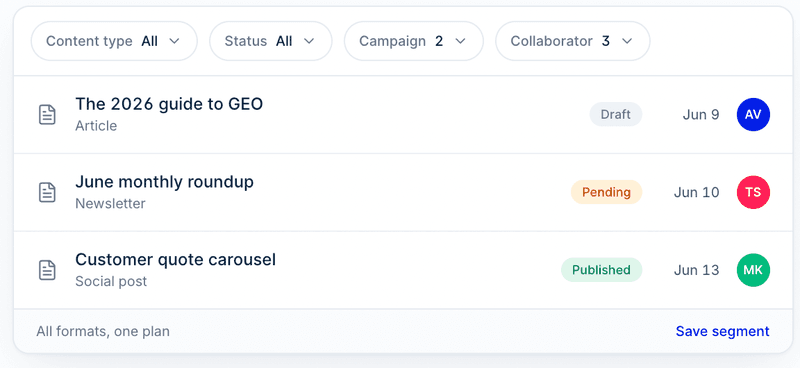
This not only makes it far easier to maintain visibility over upcoming work, but it also ensures that your content mapping insights translate into actionable tasks.
Measuring the Success of Your Content Map
To conclude this step-by-step guide, it’s important to note that your target audience can be notoriously difficult to pin down, and this means that your content mapping strategy may take some time to get up to speed.
By avoiding common pitfalls, like creating content at the expense of a functional user experience and overproducing copy at the awareness stage without giving appropriate care to subsequent stages of your funnel, you have the best chance to thrive when it comes to nurturing your conversions and CEO credentials.
It’s also important to continuously audit your content map, because customers change, intent can evolve, and the quality of your insights could lose relevance over time.
The metrics you track should depend on the stage of the customer journey you are targeting. For example, if you’re tracking awareness-stage content, focus on organic traffic, engagement, and content impressions rather than product pages or other indicators of buying interest that are more helpful for decision-stage leads.

Tools such as StoryChief's content performance tools could help you streamline this process. By tracking performance across articles and social posts and highlighting opportunities for improvement, StoryChief makes it easy to stay on track and compare real-time data alongside your content map.
Content Mapping Template
Although content mapping templates can vary in effectiveness depending on your industry, the following template can help you to get your insights in order as a way of establishing a strong strategy to boost the impact of your content:
| Buyer Persona | Stage | Pain Point | Questions | Content Ideas | Content Type | Call-to-Action (CTA) | Author |
|---|---|---|---|---|---|---|---|
| Awareness | |||||||
| Interest | |||||||
| Desire | |||||||
| Action | |||||||
| Buyer Persona | Stage | Pain Point | Questions | Content Ideas | Content Type | Call-to-Action (CTA) | Author |
| Awareness | |||||||
| Interest | |||||||
| Desire | |||||||
| Action | |||||||
| Buyer Persona | Stage | Pain Point | Questions | Content Ideas | Content Type | Call-to-Action (CTA) | Author |
| Awareness | |||||||
| Interest | |||||||
| Desire | |||||||
| Action |
Depending on your industry and the scale of your team, the table can be expanded to encompass multiple authors, or to delegate content for contributions by different departments and industry experts within the company.
Repurposing Your Content Across Multiple Channels
Remember, content mapping can also help businesses make better use of the content they already produce.
This means that every blog post, social post, newsletter and more can be adapted to serve multiple channels.

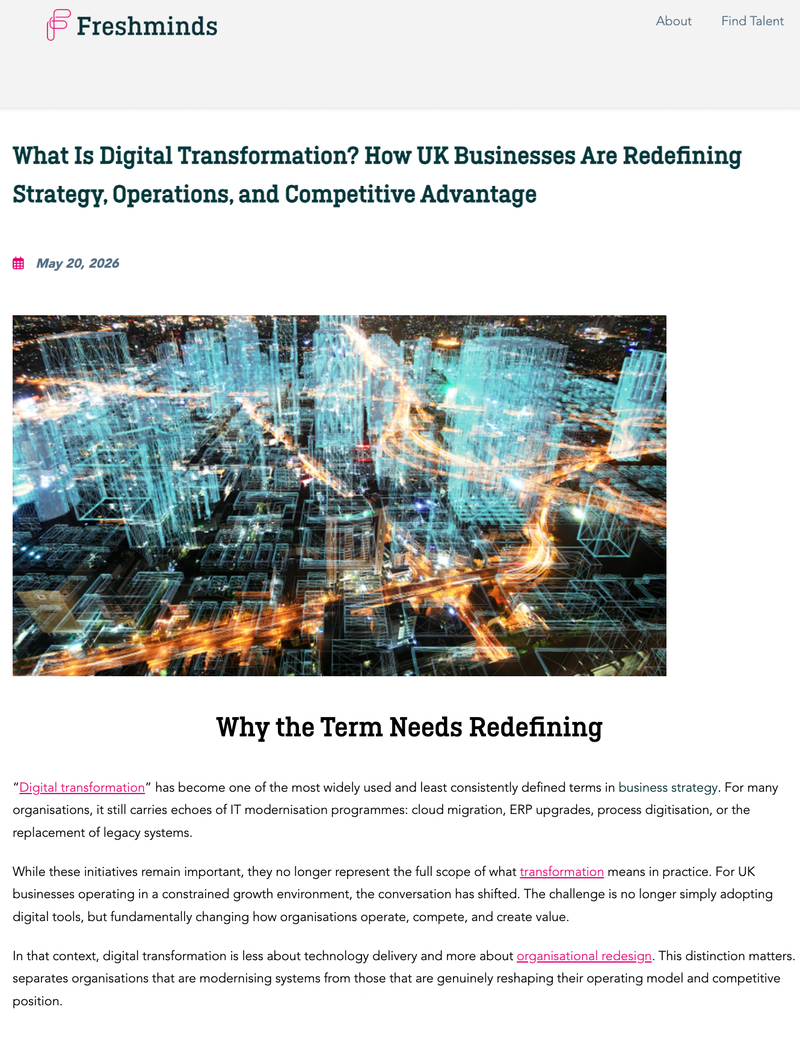
Take this example from Freshminds. Their detailed post on digital transformation has been repurposed into a LinkedIn social post, naturally linking back to their blog.
This can be re-created into newsletter snippets, a short-form video explaining one of the main challenges and more. Each format can be tailored to the platform and audience while keeping the message consistent.
StoryChief makes this process even easier by supporting multi-channel content planning and distribution. This means your team can build on their content map and manage it effectively in one connected workflow.
Every channel has its own audience, so StoryChief’s content repurposing tool helps you apply the correct voice to each rewrite, schedule the campaign sequence and even compare content engagement results cross-channel.
Getting Your Mapping Right
Content mapping is all about managing your accuracy and your ability to produce copy that’s genuinely engaging and contextually functional for your audience and SEO.
It can be hard to get right the first time, but by using the data available to you, it’s possible to refine your approach to appeal directly to the right audience to encourage leads and even attract more traffic to your pages.
Content mapping, when used effectively, can be your best friend in terms of saving time and effort on generating irrelevant and ineffective content, allowing you to focus on the most impactful topics to support your lead generation efforts.