




Content campaign research often starts with the best intentions. You sit down to “plan a campaign,” open 12 tabs, and two hours later you’ve got:”
- A half-finished keyword list
- A few competitor bookmarks you’ll never revisit
- Some audience notes that are… probably true
- Zero assets planned, zero content shipped
That’s not a discipline problem. It’s a workflow problem.
Campaign research gets heavy when it’s treated like a separate project across too many tools. A smarter approach is to keep research connected to execution—and automate the parts that don’t need human brainpower.
In this guide, you’ll learn the essential research steps for a new content campaign:
- Keywords
- Audience
- Topics
- Competitors and content gaps
- ChatGPT (how to speed it up safely)
Each section explains the “what” and “why,” then shows how an AI canvas workflow can accelerate it using StoryChief AI Canvas (StoryChief’s AI marketing agent), plus SEO insights from Google Search Console, content audits, and content gap analysis.
The content campaign research stack: what you’re building
Before you open a draft, you want five research outputs that make production almost obvious:
| Keyword set | “What are people searching for?” | SEO focus, angles, titles, subtopics |
|---|---|---|
| Audience snapshot | “Who is this for and what do they need?” | Positioning, tone, CTAs, examples |
| Topic map | “What should we publish (and in what order)?” | Campaign plan + content calendar |
| Competitor gap notes | “What’s missing in existing content?” | Differentiation + content depth |
| Messaging + brief | “What’s our point of view and plan?” | Faster drafting, fewer revisions |
If you keep these five elements together on a single canvas, you remove most of the chaos that slows teams down.
Step 1: define the campaign outcome in one sentence (so research stays focused)
Before keyword tools and competitor scans, define what the campaign must achieve. Otherwise you’ll collect information endlessly without making decisions.
Use this simple outcome statement:
Help [audience] achieve [outcome] despite [barrier].
Examples:
- Help SaaS marketers build a campaign plan despite limited time and stakeholders.
- Help content teams pick topics that will rank despite competitive SERPs.
When this sentence is clear, research becomes a filter:
- Does this keyword reflect our audience’s desired outcome?
- Does this competitor content match the problem we’re solving?
- Does this topic move the campaign toward the outcome?
How AI Canvas helps define your campaign concept
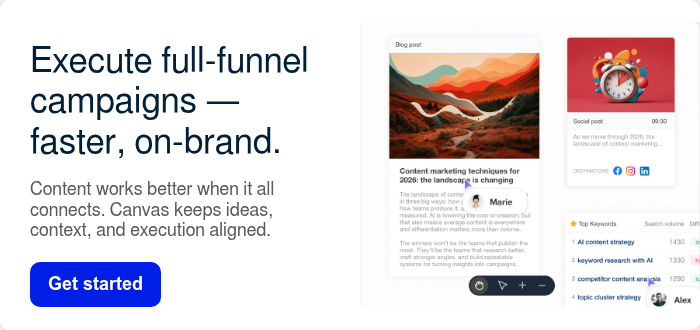
A canvas workflow turns that one sentence into the anchor for everything else on the board. It is designed as a single visual workspace where strategy and execution live together (campaign plan, assets, and data). The “single source of truth” reduces drift because people don’t need to hunt for context across tools.
Start by creating a canvas and pinning the campaign outcome at the top. Then every automated insight (keywords, competitors, opportunities) can be generated and stored right next to it.
Learn more about the canvas concept here: AI marketing agent
Step 2: understand your audience before you create anything
Most “meh” campaigns aren’t wrong—they’re generic.
Audience research makes your campaign:
- More relevant (you speak to the real situation)
- More persuasive (you address real objections)
- More actionable (you prioritize what helps)
You don’t need a 40-slide persona. You need a decision-ready audience snapshot:
- Role and context: Who are they and what environment are they in?
- Top goals: What are they trying to achieve in the next 30–90 days?
- Top blockers: Time, approvals, skills, budget, tools, confidence
- Decision triggers: What makes them act now?
- Preferred proof: Templates, data, examples, screenshots, benchmarks
How AI Canvas helps with audience research
In StoryChief’s AI Canvas, William can help you:
- Create an audience snapshot you can reuse across assets
- Translate pains/goals into messaging blocks (promise, proof, objections)
- Keep the audience insight visible next to the campaign assets so writers don’t guess
The key benefit is not that AI invents an audience—it’s that it structures your knowledge quickly and keeps it attached to the work.
If you want a dedicated example of how StoryChief approaches audience insights in campaign planning, see: audience insights for content campaigns.
Step 3: do keyword research as a cluster (not a random list)
For campaigns, keyword research is less about “one perfect keyword” and more about building a cluster that supports:
- A pillar asset (the main guide or landing page)
- Supporting assets (subtopics, FAQs, examples)
- Distribution assets (social hooks, newsletter angles, video scripts)
A practical cluster includes:
- Pillar keyword: the main theme
- Supporting keywords: subtopics needed to succeed
- Long-tail questions: how/why/what/best queries that reveal pain points
- Intent labels: Learn / Compare / Do
Then map each keyword group to an asset.
Long-tail keywords often expose the most valuable content angles because they reflect real constraints and edge cases.
How AI Canvas helps with keyword research
In AI Canvas, you can:
- Perform keyword research, discover search volume and keyword difficulty
- Generate a keyword set inside the same workspace as the campaign plan
- Turn the keyword cluster into a campaign outline and task list immediately
- Keep keywords tied to assets (instead of living in a spreadsheet no one uses)

If you want examples of how to translate keywords into angles, see: SEO keyword research examples.
Step 4: identify competitors and content gaps
Competitor research isn’t about copying outlines. It’s about differentiation.
Focus on SERP competitors (the pages ranking for your target keywords), not just business competitors.
Run a quick content gap scan:
- Topic gaps: what do ranking pages ignore?
- Depth gaps: what do they mention but not explain?
- Format gaps: are there templates, checklists, examples, visuals?
- Trust gaps: is it opinion-only, or grounded in data and practical steps?
Then write a short “differentiation brief”:
- We will cover: the non-negotiables
- We will add: unique frameworks, examples, templates, screenshots
- We will avoid: thin content, generic advice
- We will prove: the data sources and practical evidence
How AI Canvas helps with competitor research
This is one of the biggest “time sinks” in content campaign planning—and one of the areas StoryChief explicitly automates.
In practice, that means your workflow can become:
- Pick a focus keyword or competitor.
- Let StoryChief surface competitor-based gap keywords or content ideas.
- Apply the recommendations directly while outlining or updating the asset.

Step 5: turn research into topics and a campaign plan
A campaign needs structure.
Instead of a flat topic list, build a topic map with three layers:
- Pillar: the flagship guide
- Support: subtopics required to complete the job
- Boost: examples, templates, comparisons, case studies
If you want a planning reference, this article can serve as a baseline: marketing campaign plan.
How AI Canvas helps with content campaign planning
You can plan the campaign visually and keep every asset connected to the same research and messaging.
StoryChief’s AI Canvas is built around:
- Campaign planning and content calendar layout inside the canvas
- A centralized hub for goals/KPIs, positioning, competitors, audience, tone, and past performance
- Turning one idea into multi-channel content assets
For the full walkthrough of those planning and execution use cases, see: 12 ways StoryChief AI Canvas speeds campaign planning.

Step 6: use your own performance data to find “easy wins”
The fastest path to a strong campaign is often already in your data.
Look for:
- Pages with high impressions but low CTR (your title/angle isn’t winning clicks)
- Keywords where you rank just outside page 1 (a refresh can push you over)
- Topics where you have coverage, but not depth (expand clusters)
This turns campaign planning into a decision based on demand—not gut feel.
How AI Canvas helps with performance analysis
StoryChief’s AI Canvas and William are designed to pull in marketing data sources (including Google Search Console) and translate them into prioritized actions.
AI Canvas combines Google Search Console data with content recommendations to highlight:
- High impressions but low click-through topics
- Pages ranking just outside page 1
Then it outputs a prioritized list of what to improve vs. what to create.

AI Canvas vs. ChatGPT for content campaign research
The difference between “using ChatGPT” and “using AI canvas” is that the outputs don’t float away.
StoryChief’s AI Canvas keeps:
- Research outputs (summaries, competitor notes, keywords)
- Campaign plan (assets, tasks)
- Drafts and versions
…in one workspace.
The same William AI Canvas documentation also includes workflows such as analyzing content, checking competitors’ recent activity, discovering trending topics, and turning insights into actions.
A faster way to think about content campaign research: the 30-minute version
If you want a lightweight approach that still works, do this:
- 5 minutes: Write the outcome statement.
- 10 minutes: Build the audience snapshot (goals, blockers, proof).
- 10 minutes: Generate a keyword cluster and label intent.
- 5 minutes: Run a content gap scan and write 3 differentiation bullets.
Then draft the pillar and plan the supporting assets.
If you want the same workflow fully connected to your content, performance, and recommendations inside a single workspace, explore: AI marketing agent (AI Canvas).

Final checklist: what “done” looks like
You’re ready to create when you have:
- A clear campaign outcome sentence
- A specific audience snapshot (goals, blockers, proof)
- A keyword cluster mapped to assets
- A competitor gap summary with 3 differentiation bullets
- A topic map (pillar + support + boost)
- A brief that fits on one screen
Do this well once, and your next campaigns get dramatically faster—because you’re building a repeatable system, not reinventing research every time.
Tip: StoryChief AI automates keyword and competitor research, so you can find high-value opportunities, create content, collaborate, publish, and optimize — without needing SEO expertise.