



A couple of years ago, you simply needed to publish dozens of pieces of content weekly and ramp up social media posts to gain traffic and generate leads. Right now, that same effort won't move a single needle.
Algorithms keep changing, AI adoption has disrupted the usual content workflow, and your audience demands more personalized content in the right place. More distribution platforms are also shaping up, ultimately complicating content distribution.
That’s why you need an updated content marketing strategy. And to build one, you need to know what is happening right now and what your audience needs in 2026.
In this article, we’ll share some of the recent trends about content marketing and the insights you need to prioritize while rewriting your strategy.
The Current State of Content Marketing
Content marketing remains one of the most affordable ways to get people interested in what you sell.
- But only 53% of B2B marketers have a documented strategy, and those who have one see better results across almost all metrics.
- 72% of B2B marketers currently use Generative AI tools.
The massive jump in AI use hasn’t replaced the need for a good strategy. Instead, it has shown which teams knew what they were doing and which ones were just guessing as they went.
Video is Still the Format with the Furthest Reach
There are over 5.1 billion videos on YouTube alone, with an average of 20 million uploaded daily. Yet, video content marketing statistics show that consumers still demand more.
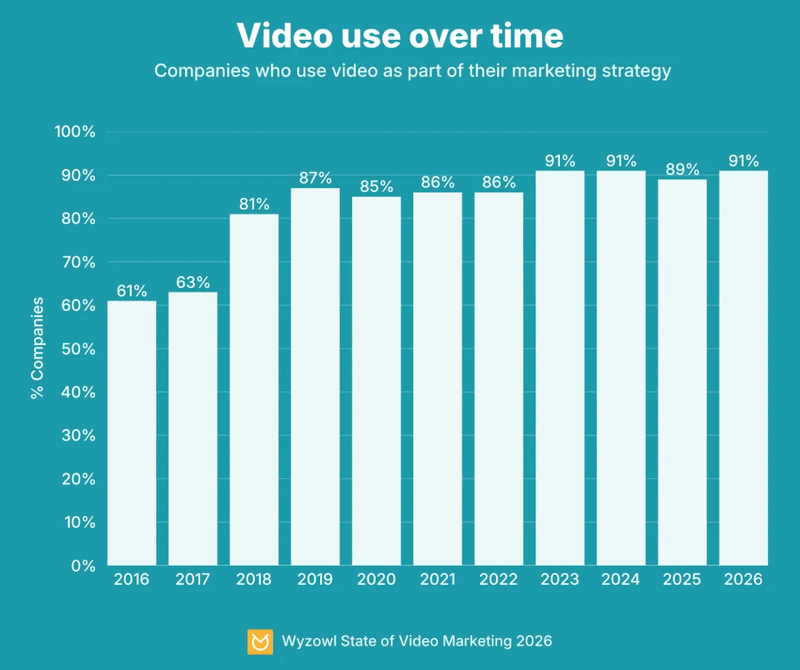
- 91% of businesses are using video for marketing.
- 93% of video marketers say this format is critical to their strategy.
- 82% of marketers say video delivers a strong return on investment (ROI).
- 83% of video marketers link increased sales directly to their video content.
- 96% of potential customers rely on explainer videos when researching a product or service.
- Nearly 9 out of 10 people say watching a video has pushed them toward making a purchase.
- Short video is the format 63% of people reach for when researching a product or service.
- 84% of consumers say they want more video from the brands they follow.
What’s Happening On Socials?
Social media remains a central channel for content marketing.

- There are over 5.24 billion social media users worldwide. That is 63.9% of the global population.
- An average user spends more than 2 hours on social media daily.
- The average social media user visits 6.5 different platforms each month.
- LinkedIn is the top organic social media platform for B2B content distribution.
Email Marketing is Not Going Anywhere Anytime Soon
Email is not dead. You just have to do it right if you want results.
- Email marketing gives you $36 for every $1 spent.
- In 2024, 62% of teams needed two weeks or more to create just one email. In 2026, 76% of teams can now send one in three days thanks to AI-assisted workflows.
- Teams that adopt advanced AI for email are 75% more likely to achieve an ROI of 45 to 1 than those who adopt AI more slowly.
Of course, while adopting AI for email marketing, ensure there’s appropriate human oversight. Generic email content and excessive AI-ism will only irk your audience.
Podcasts and Audio: The Attention Nobody Is Fighting Over
Audio content has held its ground, unlike most formats. Podcast listeners pick one intentionally and sit through the whole thing, which makes the attention you earn there qualitatively different from what most platforms offer.
- In 2024, 47% of Americans aged 12 and older listened to a podcast in the past month, up from 42% in 2023. Weekly podcast listening reached 34%.
- Among US listeners aged 13 and older, podcasts made up 2% of audio consumption in 2014. By 2024, that figure had reached 20%.
- US podcast advertising revenue hit $1.8 billion in 2022, a 26% increase from the previous year, with projections putting it past $4 billion by 2025.
Audio gives you access to the attention that most channels compete hard for. If your content plan skips it, that attention goes to whoever shows up.
SEO: The Channel Where Organic Traffic Compounds
Organic search might not generate the same excitement as video at marketing conferences, but it accounts for 53% of all tracked website traffic, more than paid traffic, social media, email, and referrals combined. In other words, SEO is still one of the clearest compounding channels when paired with consistent distribution.
- Google handles about 8.5 billion searches every single day.
- The best organic result on Google has an average click-through rate of about 27.6%, which drops to roughly 15.8% for the second position and 11% for the third. The drop in clicks between the first and second spot is bigger than the drop from the second spot all the way to the tenth.
- If your page takes just one second longer to load, going from 1 to 3 seconds, the chance of a visitor leaving increases by 32%. If it takes 1 to 5 seconds, the bounce rate increases by 90%.
- A strong 55% of B2B buyers now rely more on content during their research than they did last year. Also, 41% of them review 3 to 5 pieces of content before contacting a sales representative.
The Gap Between Expectation for Personalization and Delivery
What most customers want is content that fits where they actually are right now. That’s why 76% of consumers say they get frustrated, and sometimes, leave when a company fails to deliver on that.
Of course, companies that personalize customer experience generate 40% more revenue than the others.
AI and Automation in Content Programs
AI has moved incredibly fast from being a fun experiment to becoming the backbone of how many businesses get things done.
Right now, 80% of marketers are using or testing generative AI to help them brainstorm, outline, and repurpose content. The first groups to adopt AI are seeing faster production times and better personalization as their biggest benefits.
An overwhelming 94% of organizations agree that investing in privacy delivers benefits that outweigh the costs, and 95% of those surveyed feel that customers would refuse to buy from them if their data were not kept safe.
Privacy isn’t just for the legal team to worry about. Everyone needs to ensure AI is used properly to keep customer data safe.
AI gives content teams an incredible advantage in scale and speed, but the brands that will win long-term are those that use it to enhance human creativity, not replace it," says Rawad Baroud, CEO of ZeroGPT.
Challenges and How To Handle Them
The bar for content is higher than ever, driven by AI and what customers need now. This pressure makes many teams try to post as much as they can, but that usually doesn’t work if the quality just isn’t there.
If you want your content to work, you should focus on these things.
Differentiation
AI is causing a poor content pandemic. You need to stand out by being specific. Think about what your audience cannot find anywhere else. Create unique reports, bring in new perspectives, and challenge existing norms with concrete evidence.
Measurement
Only a small number of marketers feel confident that they can connect content directly to the sales pipeline and revenue, even though those are the exact numbers needed to protect a budget during an economic slowdown.
You should try to bridge that gap and decide how you will measure success before you start a campaign. Define 5 to 7 metrics or KPIs that tie your strategy to pipeline metrics, such as the MQL-to-conversion rate.
Search Volatility
Algorithm updates, expanding SERP features, and the growing share of zero-click searches have made it harder to forecast traffic from organic search alone.
You can handle this by sharing your work in places you control, like email and your own community. That way, you are safer when search engines change their rules.
Accessibility
A strong 55% of B2B buyers now rely more on content during their research than they did last year. Also, 41% of them review 3 to 5 pieces of content before contacting a sales representative. Be available by ensuring your content is indexed, searchable, and downloadable.
Consider socio-cultural and lingual barriers and make provisions for them so your audiences can access content more easily.
Formats Your Audience Is Already Responding To
There is more than one way to succeed with content. Here are a few formats that are currently working.
Wrapped Trends
Spotify Wrapped turned data about what people listen to into a huge social event. In 2022, more than 156 million users engaged with Wrapped and shared it widely, proving that personal and fun storytelling works best when it is designed for sharing from the start. Each wrap challenge becomes user-generated content and has so far helped Spotify gain an edge over competitors.
Platforms like YouTube already implement the same approach. Brands looking to extend this into the physical world have also found success with custom merchandise — branded t-shirts, for example, turn loyal audiences into walking brand ambassadors, reinforcing the same community-driven momentum that makes shareable content so effective.
In 2022, more than 156 million users engaged with Wrapped and shared it widely, proving that personal and fun storytelling works best when it is designed for sharing from the start.
Each wrap challenge becomes user-generated content and has so far helped Spotify gain an edge over competitors. Platforms like YouTube already implement the same approach.
Long-Form Education in B2B
Research reports (43%), case studies (40%), and webinars (40%) are the top three most valuable content formats for B2B buyers doing purchase research.
Gated long-form assets like eBooks, which make up 39.5% of demand, and case studies, show high buying intent. Those who request case studies are 78.5% more likely to purchase within 12 months than in previous years.
The overall demand for gated content rose 14.3% year over year, confirming it remains a valuable lead driver despite production costs.
Community-Led Content
Building a community around your content, whether through private groups or creator partnerships, can push member retention to 86%.
Referrals from these communities also cut acquisition costs by almost 45%. That’s because people who discovered a brand through a community member are more likely to refer someone else in. And the cycle continues while giving you lasting value.
Conclusion
While there have been so many changes due to algorithms, demand, and AI, the basics of content marketing still remain the same. Go where people are, give them something actually helpful, and measure what really matters for your business.
See which formats your audience likes most. Short videos are great for being found, long resources help build trust, podcasts create a connection, and newsletters keep people coming back.