



Let’s talk about one of the most important parts of your online presence: connecting with your audience through a highly relevant content strategy. Many businesses publish regularly, but still struggle to earn attention, traffic, and conversions.
Here’s why: only ~40% to 47% of marketers have a documented content marketing strategy—so most teams are creating content without a clear plan. That’s exactly where an AI content strategy can help: they turn scattered ideas into a focused, data-driven roadmap you can finally execute.
What is an AI content strategy?
An AI content strategy is a clear, practical plan for how your team uses AI to research, create, improve, distribute, and measure content, without losing sight of your business goals, brand voice, or what your audience actually needs.
Compared to a traditional content strategy (which usually focuses on topics, channels, workflows, and KPIs), an AI content strategy also answers one extra question: where does AI genuinely make the work better, faster, or smarter?
For example:
- Audience and topic insights: using AI to spot real search demand, content gaps, and intent-based opportunities.
- Content planning: building briefs, outlines, and content calendars from data—not hunches.
- Content creation and optimization: speeding up drafts, tightening structure, and improving SEO and readability—while keeping a human in the loop for accuracy and brand fit.
- Distribution and repurposing: turning one strong piece of content into multiple channel-ready versions (blog, email, LinkedIn, ads) in a fraction of the time.
- Performance measurement: using AI to pull out patterns, insights, and “what to do next” recommendations from your content analytics.
The key point: an AI content strategy is not “let AI write the content.” It’s a repeatable, team-wide system that blends human expertise + AI support + performance data so you can publish higher-quality content faster—and keep improving results over time.
Importance of an AI content strategy
AI brings structure, speed, and insight into your content process:
- Replaces guesswork with data
AI combines search demand, performance data, and competitor insights to help you prioritize topics that actually matter. - Speeds up execution
Research, briefs, outlines, and even first drafts are generated faster—freeing up time and reducing bottlenecks. - Improves consistency at scale
Tone, structure, and messaging stay aligned across blogs, social posts, newsletters, and campaigns. - Unlocks more creative, differentiated content
By automating repetitive tasks, AI gives your team more space to focus on expertise, unique perspectives, and real-world examples. - Makes performance measurable and actionable
AI helps you see what’s working, what needs updating, and what to stop—connecting content directly to traffic, conversions, and pipeline.

What this looks like in practice
AI-powered tools and AI agents can support your team by:
- Automating content calendars with data-backed ideas
- Content generation of like blogs, social posts, landing pages, newsletters, images, and ads
- Suggesting high-impact keywords to strengthen SEO
- Maintaining a consistent tone and structure across platforms
- Revealing audience insights and missed opportunities
- Optimizing social media performance through trend and algorithm analysis
Key components a good AI content strategy covers
Used well, AI helps connect the whole workflow; from choosing topics and drafting to planning, publishing, and measuring what worked, so content feels less chaotic and more consistent.
Here are the key components a good AI content strategy should cover:
- Content ideation and research: Forget spending hours digging through trends and competitor content. AI can do the heavy lifting for you—spotting what’s hot, what your audience loves, and giving you fresh, relevant content ideas in minutes.
- Content creation: Whether it’s blog posts, social media updates, or email campaigns, AI can help you craft content that speaks to your audience while staying true to your brand. It’s like having a writing assistant who never sleeps.
- Content optimization: AI isn’t just about creating content—it makes sure your content actually works. From improving readability to boosting engagement and SEO, it gives you tips to make every piece perform at its best.
- Strategic content planning: Planning content for the next three months? AI can help map it out, balancing different types—social-first posts, SEO-driven articles, and more—so your strategy hits your goals and keeps your audience engaged.
- Content distribution: Once your content is ready, AI can handle the logistics: posting across channels, timing it just right, and making sure it reaches the people who will actually care.
- Performance tracking: AI keeps an eye on how your content performs, analyzing engagement, tracking metrics, and giving you actionable insights. You’ll always know what’s working and where to tweak for next time.
How to use AI to execute your content strategy
AI is no longer just a writing assistant. It has become a full marketing engine.
Recent studies show that 90%+ of marketers now use AI in some part of their content workflow.
The most common AI content marketing use cases today include:
| Content type | Usage |
|---|---|
| Social media content | 86% |
| Short-form articles | 82% |
| Content outlines | 75% |
| Video scripts & editing | 74% |
| SEO optimization | 71% |
| Email & newsletters | 59% |
| Visual & image generation | 54% |
| Content ideation | 49% |
| Long-form articles | 47% |
But the newest wave of AI adoption in 2026 focuses on:
- AI search optimization (AEO) for AI assistants
- Content refresh automation
- Predictive content analytics
- AI-generated multimedia campaigns
This is where AI agents are starting to replace traditional manual workflows.

How to build an AI content strategy: 6 steps
When you sign up for a free StoryChief account, our AI content agent William helps you move from “ideas” to a clear plan.
The goal is simple. Publish content that ranks. Repurpose it fast. Track what works. Improve every month.
0. Activate William – your AI content agent (free)
William is built to support the full workflow. Not just writing. He connects research, planning, creation, and distribution in one place.
You stay in control, approve what gets published, and decide what matters most.
Active William here (it’s free!)
1. Website analysis (get a clean starting point)
Start with your website URL. William scans your existing pages and creates a baseline. This shows what you already cover and what you do not.
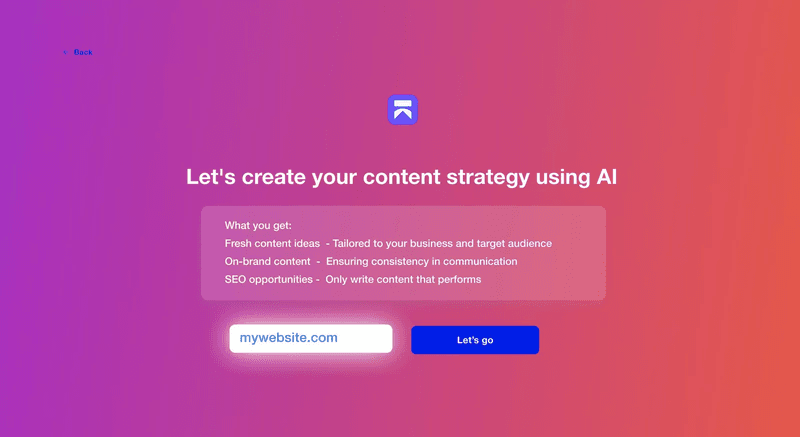
This step usually reveals three types of opportunities:
- Pages that already get impressions but do not get clicks
- Pages that rank on page two and could move up with updates
- Topics your competitors cover that you do not
You get a short list of what to fix first, so you can improve results before you write new posts.
2. Company description (keep the strategy aligned with your offer)
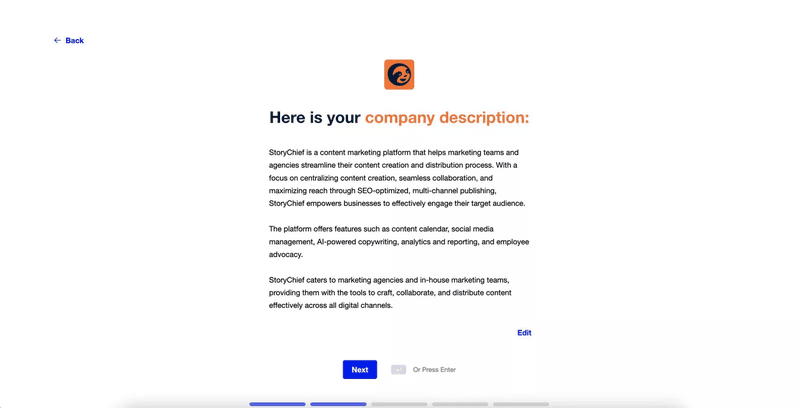
Next, William generates a company summary from your site. This matters because it shapes everything that follows.
A strong summary answers four questions. Who you help. What you help them do. How you do it. Why you are different.
When that is clear, content decisions get easier. Your topics stay relevant, your CTAs make sense, your AI drafts stop sounding generic.
3. Brand voice (make quality easier to repeat)
Publishing faster only works if quality stays consistent. William analyzes your content and turns it into a brand voice profile.
That voice profile guides future drafts. It reduces rewrite time and keeps multi-author teams aligned.
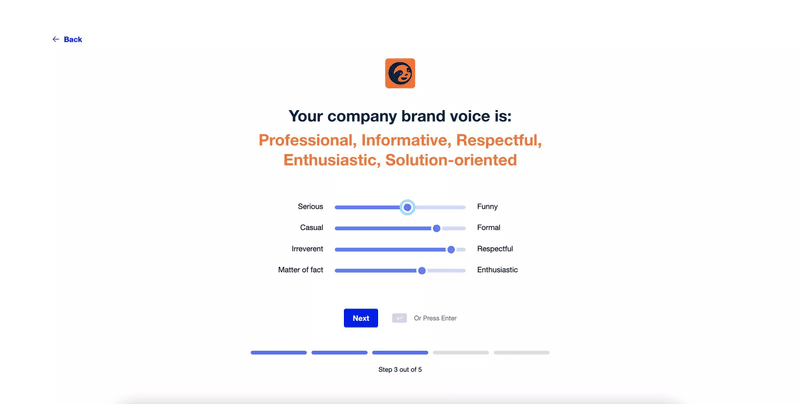
It typically captures a few practical rules, like:
- The tone you use (direct, helpful, expert)
- The sentence style (short, structured, low fluff)
- The formatting style (clear headings, scannable sections)
If you want a quick start, you can use StoryChief’s AI Brand Voice Generator.

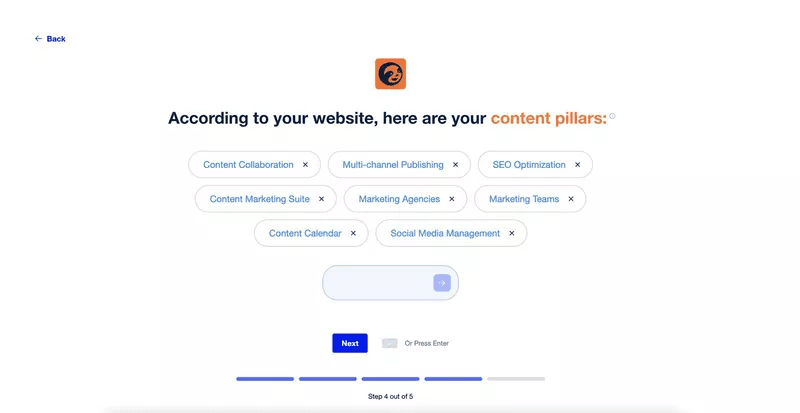
4. Content pillars (build authority that compounds)
Now you define your pillars. Pillars are the themes you want to be known for. They help you stop publishing random posts.
Each pillar becomes a cluster. You build one strong “hub” piece, then supporting articles that answer related questions. This improves internal linking and helps search engines understand your expertise.
A good pillar is broad enough for many articles, but specific enough to match your product.
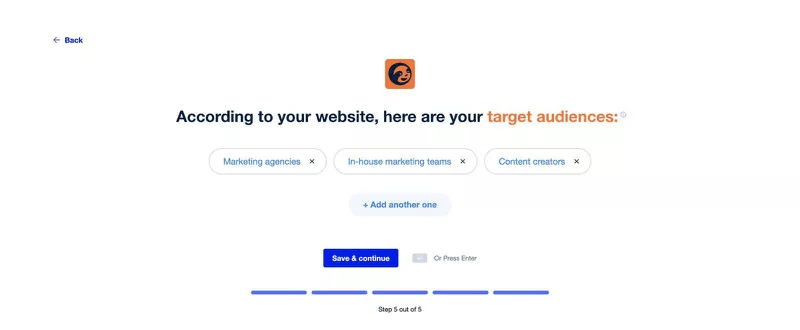
5. Audience intent (write what people actually want)
Keywords are not the strategy. Intent is.
William helps you map what people mean when they search. That changes what you write and how you structure it.
For example, “best tools” needs comparisons. “how to” needs steps. “examples” needs real samples. When you match intent, rankings and conversions both improve.
6. Content ideas (turn research into a real backlog)
Once you have pillars and intent, William generates ideas that fit. These are easier to execute because each idea has a purpose.
You typically end up with a balanced backlog:
- Quick wins (low competition, clear intent)
- Authority posts (bigger topics that take time)
- Conversion content (use cases, alternatives, comparisons)

This is where strategy becomes practical. Your team stops debating topics and starts shipping.
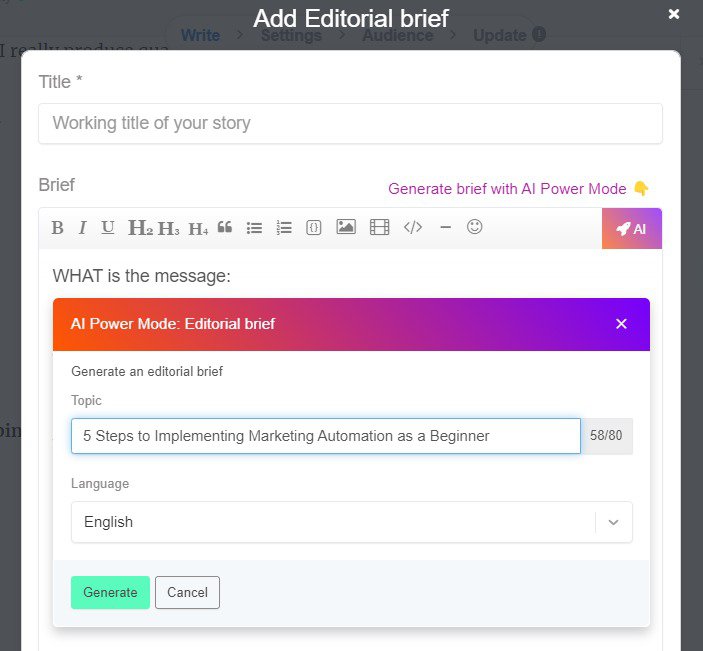
7. Briefs (keep content consistent across writers)
Ideas still fail without direction. Briefs make quality repeatable.
A useful brief stays short. It includes the intent, the outline, the key questions to answer, and the CTA. That is enough to reduce revisions without slowing the team down.
8. Create, distribute, and measure (one workflow)
Execution is where most teams lose time. StoryChief keeps planning, writing, approvals, publishing, and performance in one workflow.
This makes it easier to repurpose one article into multiple channels. It also makes results visible, so you know what to update next.

9. Improve every month (small updates, compounding gains)
Your strategy is not a one-time project. Rankings change. Competitors update content. Older pages lose relevance.
So the loop is simple: publish, measure, refresh. Update pages that are close to page one. Expand what already performs. Consolidate overlap when needed.
That is how content becomes a growth system.


Measure whether AI search actually sees your content
Traffic and rankings still matter, but they do not show the full picture in 2026. Buyers increasingly get answers directly from ChatGPT, Gemini, Copilot, Google AI Overviews, and Google AI Mode. Your strategy should therefore track whether those answers mention your brand, cite your website, or recommend a competitor instead.
StoryChief’s AI Visibility Tracker helps teams monitor the buyer questions that matter most, compare mention and citation rates across AI providers, and identify the pages and competitors shaping each answer. Rather than treating a visibility score as the end goal, use those findings to decide what to create, refresh, or strengthen next.

That closes the loop: build content around real buyer questions, publish it with clear proof and editorial depth, then use AI visibility data to see whether it is earning a place in the answers your audience sees.

Conclusion
AI hasn’t changed what great content marketing is about: helping the right people find you, trust you, and eventually choose you. What it has changed is how quickly you can get from “we should write something” to “we have a plan, and it’s working.”
When you use AI with a real strategy, content stops feeling like a never-ending to-do list. You’re no longer guessing topics, rewriting the same briefs, or forgetting to distribute. Instead, you’re building a repeatable system: clear pillars, smarter ideas, faster production, and performance insights that tell you what to double down on next.
If you’re ready to turn scattered ideas into a focused roadmap you can actually execute, William—StoryChief’s AI content agent—can help you map out your strategy, speed up planning, and keep everything moving from creation to distribution and measurement.

FAQs
Q1: How should I use AI to actually boost content performance in 2025?
AI isn’t just a writing tool anymore—it’s a performance engine. Use AI to:
- Generate topic clusters based on search trends and competitor gaps.
- Optimize content in real-time for readability and SEO, including LLM-assisted keyword placement.
- Predict engagement metrics before publishing using AI-powered analytics tools like MarketMuse or StoryChief’s AI insights.
- Automatically conduct content audits to uncover actionable insights that boost your visibility on LLMs, search engines, and social media platforms.
Q2: What’s the biggest mistake marketers make when using AI today?
Over-reliance without human editing. Even advanced AI still struggles with:
- Niche tone, brand voice, or context-specific humor.
- Fact-checking nuanced topics (AI hallucination is still a 2025 reality).
The fix? Use AI to draft or outline, then apply human oversight for accuracy, voice, and emotional resonance.
Q3: How can AI-generated content stay compliant with Google’s 2025 SEO standards?
Google now favors “experience-first” content. That means:
- AI-generated content must be fact-checked, well-structured, and genuinely helpful.
- Avoid thin “SEO-first” articles—AI should supplement, not replace, human insight.
- Use AI to optimize metadata, schema markup, and internal linking patterns that align with your SEO roadmap.
Q4: What are AI Humanizers and which ones actually work in 2025?
AI Humanizers go beyond grammar—they make content sound like a real person wrote it:
- Tools like GrammarlyGO, Hemingway AI, and StoryChief adjust tone, idioms, and sentence flow.
- They reduce “robotic phrasing” that lowers engagement and improves dwell time metrics.
Q5: Can AI create content that genuinely converts in 2025?
Yes—but only when paired with human strategy:
- AI can A/B test headlines, intros, CTAs, and social snippets at scale.
- It can predict emotional triggers for specific segments.
- Conversion-focused marketers combine AI insights with qualitative research to maximize results.