



Inbound marketing used to be fairly straightforward: publish blog posts, send emails, rank in search, and move leads through your funnel. Now? The workflow is messier. You need AI help for ideation, drafting, optimization, repurposing, visuals, approvals, publishing, and reporting. And if your stack is spread across six or seven disconnected tools, inbound starts feeling a lot more like admin work than growth.
That’s why the best inbound marketing tools in 2026 don’t just help you write faster. They help you build a better system
If you’re still tightening your foundation, start with a clear content marketing strategy, validate topics through smart keyword research, and map distribution in a realistic content calendar. Once those pieces are in place, the right software can multiply your output without making your brand sound robotic.
In this guide, I reviewed the current inbound marketing landscape with a strong focus on AI content strategy, content generation, image creation, scheduling, SEO, and workflow management. The result is a buyer-friendly shortlist of tools that actually help modern marketing teams attract, nurture, and convert demand.
The best inbound marketing tools at a glance
| Tool | Best for | Starting price | Standout strength |
|---|---|---|---|
| StoryChief | Teams that want strategy, creation, SEO, and scheduling in one place | Free; paid plans from €19/mo | All-in-one inbound workflow |
| HubSpot Marketing Hub | CRM-led inbound programs | Free; Starter from $9/seat/mo | Lead capture + automation + CRM |
| Jasper | On-brand AI writing at scale | $59/seat/mo billed yearly | Brand-aware content generation |
| Semrush Content Toolkit | SEO-backed AI content creation | $60/mo | Keyword + SERP-driven content workflow |
| Canva | Visual content and AI-assisted design | Canva Business from $20/person/mo | Fast image and creative production |
| Buffer | Simple social scheduling with AI help | Free; paid plans from $5/channel/mo | Clean, affordable scheduling |
| CoSchedule | Marketing calendar and social planning | Free; paid plans from $19/user/mo | Calendar-first campaign management |
| Copy.ai | GTM workflows and content ops | $24/mo billed yearly | Workflow-based AI automation |
| Surfer | SEO optimization and AI search visibility | $99/mo billed yearly | Content scoring and search optimization |
| ActiveCampaign | Email nurture and lifecycle automation | From $15/mo | AI-assisted automation for lead nurture |
A lot of “best tools” roundups feel padded. They mix CRMs, chat tools, webinar software, and random add-ons into one giant list without helping you decide what actually fits your workflow.
This list is different. I prioritized tools that support one or more of the most important inbound marketing jobs today:
- AI content strategy: topic discovery, planning, briefs, and campaign ideation
- Content generation: blogs, emails, landing pages, social posts, and repurposing
- Image creation: visual assets, AI-generated images, and creative production
- Scheduling and distribution: social publishing, content calendars, and multichannel workflows
- SEO and discoverability: keyword research, content optimization, and AI search visibility
- Lead nurturing: email automation, segmentation, and conversion support
I also weighted usability, collaboration, pricing transparency, and how well each tool supports a human-sounding brand voice. Because yes, AI can help a lot, but if you don’t protect your brand voice, your content starts sounding like everybody else.
The 10 best inbound marketing tools
1. StoryChief

If you want one platform that can help you plan strategy, write content, optimize for SEO, collaborate with your team, and schedule distribution across channels, StoryChief is the strongest all-around inbound marketing tool on this list.
What makes StoryChief especially useful for inbound teams is that it connects the parts most tools keep separate. You can turn strategy into an actual publishing workflow, draft inside the AI & SEO Content Editor, manage approvals, run a Content Audit, and publish through Social Media Management without bouncing between tabs all day.
- Best for: Marketing teams and agencies that want strategy, content creation, SEO, collaboration, and scheduling in one place
- Key features: AI content strategy, AI writing assistant, SEO and readability scoring, content audits, multichannel publishing, editorial approvals, collaboration, analytics, social scheduling, brand voice controls
- Pros: Truly all-in-one, excellent balance of SEO and social workflows, strong for team collaboration, great fit for agencies and content teams, helps reduce tool sprawl
- Cons: Advanced AI image generation is available through add-ons, not every team needs the full platform, CRM depth is lighter than HubSpot’s
- Pricing: Free plan available. Social Media Calendar starts at €19/month billed yearly. Team Social starts at €29/seat/month. Team Editorial starts at €69/seat/month. AI image generation is available through add-ons from €49/month
2. HubSpot Marketing Hub

If your inbound engine revolves around lead capture, forms, landing pages, CRM data, and lifecycle automation, HubSpot is still one of the biggest names worth considering.
HubSpot is strongest when you need your content efforts tied tightly to contacts, deals, email automation, and reporting. It’s less of a lightweight content workflow tool and more of a full revenue platform. That makes it powerful, but also heavier and more expensive as your team grows.
- Best for: Businesses that want CRM-led inbound marketing with strong lead management and automation
- Key features: CRM, forms, landing pages, email marketing, marketing automation, social tools, campaigns, analytics, AI-powered marketing features, lead scoring
- Pros: Deep CRM integration, strong automation, solid reporting, good fit for growing demand gen teams, excellent for connecting content to pipeline
- Cons: Costs rise quickly, onboarding fees on higher plans, can feel bulky if you mainly need content operations and publishing
- Pricing: Free plan available. Starter starts at $9/seat/month billed annually. Professional starts at $800/month plus a one-time onboarding fee. Enterprise starts at $3,600/month plus onboarding
3. Jasper

If your biggest bottleneck is producing high volumes of on-brand marketing copy, Jasper is one of the strongest AI writing platforms built specifically for marketers.
Jasper shines when you need campaign copy, blog drafts, landing page messaging, email sequences, and brand-consistent content across teams. It’s especially compelling for companies that care deeply about tone, governance, and scaling content production without handing everything over to a generic chatbot.
- Best for: Teams that need fast, on-brand AI writing for campaigns and content production
- Key features: Brand voices, knowledge assets, audiences, marketing agents, content canvas, collaboration, workflows, integrations, rewrite tools, campaign support
- Pros: Strong brand controls, made for marketers instead of general AI users, good for scaling copy production, useful for multi-team consistency
- Cons: Not a full inbound platform, publishing and scheduling need other tools, pricing is less friendly for small teams than lighter AI writers
- Pricing: Pro starts at $59/seat/month billed yearly or $69/seat/month billed monthly. Business pricing is custom
4. Semrush Content Toolkit

If you want inbound content that starts with search demand instead of guesswork, Semrush deserves a spot near the top of your shortlist.
The big advantage here is that Semrush doesn’t just help you write. It helps you choose better topics, study competitors, build SEO briefs, optimize drafts, and even generate images inside the workflow. For inbound marketers who care about organic traffic, this is one of the most practical AI-assisted content stacks available.
- Best for: SEO-first teams that want AI content generation backed by live search data
- Key features: Topic Finder, SEO briefs, content optimization, AI article writing, AI rewriting, AI chat, AI image generation, brand voices, one-click WordPress export
- Pros: Strong keyword and SERP intelligence, helpful for planning as well as writing, good bridge between SEO and AI content, useful for teams publishing at scale
- Cons: Best value is in the content and SEO workflow rather than social scheduling, interface can feel feature-heavy for beginners, boosted article limits may feel tight for busy teams
- Pricing: Content Toolkit costs $60/month. It includes unlimited standard articles and 5 SEO-boosted articles per month. Additional SEO Boost credits are available for $30/month
5. Canva

If visual content is slowing your inbound team down, Canva is still one of the easiest ways to create social graphics, blog visuals, slide decks, lead magnets, and branded creative without turning every request into a design ticket.
Canva has become much more than a template library. Its AI-assisted features, brand controls, and team collaboration options make it especially useful for marketers who need polished assets fast. It’s not your central inbound platform, but it is one of the best companions to one.
- Best for: Teams that need fast, branded visual content and lightweight creative collaboration
- Key features: AI-powered design tools, premium templates, brand kit, image editing, background remover, content creation workflows, shared workspaces, social-friendly sizing and exports
- Pros: Very easy to use, strong design speed, ideal for non-designers, helps teams stay visually consistent, useful across social, blog, email, and lead magnets
- Cons: Not a full SEO or inbound automation platform, deeper team governance lives in higher plans, analytics are not the reason to buy it
- Pricing: Canva Pro is aimed at individual creators. Canva Business starts at $20/person/month for new team sign-ups
6. Buffer
If you want a simpler social scheduling tool that doesn’t punish you for breathing near the pricing page, Buffer remains one of the cleanest options around.
Buffer works well for smaller teams, lean marketing departments, founders, and agencies that mainly need publishing, planning, basic analytics, and a bit of AI help without a massive learning curve. It won’t replace your inbound strategy platform, but it makes the distribution side refreshingly painless.
- Best for: Small teams and lean marketers who want simple, affordable social scheduling
- Key features: Social scheduling, AI Assistant, ideas capture, community inbox, advanced analytics, first comment scheduling, hashtag manager, Canva integration, approval workflows on Team
- Pros: Easy to learn, affordable entry point, clean UI, solid publishing workflow, good value for social-first teams
- Cons: Limited for deeper SEO or campaign strategy, not built for long-form inbound content operations, reporting is lighter than enterprise social suites
- Pricing: Free plan available. Essentials starts at $5/month per channel billed yearly. Team starts at $10/month per channel billed yearly
7. CoSchedule

If your team thinks in campaigns, deadlines, and calendar views first, CoSchedule is a strong fit.
CoSchedule is particularly useful when the real problem isn’t writing the content, but organizing all the moving parts around it. You get a calendar-centric workflow for social publishing, campaign planning, approvals, evergreen re-sharing, and AI support. That makes it a good choice for teams that want more structure around execution.
- Best for: Teams that want a marketing calendar with social publishing and campaign planning baked in
- Key features: Marketing calendar, social publishing, AI social assistant, reusable templates, approvals, ReQueue automation, inbox, analytics dashboards, best-time scheduling, bulk scheduling
- Pros: Great calendar UX, strong for planning and recurring promotion, useful for content marketing teams that need more process, good campaign visibility
- Cons: Less SEO depth than StoryChief or Semrush, social profile limits matter on lower plans, X profiles cost extra
- Pricing: Free plan available. Social Calendar starts at $19/user/month billed annually. Agency Calendar starts at $59/user/month billed annually
8. Copy.ai

If your team wants to use AI less like a writing toy and more like an operating layer for marketing workflows, Copy.ai is worth a serious look.
Copy.ai has moved beyond simple copy generation into workflow automation for go-to-market teams. That means it’s helpful when you want repeatable systems for briefs, content creation, inbound lead processing, and connected execution across teams. It’s a smart pick for operations-minded marketers.
- Best for: Teams that want AI-driven workflows for repeatable content and GTM operations
- Key features: Chat, workflow automation, content generation, brand voice controls, multi-model access, inbound lead processing workflows, integrations, process templates
- Pros: Strong workflow angle, good for standardizing repeatable work, useful for content ops, flexible for broader GTM use cases
- Cons: Less native publishing than dedicated content platforms, can feel abstract if you just need a scheduler or editor, larger plans escalate fast
- Pricing: Chat starts at $24/month billed yearly or $29/month billed monthly. Growth starts at $1,000/month billed annually
9. Surfer
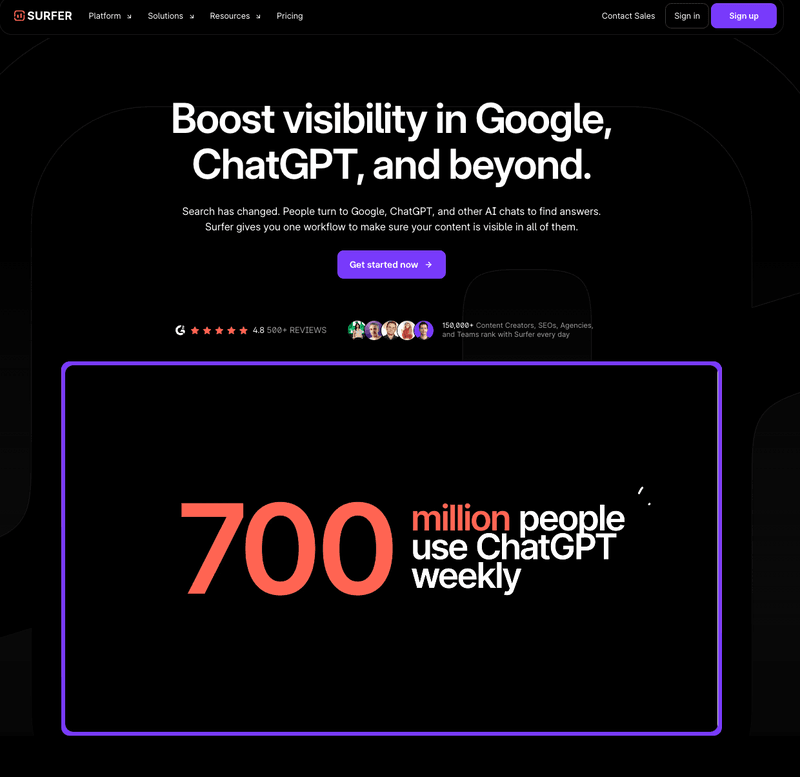
If your content team already writes a lot but struggles to rank consistently, Surfer is one of the cleanest ways to tighten your optimization workflow.
Surfer is not trying to be your full inbound operating system. It is trying to help your content become more visible in search and AI discovery environments. That makes it especially useful for teams that already have writers, calendars, and publishing systems in place but want better results from what they publish.
- Best for: Content teams that want stronger SEO optimization and AI visibility support
- Key features: Content scoring, document optimization, AI visibility tracking, prompt tracking, workflow guidance, content updates, visibility-focused optimization
- Pros: Strong focus on ranking improvement, practical optimization workflow, useful for updating existing content, good add-on to an existing stack
- Cons: Not a publishing or social scheduling tool, not ideal as a standalone inbound platform, more optimization-focused than strategy-focused
- Pricing: Standard starts at $99/month billed yearly. Larger plans are custom
10. ActiveCampaign

If your inbound strategy depends heavily on email nurture, segmentation, and marketing automation after the content has done its job, ActiveCampaign is a smart addition to the stack.
What’s interesting now is that ActiveCampaign is leaning harder into AI than many marketers realize. It includes AI content generation, AI image generation, AI brand kits, AI-powered automation building, and campaign calendar support alongside its core automation strengths. That makes it more useful for modern inbound teams than the old “email tool” label suggests.
- Best for: Businesses that want stronger lead nurture and automation after initial inbound capture
- Key features: Email marketing, automation builder, segmentation, landing pages, AI content generation, AI image generation, AI brand kit, campaign calendar, predictive sending, attribution and conversion tracking
- Pros: Strong automation depth, helpful AI additions, good for lifecycle marketing, solid choice for nurture-heavy funnels
- Cons: Less editorial and SEO workflow support than content-first platforms, pricing scales with contacts and feature depth, can be more than small teams need at the start
- Pricing: Starts at $15/month for accounts with fewer than 1,000 contacts
Which inbound marketing tool should you choose?
Here’s the short version.
Choose...
- StoryChief if you want the best all-in-one inbound workflow for strategy, creation, SEO, collaboration, and multichannel scheduling
- HubSpot if your priority is CRM depth, lead capture, and revenue reporting
- Jasper if your main bottleneck is on-brand AI writing
- Semrush if SEO and topic research drive your inbound motion
- Canva if visuals, lead magnets, and social creatives are slowing your team down
- Buffer if you want affordable, low-friction social scheduling
- CoSchedule if campaign planning and calendar visibility matter most
- Copy.ai if you want repeatable AI workflows for marketing operations
- Surfer if your content is live but underperforming in search
- ActiveCampaign if your biggest gains will come from better lead nurture and automation
Final verdict
For most modern content teams, StoryChief is the best inbound marketing tool because it solves the biggest real-world problem: fragmentation.
Instead of stitching together one tool for planning, another for writing, another for SEO, another for approvals, and another for scheduling, StoryChief gives you a connected workflow that actually reflects how inbound marketing works today.
That matters even more in an AI-heavy world.
The teams winning with inbound right now are not just generating more content. They’re building stronger systems for strategy, consistency, optimization, and distribution. If that’s what you want, StoryChief is the best place to start.
And once your system is in place, you can build faster with an AI-powered social media content plan and expand with proven AI content marketing strategies that keep your workflow efficient without losing the human touch.

Frequently asked questions
What are inbound marketing tools?
Inbound marketing tools help you attract the right audience, convert visitors into leads, nurture those leads, and measure performance. In practice, that includes tools for content strategy, SEO, content creation, social scheduling, email automation, analytics, and CRM.
Do I need one all-in-one platform or a stack of specialized tools?
It depends on your team.
If you’re small or mid-sized, an all-in-one platform usually gives you more speed and less chaos. If you’re larger and already have mature systems for CRM, design, and analytics, a specialized stack can make sense. The tradeoff is complexity.
What is the best inbound marketing tool for AI content strategy?
StoryChief is the strongest choice if you want AI content strategy tied directly to execution. Semrush is excellent if your strategy begins with SEO data. Jasper is great for AI-assisted production once strategy is already clear.
What is the best inbound marketing tool for image generation?
For pure visual creation, Canva is the easiest win. If you want image generation closer to your content workflow, StoryChief and Semrush are both more practical than many marketers expect.
What is the best tool for scheduling inbound content across channels?
StoryChief is the best all-around option if you want to schedule both content and promotion inside a broader inbound workflow. Buffer is great for simpler social scheduling, and CoSchedule is strong if your team loves calendar-based planning.
What matters most when comparing inbound marketing tools?
Don’t just compare feature grids. Compare workflow fit.
The best tool for your team is the one that helps you move from idea to published campaign with less friction, fewer handoffs, and more consistency. That’s what drives real inbound results over time.