



Generative engine optimization (GEO) is measurable, but not with one visibility score or a single AI prompt. To measure GEO well, track whether your brand is mentioned, recommended, and cited for the buyer questions that matter, then connect that exposure to referral traffic, qualified actions, and revenue.
That distinction matters. AI-search answers vary between runs, platforms, locations, and prompt wording. Recent research on GEO measurement concludes that a one-off result is not representative, and that visibility should be treated as a distribution rather than a fixed rank. Google’s own guidance also recommends using its Generative AI performance report to understand discovery through Google’s AI features, rather than relying on third-party claims about internal rankings.
For content teams, the goal is not to chase a flattering dashboard. It is to answer a harder question: is AI search increasing your qualified demand, and which content action caused it?
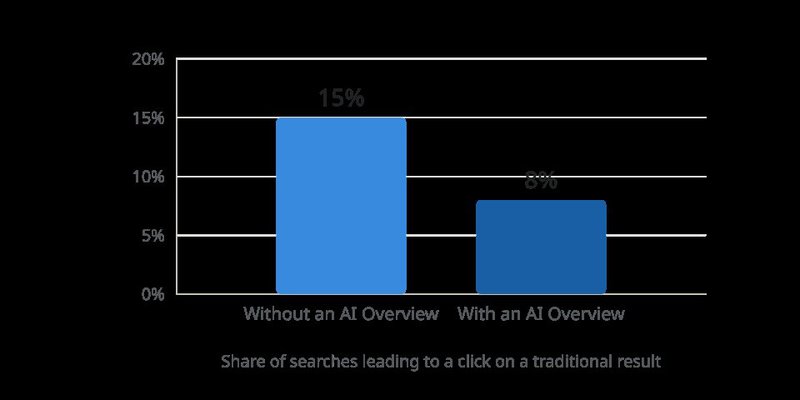
Why measure beyond clicks? This CC0 chart, based on Pew Research Center’s 2025 browsing study, compares traditional-result clicks when Google showed an AI Overview versus when it did not. View the source and licence details.
The GEO measurement model: exposure, evidence, and impact
A useful GEO dashboard has three layers. If you report only the first layer, you can mistake attention for business impact.
| Layer | What it answers | Core GEO metrics |
|---|---|---|
| Exposure | Does the AI answer surface us? | Mention rate, recommendation rate, citation rate, share of answer |
| Evidence | Does it represent us correctly and credibly? | Citation quality, message accuracy, source mix, competitor comparison |
| Impact | Does that visibility create valuable demand? | AI referral sessions, engaged sessions, conversions, pipeline, branded search trend |
This is a more useful model than a blended “GEO score.” A composite score can be helpful as a simple executive trend line, but it should never replace the underlying evidence. A score that rises while AI-referred conversions stay flat is a question to investigate, not proof of success.
The GEO metrics that matter
1. Mention rate: are you present in relevant answers?
Mention rate is the percentage of tracked prompts where the AI names your brand, product, or domain.
Formula:
Prompts with a brand mention ÷ total prompts tested × 100
Track this by platform, topic, audience, and intent. A 40% mention rate across broad educational prompts tells a different story from a 40% rate across high-intent comparison prompts.
Mention rate is an awareness signal. It does not prove that the model selected you as a source, recommended you, or drove a visit.
2. Recommendation rate: does the answer actually put you forward?
A brand can appear in an AI response without being a viable choice. Recommendation rate measures prompts where the answer explicitly includes your business, product, or approach as a suggested option.
Formula:
Prompts that recommend you ÷ total prompts tested × 100
For B2B teams, segment this metric by buyer intent:
- Problem discovery: “How do agencies measure content performance across clients?”
- Solution research: “What should a content operations platform include?”
- Evaluation: “Best content marketing platforms for agencies managing multiple brands”
- Decision support: “StoryChief alternatives for distributed content teams”
A growing recommendation rate on evaluation prompts is usually more commercially meaningful than a growing mention rate on generic definitions.
3. Citation rate: does the engine use your content as evidence?
Citation rate measures the percentage of tracked prompts where an AI answer links to or cites one of your pages as a source.
Formula:
Prompts that cite one of your URLs ÷ total prompts tested × 100
Citation rate is often the clearest GEO metric for content teams because it points to a specific page to improve or replicate. It also separates being named from being used as supporting evidence.

An AI-search answer is a generated response, not a fixed list of blue links. That is why GEO reporting needs to record whether your content was cited and what role it played in the answer.
Do not treat every citation as equal. Record the cited URL, the page type, the prompt intent, and whether the citation supports a central claim or sits in a long list of sources. Bing’s AI Performance reporting is one official source of citation data, including citation activity, cited pages, and the queries that grounded an answer.
4. Citation quality: is the right content being cited for the right reason?
Citation count alone can reward the wrong content. Add a simple qualitative field to every citation:
| Citation-quality check | What to record | Why it changes the decision |
|---|---|---|
| Prominence | Early, middle, or trailing source | Early sources may have more influence on the answer |
| Role | Definition, proof, comparison, or next step | Reveals what the page is contributing |
| Accuracy | Accurate, incomplete, or wrong | Protects brand and product messaging |
| Intent fit | Informational, evaluative, or decision-stage | Keeps reporting tied to buyer value |
5. Share of voice: how often do you appear relative to named competitors?
In GEO, share of voice is your proportion of brand mentions or citations among a defined competitor set for the same prompt set.
Formula:
Your mentions or citations ÷ all tracked competitor mentions or citations × 100
Use two versions:
- Citation share of voice for evidence-led informational prompts
- Recommendation share of voice for commercial and comparison prompts
Only compare brands that a buyer would genuinely consider. Adding unrelated household names can make the number look better without making the report more useful.
6. Message accuracy and sentiment: how does AI describe you?
AI answers can accurately cite a page and still frame your company poorly. For every meaningful brand mention, score the answer against the message you want buyers to retain:
- Is the category accurate?
- Is the product capability described correctly?
- Does the answer use a credible benefit or a vague claim?
- Does it introduce an objection, limitation, or outdated positioning?
- Is the tone positive, neutral, or negative?
This is not a vanity exercise. If AI-search answers repeatedly describe your product using an old category label, your existing pages, third-party coverage, and product messaging may not provide enough current evidence.
7. AI referral traffic: are citations producing visits?
AI referral traffic is the traffic that arrives with an identifiable referrer from AI-search or assistant experiences. Measure sessions, engaged sessions, engagement rate, key events, and landing pages.
Use Google Analytics alongside Search Console rather than expecting the two systems to report the same number. Search Console is the source of truth for Google Search exposure and clicks, while Analytics shows what visitors did after arrival.
For Google specifically, use the Generative AI performance report in Search Console to monitor discovery in AI features. Google documents that AI Overviews and AI Mode contribute to Search Console performance reporting, so keep Google AI data separate from non-Google assistant referral data when interpreting results.
AI referral traffic will undercount influence. Some people see an answer, then search for your brand later, type the URL directly, or convert on another device. That is why referral sessions should be paired with branded-search trend, direct-traffic trend, form attribution, and sales-call feedback.
8. Conversion and pipeline contribution: did AI visibility create business value?
The highest-value GEO metrics are the same business outcomes you use for other acquisition channels:
- Newsletter signups and resource downloads
- Demo or consultation requests
- Trial starts
- Qualified leads
- Opportunities and pipeline
- Revenue, where attribution is reliable
Create an AI-source segment in your analytics and report conversion rate alongside volume. Then review assisted paths, not just last-click conversions. An AI answer may start the research, while a branded search or direct visit closes the gap later.
Build a prompt set before you build a dashboard
A GEO metric is only as credible as the prompts behind it. Do not track a collection of clever queries chosen because your brand already appears. Build a fixed, documented prompt set that mirrors the questions your buyers ask.
For a B2B content platform, that could include questions about content strategy, collaboration, multi-channel distribution, content reporting, AI-assisted creation, and agency delivery. The best prompts come from keyword research, sales objections, customer conversations, support questions, and the pages competitors are repeatedly cited for.
Use a balanced prompt set:
| Prompt group | Purpose | Example |
|---|---|---|
| Category | Test basic inclusion | “What is a content operations platform?” |
| Problem | Test topical authority | “How can an agency reduce content approval delays?” |
| Comparison | Test consideration visibility | “Best tools for planning and distributing B2B content” |
| Decision | Test recommendation visibility | “Which platform helps agencies manage client content calendars?” |
| Proof | Test evidence and credibility | “How do teams measure whether content is driving pipeline?” |
Why a single prompt run is not a GEO baseline
AI-search answers are probabilistic. Change the wording, time, location, model version, chat history, or web results and you can get a different answer. Two 2026 research papers reached the same operational conclusion: one-off GEO observations are unreliable, and apparent visibility differences can fall inside normal measurement noise. The research on repeated GEO measurement recommends treating visibility as a distribution, while a statistical study of AI citation variability found substantial variation across repeated samples and advises reporting uncertainty.
Use this practical protocol:
- Lock the first version of your prompt set for a quarter.
- Run each prompt in fresh sessions, using the same market and language settings where possible.
- Repeat important prompts multiple times per reporting period.
- Log the full answer, cited domains, cited URLs, your brand’s role, competitors, and any inaccurate claims.
- Report the rate and the number of observations, such as “cited in 12 of 30 runs,” not only “40% citation rate.”
- Keep prompt changes in a change log. If you alter the test, label the result as a new baseline.
You do not need perfect scientific control to make better content decisions. You do need enough consistency to distinguish a meaningful pattern from one surprising answer.
A 90-day GEO measurement cadence
The first 90 days should establish a baseline, identify content gaps, and show whether changes are improving meaningful coverage.
| Timing | What to do | What to report |
|---|---|---|
| Weeks 1-2 | Define prompts, competitors, metrics, and conversion events | Baseline by platform and prompt group |
| Weeks 3-4 | Audit cited pages and competitor source patterns | Priority content gaps and pages to refresh |
| Month 2 | Publish or improve the highest-impact pages | Citation and recommendation movement by topic |
| Month 3 | Review traffic, conversions, and assisted demand | What to scale, revise, or stop |
Turn GEO reporting into content decisions
A GEO dashboard is useful only when it tells the team what to do next. Use these patterns to guide the work.
| What you see | Likely interpretation | Best next action |
|---|---|---|
| Low citations, strong topic relevance | Your evidence is not being selected | Improve the most relevant page with original examples, clear claims, and stronger supporting sources |
| Mentions rising, citations flat | You are known but not used as evidence | Publish a page that answers the recurring question directly and provides proof |
| Citations rising, referrals flat | Answer visibility may be awareness-led or poorly attributed | Check citation prominence, prompt intent, CTA relevance, branded search, and assisted conversions |
| Strong informational visibility, weak comparison visibility | You teach the topic but are not entering consideration | Create clear evaluation and comparison content that reflects real buyer criteria |
| Accurate citations, outdated product description | Your source ecosystem is stale | Refresh core pages, update credible third-party profiles, and align product language |
| One platform improves while others do not | Platforms select sources differently | Analyze the prompt, cited-source mix, and audience intent before copying tactics across engines |
What not to measure as your primary GEO KPI
Avoid making these the headline metric:
- A proprietary visibility score with no raw prompts or methodology: It may be useful for trend monitoring, but you cannot diagnose or defend it without the data underneath.
- One screenshot of a brand mention: It is an observation, not a baseline.
- Raw citation totals across unrelated prompts: A citation from a low-value question should not count as much as a decision-stage recommendation.
- AI crawler visits as proof of visibility: Crawling shows possible access, not that a model selected, cited, or recommended your content.
- Traffic alone: AI answers can shape consideration without sending a trackable click.
Google explicitly cautions marketers not to accept third-party claims of internal AI-ranking access at face value. Focus on observable results, your own analytics, official reporting, and evidence you can audit.
The simple GEO scorecard to share with leadership
Keep leadership reporting short enough to guide a decision. A monthly scorecard can include:
- Priority prompt coverage: mention, recommendation, and citation rates
- Competitive position: citation and recommendation share of voice
- Message quality: accuracy issues and the content responsible
- Business impact: AI referrals, conversion rate, key events, and assisted pipeline
- Content actions: pages updated, pages created, and the hypothesis behind each action
Add the trend, the sample size, and one plain-language conclusion. For example: “Our citation rate for agency reporting prompts increased from 8 of 30 runs to 15 of 30 after updating our analytics guide. Referral traffic is unchanged, so next month we will test stronger decision-stage content and form attribution.”
Measure GEO to learn, not to create another vanity dashboard
The right GEO metrics connect AI visibility to a repeatable content system. Measure exposure so you know whether you appear. Measure citation quality and message accuracy so you know what AI systems are using and saying. Measure referral traffic, conversions, and assisted demand so you know whether the visibility matters.
That creates a practical loop: identify the questions that matter, measure the answer landscape, improve the content with the strongest evidence, and use results to choose the next action. It is the same discipline behind an effective AI content strategy, applied to a new and less transparent search environment.
Frequently asked questions
What is the best GEO metric?
There is no universal single best metric. For awareness, use mention rate. For content quality and source selection, use citation rate and citation quality. For commercial impact, use AI-referred conversions and assisted pipeline. The strongest reporting combines all three layers.
How often should you measure AI-search visibility?
Run high-priority prompts repeatedly on a consistent weekly or biweekly cadence, then use monthly reporting for content and budget decisions. Keep the prompt set stable long enough to make trends comparable.
Can Google Search Console measure GEO?
It measures Google’s generative AI visibility, not every AI platform. Use Google’s Generative AI performance report for Google AI features, then combine it with Analytics and separate monitoring for other assistant platforms.
Is a higher GEO score always better?
No. A higher score can hide weak performance on buyer-intent prompts, inaccurate brand descriptions, or no measurable business impact. Always inspect the underlying prompts, citations, and outcomes.
Should GEO replace SEO reporting?
No. GEO expands the measurement model. Strong technical foundations, helpful original content, search performance, engagement, and conversions still matter. Google’s guidance is clear that the same people-first, non-commodity content and foundational SEO practices support visibility in generative search experiences too.