



The best content distribution examples are not a list of channels. They are moments when the right people have a real reason to help a useful story travel.
That distinction matters. Posting to your own social channels is an owned-media activity. Asking employees, customers, partners, or press contacts to share a relevant message introduces an earned-distribution layer. A solid distribution plan needs both.

As LinkedIn’s employee advocacy guide explains, advocacy works when people understand the value of sharing and have a practical way to participate. Its employee advocacy mini guide makes the operational advice even clearer: provide ready-made messages, make them easy to access, and keep measuring what works.
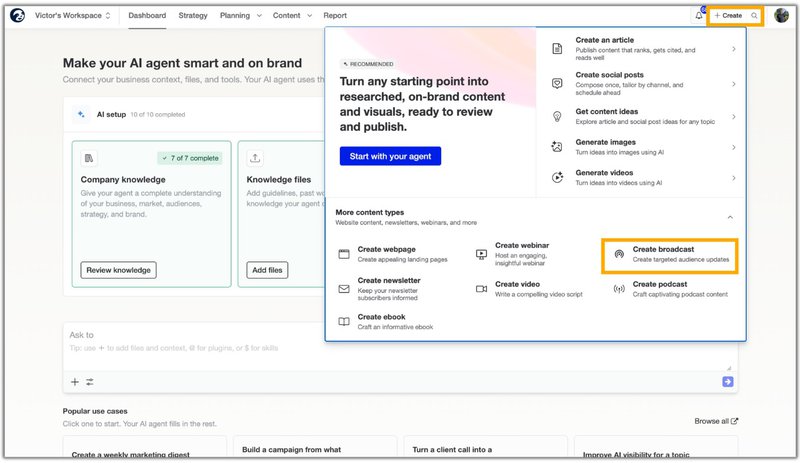
Broadcast gives teams a focused way to put that principle into practice. Create a short message, attach share kits with guidance, media, and caption variants, choose the relevant audience, then send or schedule the request. Recipients can open a public page, choose an angle, and use the prepared assets to share. The full flow is covered in the Broadcast guide.
Here are five moments worth planning for.
1. A product release that solves a visible customer problem
A product release is one of the clearest moments to activate your network, but only if the message goes beyond “we shipped something.”
People share launches when they can explain the change in a way their own audience cares about. Your job is to give them that explanation.
What to include in the Broadcast
| Share kit | Best audience | Angle |
|---|---|---|
| Customer-problem post | Sales, customer success, customers | Name the workflow friction the release removes |
| Product-workflow post | Product and marketing teams | Show the before-and-after process |
| Team-perspective post | Employees and leaders | Share what the team set out to improve and why |
Prepare these assets before the announcement is approved. That way, the launch article, product post, and ambassador request all reinforce the same story.
2. A research report or original data story
Original research gives ambassadors a stronger reason to share than a standard promotional post. It helps them bring an insight to their network, not simply promote a brand.
The most useful research Broadcasts give people more than a link to a long report. They give them a clear point of view they can add to a conversation.
What to include in the Broadcast
- A headline finding in plain language
- One visual that makes the finding understandable at a glance
- A short caption for people who want to share the result quickly
- A longer expert caption that explains the implication
- A client, partner, or executive angle where relevant
Do not make every caption restate the same statistic. One person may want to share what changed in their industry. Another may want to explain the operational consequence for their team. A third may want to invite a discussion around the finding.
This is where a connected content workflow matters. The research brief, report, graphics, social derivatives, and distribution plan should stay connected, so the context does not disappear as the campaign moves across channels.
3. An event, webinar, or conference appearance
Events create a short window where timing matters. A Broadcast can help attendees, speakers, partners, and internal teams share the same moment with different perspectives.
The mistake is waiting until the event starts to ask for amplification. By then, recipients are already busy, speakers are in preparation mode, and the core assets are often still being revised.
What to include in the Broadcast
| Timing | Share kit | Purpose |
|---|---|---|
| Before the event | Invitation post | Help relevant contacts promote attendance |
| During the event | Live insight post | Give attendees a credible, fast way to share a takeaway |
| After the event | Key learning post | Extend the event’s value beyond the room |
Plan all three moments in the same content publishing calendar. This prevents the common problem of producing the event assets without preparing the distribution sequence that makes them perform.
4. A customer story or partner announcement
Customer stories and partner announcements are high-trust content moments because the message does not only come from the brand. It includes an external relationship with a reason to care.
That makes audience selection especially important. The ideal recipient list may include the customer-facing team, relevant partners, executives, regional teams, and press contacts. Not everyone needs the same caption.
What to include in the Broadcast
- A customer-result angle, where approved
- A practical workflow takeaway for peers
- A partner angle focused on the shared opportunity
- A proud-team angle for employees who supported the work
- An approved image, quote card, or video excerpt
Keep the sharing guidance specific. Tell people which post is appropriate for a customer, partner, or industry audience. This helps them choose a message that supports their own credibility.
If the core asset is an article, you can already share published articles with ambassadors and press contacts. Broadcast is most useful when you want to package several related options around the same announcement.
5. A useful point of view that deserves a wider conversation
Not every Broadcast needs to support a launch. A strong point of view can be just as valuable when it gives your audience language for a problem they already recognize.
Good candidates include:
- A contrarian take on a common workflow
- A lesson learned from customer conversations
- A practical framework your team uses
- A response to a major shift in your market
- A clear explanation of a confusing topic
The test is simple: would someone outside the marketing team feel proud to put this idea in front of their network?
If the answer is yes, create a few share kits that make the perspective easy to carry. Give the subject-matter expert a deeper version, the broader team a concise version, and partners a version that connects to the shared audience problem.
This approach builds on the same principle behind turning approved content into campaign assets: do not leave the strongest insight trapped in its original format. Adapt it for the people and places that can give it a useful second life.
How to choose the right moment
Before sending a Broadcast, ask five questions:
- Is there a clear story, not just an internal update?
- Does a specific group have a genuine reason to share it?
- Can we provide at least two distinct caption angles?
- Do we have the approved media and destination links ready?
- Will we review participation and improve the next send?
If you cannot answer yes to most of these, the issue is usually not the Broadcast. The content moment is not ready yet.
Build a repeatable rhythm, not a stream of requests
The goal is not to ask your network to share every piece of content. It is to make the moments that matter easier to support.
Start with one upcoming product release, report, event, customer story, or point-of-view piece. Build two or three share kits around the different reasons people may want to participate. Keep the Broadcast message short, the options useful, and the audience relevant.
Over time, this turns ambassador activation from an ad hoc reminder into a real distribution channel. For the wider operating model, see how to build a repeatable ambassador distribution channel that connects the message, assets, recipients, and follow-up learning.