




Creating good content is only half the job. You can spend hours researching a topic, writing useful articles, polishing the headline, and designing the perfect graphic. But if the right people never see it, all that work doesn't have much of a chance to pay off especially in the B2B space. That’s why having a content distribution toolkit matters.
The variety of digital channels keeps on growing and people try to keep up with the trends, but they rarely pay attention to all of those channels. As specified in the 2026 Clutch survey, most participants (64%) have an average of 30 apps installed but they use only 5-10 apps daily. This means that utilizing various channels doesn't automatically mean earning more attention. Distribution needs to focus on the channels where your audience is already active.
That's why content distribution deserves just as much attention as content creation and it’s important to have a great content distribution toolkit.
The good news? You don't need a full marketing team or a complicated collection of disconnected tools to do it well. In fact, some platforms now cover several parts of the content process in a single workflow. StoryChief is one example, which is why you'll see it pop up more than once in this list.
It can take teams from planning and content creation through distribution, SEO, and performance tracking without constantly jumping between platforms.
Alongside it, a few more specialized tools can fill important gaps. Here are the tools worth having in your content distribution toolkit.
1. Plan Your Content Calendar
Content planning can get messy surprisingly fast. You start with one blog post. Then there’s a LinkedIn campaign to support it, an email newsletter, a webinar coming up, a case study waiting for approval, and another thought-leadership article that needs to go live next Thursday.

Having a content calendar gives everything a home. Tools like StoryChief should be definitely on your content distribution toolkit as it lets you organize upcoming content, campaigns, deadlines, and distribution from one place. That makes it much easier to see what's going live, where it's being published, and whether you're covering the topics that actually matter to your audience.
More importantly, planning ahead helps you move away from the "What should we post today?" approach. You can build content around campaigns, product launches, seasonal opportunities, and larger business goals instead of publishing just to fill an empty day.
What’s best is the calendar tells you which team member owns what, when it’s due, and how each task contributes to your goals.

2. Strengthen Email Distribution
You've written a great newsletter. The subject line works, the CTA is clear, then it lands in spam. Email distribution isn't just about growing a mailing list. Your emails actually have to reach that list.
To improve email deliverability, it’s important to validate your email list and SignalHire can help you collect email addresses in bulk and make sure you have valid contacts. It’s also important to check how emails perform across different mailbox providers, review authentication, and spot potential spam problems before they affect an important campaign.

This becomes especially useful as your email program grows. Even a small improvement in deliverability can mean hundreds or thousands more people actually seeing the content you've worked to create.
Deliverability is only half the picture though. If your domain isn't protected, someone else can send phishing emails that look like they're from you, quietly wrecking the sender reputation you've worked to build. DMARKOFF helps to monitor your SPF, DKIM, and DMARC records and flags unauthorized senders before they hit your inbox placement or your brand's reputation.
3. Repurpose Content With AI
One strong piece of content can become several assets for different channels. A webinar could become a blog post, a series of LinkedIn posts, newsletter content, sales material, and even a short video—without having to start from square one each time.

This is where AI-assisted repurposing can save a lot of time. With a platform such as StoryChief, teams can take existing content and adapt it into different formats without manually rewriting everything from scratch. The goal isn't to copy and paste the same message everywhere. It's to reshape the core idea for the way people consume content on each platform.
For example, a detailed 1,500-word guide makes sense on your website but that same guide probably shouldn't become a 1,500-word Instagram caption. Repurposing helps you get more mileage out of the original idea while keeping each piece appropriate for its channel.

4. Maintain a Consistent Social Presence
For many B2B brands, LinkedIn is one of the most important places to stay visible. But consistency is also where many content strategies fall apart.
You post regularly for two weeks. Work gets busy. A campaign launches. Suddenly, the company page—and maybe your executives' thought-leadership accounts—haven't posted anything in ten days.

Bulk.ly is built to help automate and recycle social media content, making it useful for brands with a library of evergreen posts that still have value. Instead of letting older content disappear after one share, you can keep useful pieces circulating.
Of course, that doesn't mean endlessly reposting the exact same thing.
Bulkly allows you to mix evergreen posts with timely content, fresh ideas, company updates, and conversations happening in your industry. Automation should keep your social presence moving. It shouldn't make the account feel like nobody's actually behind it.
5. Schedule Social Posts
There's very little benefit to manually logging into every social platform each time you want something to go live. It only takes more of your time. Scheduling tools let you batch post the work instead.

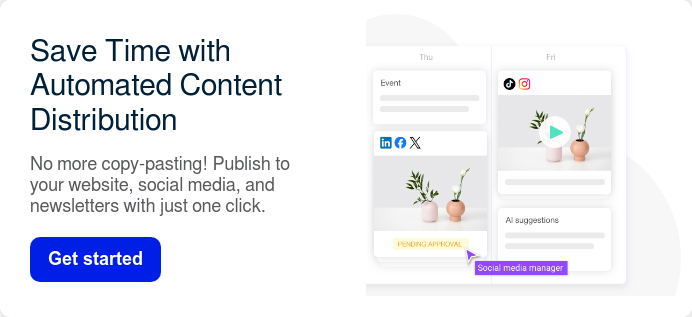
StoryChief, for example, can be used for content planning and scheduling social content alongside the rest of your content workflow. Rather than treating social distribution as something that happens after an article is published, you can build those posts into the process from the beginning.
This is particularly helpful when you're distributing one campaign across several channels. Your blog, newsletter, and social posts can support the same idea without everyone scrambling to publish them separately. Again, this feature is especially useful for teams because you can see who’s working on what.
It also gives you more control over timing. You can prepare content while you have the time and schedule it for when your audience is more likely to see it.
Organic distribution is only one part of the picture. B2B teams running paid campaigns also need to think about how content is delivered beyond their owned channels. For video campaigns in particular, understanding how video ad serving can help marketers make better decisions around delivery, targeting, tracking, and optimization.
6. Design Social Assets
Great copy can still get scrolled past. Visuals help content stand out, particularly on crowded social feeds where you may only have a second or two to catch someone's attention.

Envato works as an all-in-one creative asset toolkit, giving content teams access to templates, graphics, stock assets, video elements, and other creative resources. Whether you're putting together LinkedIn graphics, webinar promotions, report covers, presentation visuals, or paid ad creative, starting with professional assets can save a lot of production time, and everything comes with a lifetime commercial license.
This can be a lifesaver for smaller teams that don't have a designer available for every social post. Just remember that consistency matters more than constantly chasing new design trends. Use templates as a starting point, then apply the same fonts, colors, imagery, and overall visual identity across your content.
Once you build a strong brand identity, followers should eventually be able to recognize your posts before they even notice the account name.
7. Monitor Your Backlinks
Content distribution doesn't stop once you've shared an article yourself. Backlinks can extend the reach of your content, send referral traffic to your website, and contribute to your site's authority in search. They're also a useful signal that other websites consider your content worth referencing.
Ahrefs makes it easier to see who's linking to your site, which pages are attracting links, and whether you've gained or lost backlinks over time.

That information can shape future content decisions too.For example, if one particular guide keeps earning links naturally, that's a clue. Maybe the topic deserves a follow-up article. Perhaps the original post could be updated or expanded. You could even create a related resource designed specifically to attract more links.
Don't just track backlinks as a number. Look at what they're telling you about the content people find valuable enough to cite.
8. Measure Your Results

Publishing more content isn't necessarily a sign that your strategy is working. You need to know what happens after you hit publish.
Which topics are generating traffic? Which channels are bringing people to your content? What are readers engaging with? And which pieces aren't doing much at all?
This brings the StoryChief workflow almost full circle. Since planning, creating, repurposing, and distributing content can happen within the same platform, teams can also use its analytics to understand how that content performs.
That continuity matters. Instead of treating reporting as a completely separate exercise, performance data can feed directly into your next decision.
Pay attention to metrics that match the purpose of each piece. For example, a thought-leadership article might be judged by reach, engagement, and backlinks. In comparison, a product-focused article may be much more valuable if it generates qualified leads or conversions, which can then be tracked and analyzed with Phonexa. And a newsletter could be evaluated through clicks and subsequent website activity.
There's no single metric that points to your success. Finally, you can have the results of all of your content in one single place.
9. Optimize Your Content for SEO

Distribution can generate an immediate burst of traffic. SEO can keep bringing people to your content long after that initial push is over. That's why search optimization should happen before publishing, not as an afterthought.
And yes, StoryChief comes into play here too. SEO optimization is built into the same content workflow already covered, helping writers review elements such as keywords, headings, readability, metadata, and overall content structure before an article goes live.
That's ultimately the benefit of having several of these functions under one roof. You're not planning in one tool, writing in another, optimizing somewhere else, and then trying to piece together performance afterwards. Each step feeds into the next.
But don't fall into the trap of writing for an SEO score.Search engines are trying to surface content that actually answers what people are looking for. Your first priority should still be creating something useful, clear, and worth reading. SEO simply helps make that content easier to discover.
And once it's published, revisit it. Update outdated information, improve sections that aren't performing, strengthen internal links, and look for new search opportunities. Some of your best-performing content may end up being an article you wrote years ago and kept improving.

Wrapping up
You don't need to use every tool on this list. What matters is having a repeatable system that takes content from idea to distribution and, eventually, measurement. Planning ahead, repurposing what you've already created, staying consistent across channels, and paying attention to performance can help you get much more value from every piece of content.
It's also why having multiple functions within one workflow can make such a difference. Instead of constantly switching platforms or rebuilding the same content for different channels, your process becomes easier to manage and easier to repeat.