





If you’re searching for the best Gemini alternatives, there’s a good chance you’re not just looking for another chatbot.
You’re looking for something that helps you move from idea to execution faster. Maybe you need stronger AI content strategy, better long-form writing, built-in image generation, a cleaner workflow for approvals, or a way to schedule everything without duct-taping five tools together.
That’s where most Gemini comparisons fall short. They focus on raw model performance, then stop there.
For marketers, content teams, and agencies, the better question is this:
Which Gemini alternatives helps you research, create, optimize, and publish content with the least friction?
That’s the lens we used for this list.
We prioritized tools that overlap with Gemini in meaningful ways, including:
AI content strategy and research
Content generation and rewriting
- Image generation or visual creation
- Multi-channel planning and scheduling
- Collaboration, approvals, and campaign workflows
If you’re building a real marketing engine, not just prompting for one-off answers, here are the best Gemini alternatives worth your time.
Quick comparison: the best Gemini alternatives at a glance
| Tool | Best for | Standout strength | Starting price |
|---|---|---|---|
| StoryChief | End-to-end AI content marketing | Strategy, writing, collaboration, publishing, analytics in one place | Team Editorial from €69/seat/month billed yearly |
| ChatGPT | Flexible general-purpose AI | Strong writing, brainstorming, image generation, research workflows | Free; Plus from $20/month |
| Jasper | Brand-safe marketing content | Brand voice controls and campaign-oriented writing | Pro from $69/seat/month |
| Copy.ai | GTM and workflow automation | Workflow-based content and sales enablement | Chat from $29/month |
| Writesonic | SEO-heavy AI content operations | Content + SEO + AI search visibility tools | Starter from $99/month |
| Adobe Express | Fast creative production | Easy visual content creation with built-in generative AI | Premium from $9.99/month |
| Midjourney | High-quality AI image generation | Striking visuals for campaigns and creative concepts | Basic from $10/month |
| Buffer | Simple AI-assisted scheduling | Lightweight publishing and social planning | Essentials from $5/month per channel |
| Hootsuite | Enterprise-style social management | Social scheduling, listening, inbox, and AI support | Standard from $39/user/month |
| Notion AI | AI-assisted planning and knowledge work | Notes, briefs, docs, and team planning in one workspace | Business from $20/member/month |
Most “best Gemini alternatives” articles just compare chat quality. That’s useful, but incomplete.

We looked at what marketers actually need after the prompt is written:
- Can the tool help shape strategy, not just output text?
- Does it create usable content across blog, social, email, and campaign formats?
- Can it help with visuals?
- Does it support collaboration and approvals?
- Can it actually help you publish or schedule content?
- Does the pricing make sense for a solo marketer, growing team, or agency?
That’s also why StoryChief ranks first here. It doesn’t just answer prompts. It helps teams turn ideas into finished, published campaigns.
If your goal is to build a smarter workflow, not just collect AI tabs, it’s the most complete option on this list.
1. StoryChief
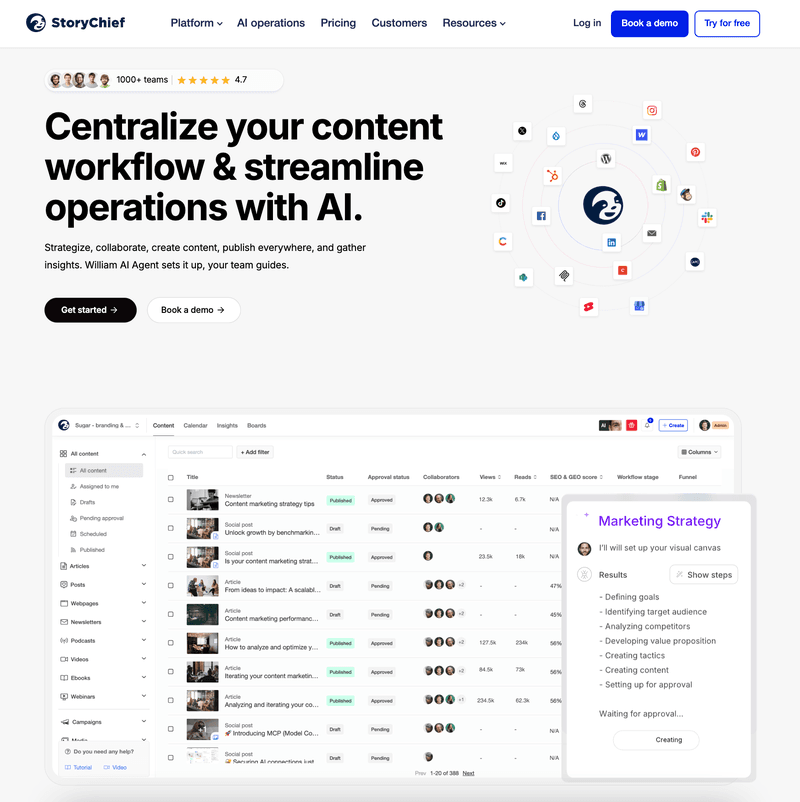
If Gemini feels useful but incomplete, StoryChief is the alternative built for what marketers actually need next.
Instead of giving you a blank chat box and leaving the rest up to you, StoryChief helps you connect the full workflow: idea generation, content strategy, writing, collaboration, optimization, publishing, and performance tracking. That makes it especially strong for in-house teams and agencies that want fewer tools, fewer handoffs, and faster execution.
It also fits naturally into a modern AI content strategy, because you can move from keyword and topic planning into production without switching platforms every ten minutes.
Key features
- AI-assisted topic ideation and campaign planning
- SEO and GEO-focused content creation workflows
- Blog, social, and multi-format content production
- Collaboration, approvals, and shared workspaces
- Multi-channel publishing and scheduling
- Analytics, SEO insights, and content audit features
- Optional AI image and video generation add-ons
Pros
- Best all-in-one fit for content teams, agencies, and editorial workflows
- Strong overlap with Gemini plus much better execution for publishing teams
- Built-in scheduling and distribution, not just content generation
- Useful for both strategy and production
- Great for reducing tool sprawl
Cons
- More robust than a simple chatbot, so it may be more than solo casual users need
- Advanced AI visual features may require add-ons depending on your plan
Pricing
- Team Editorial starts at €69/seat/month billed yearly
- Agency Social starts at €49/customer/month billed yearly
- Agency Editorial starts at €79/customer/month billed yearly
- AI add-ons for image and video generation are available separately
2. ChatGPT

If you want a flexible all-purpose AI assistant, ChatGPT is still one of the easiest Gemini alternatives to recommend.
It’s great for brainstorming, outlining, rewriting, summarizing, and drafting. It also supports image generation and web-assisted research on paid plans, which gives it broader day-to-day utility than a basic text-only assistant. For solo marketers, it’s often the first tool that earns a spot in the stack.
That said, it still works best as a powerful creation layer, not a full content operations system. You’ll usually need other tools for approvals, editorial planning, and distribution.
Key features
- Strong long-form and short-form writing support
- Brainstorming, summarization, and editing workflows
- Image generation
- Data analysis and file-based workflows
- Research support with web access on supported plans
- Custom GPTs, projects, and task organization
Pros
- Very versatile across many marketing tasks
- Good mix of writing, ideation, and visual generation
- Free plan available
- Strong for rapid drafting and iteration
Cons
- Not purpose-built for editorial collaboration or publishing
- Scheduling and campaign management require other tools
- Output quality depends heavily on prompting discipline
Pricing
- Free plan available
- Plus starts at $20/month
- Pro starts at $200/month
- Team starts at $25/user/month billed yearly

3. Jasper

For teams that care deeply about on-brand messaging, Jasper is one of the strongest Gemini alternatives on the market.
Jasper is especially useful when your challenge is not generating more words, but generating words that consistently sound like your company. It leans hard into brand voice, campaign workflows, and marketing use cases, which makes it a better fit than Gemini for structured content production.
It also complements teams building repeatable AI content marketing strategies, because it’s designed around scaling content without losing tone.
Key features
- Brand voice and knowledge asset controls
- AI-assisted campaign and marketing content creation
- Canvas-based writing environment
- Marketing-focused agents and workflows
- Collaboration features for teams
Pros
- Excellent for brand consistency
- Strong fit for marketing departments and content teams
- Better structured than a generic chatbot for campaign work
- Helpful for scaling repeatable content creation
Cons
- Pricier than general AI assistants
- Less useful if you mainly need research, scheduling, or publishing
- Best value appears when a team uses it consistently
Pricing
- Pro starts at $69/seat/month billed monthly
- Pro is $59/seat/month billed yearly
- Business pricing is custom
4. Copy.ai

If your work sits at the intersection of content and go-to-market execution, Copy.ai is a compelling Gemini alternative.
It has moved beyond “AI writer” territory and now focuses heavily on workflows, automation, and GTM use cases. That makes it especially relevant for marketing and revenue teams that want help producing content tied to sales enablement, outbound messaging, and campaign operations.
It’s less editorial than StoryChief and less conversational than ChatGPT, but very useful if you want structured AI workflows instead of one-off prompting.
Key features
- Workflow-based content creation
- GTM-focused use cases and automations
- Chat projects and reusable workflows
- Access to multiple underlying AI models
- Team-oriented implementation and scaling options
Pros
- Good fit for GTM and revenue teams
- More process-driven than many AI writers
- Helpful for repeatable workflows
- Broad use cases across marketing and sales
Cons
- Less focused on publishing and editorial scheduling
- Can feel more operational than creative
- Higher-tier plans get expensive quickly
Pricing
- Chat starts at $29/month billed monthly
- Chat is $24/month billed annually
- Growth starts at $1,000/month billed annually
- Higher enterprise tiers are available
5. Writesonic

If your main priority is SEO content production with AI layered on top, Writesonic deserves a close look.
Compared with Gemini, Writesonic is much more opinionated about content marketing workflows. It combines AI writing with SEO, content optimization, and AI search visibility features. That makes it attractive for teams that care about search performance just as much as speed.
It also pairs well with a documented content strategy template, since it helps translate strategy into keyword-driven execution.
Key features
- AI article and content generation
- SEO and content optimization tools
- AI search visibility tracking
- Integrations with external data sources
- Team and project management options
- Image generation access on supported plans
Pros
- Strong SEO-first positioning
- Better fit than Gemini for search-focused teams
- Useful mix of content generation and optimization
- Good option for marketers managing one or more sites
Cons
- Pricing starts higher than several alternatives
- Can be overkill for light or occasional content needs
- Scheduling and approvals are not as central as in StoryChief
Pricing
- Starter starts at $99/month
- Basic starts at $249/month or $199/month billed annually
- Growth starts at $499/month or $399/month billed annually
- Enterprise pricing is custom

6. Adobe Express

If your version of “Gemini alternative” leans more visual, Adobe Express is worth adding to your shortlist.
It’s not trying to be a full editorial command center. Instead, it shines when you need to create social graphics, lightweight branded visuals, short videos, and quick campaign assets without getting buried in complex design software. For marketers who need visual output fast, that’s a real advantage.
It also fills a gap many text-first AI tools leave open: turning ideas into polished visual assets your team can actually publish.
Key features
- Fast graphic, video, and social asset creation
- Generative AI features for creative production
- Brand-friendly templates and design workflows
- Easy resizing and repurposing for multiple channels
- Firefly-powered creative AI options
Pros
- Easy for non-designers to use
- Great for quick branded assets
- Helpful for social teams and campaign support
- Lower learning curve than traditional design suites
Cons
- Not built for deep content strategy or SEO writing
- Limited as a standalone content operations platform
- Best used alongside a writing or scheduling tool
Pricing
- Premium starts at $9.99/month
- Firefly Pro starts at $19.99/month
7. Midjourney

For pure image generation quality, Midjourney is still one of the most impressive Gemini alternatives available.
If you’re creating campaign concepts, blog hero images, ad creative directions, or visual moodboards, Midjourney can produce more distinctive results than many general AI assistants. It’s especially helpful when you want visuals that feel less template-driven and more imaginative.
The tradeoff is simple: it’s a specialist. You’ll still need another tool for content strategy, writing, and scheduling.
Key features
- High-quality AI image generation
- Multiple subscription tiers based on usage needs
- Relax mode on higher plans for larger generation volume
- Stealth mode on higher plans for privacy
- Video generation access on higher plans
Pros
- Excellent visual quality
- Great for campaign ideation and creative exploration
- Better than most general AI tools for standout imagery
- Flexible pricing tiers
Cons
- Not a content writing or scheduling platform
- Requires a separate workflow for approvals and publishing
- Best for teams that will actively use image generation
Pricing
- Basic starts at $10/month
- Standard starts at $30/month
- Pro starts at $60/month
- Mega starts at $120/month
8. Buffer

If you mainly want a simpler option for Gemini alternatives, Buffer is one of the easiest tools to adopt.
Buffer doesn’t try to do everything. That’s part of its charm. It focuses on scheduling, publishing, and lightweight AI assistance for social teams that want a clean workflow without enterprise-level complexity. For smaller businesses and lean marketing teams, that can be exactly the right tradeoff.
It’s also a natural companion to a structured content calendar if your biggest challenge is staying consistent across channels.
Key features
- Social post scheduling and publishing
- AI assistant features
- Basic and advanced analytics depending on plan
- Community inbox features
- Hashtag management and first-comment scheduling on paid tiers
Pros
- Very approachable for small teams
- Affordable entry point
- Useful for social consistency and lightweight planning
- Cleaner and simpler than heavier enterprise tools
Cons
- Limited for full content strategy and long-form editorial work
- Not built for SEO content production
- Collaboration depth depends on your needs and plan
Pricing
- Free plan available
- Essentials starts at $5/month per channel billed yearly
- Team starts at $10/month per channel billed yearly
9. Hootsuite

If you need a more advanced social media management layer than Gemini can offer, Hootsuite remains a strong option.
Hootsuite is built for teams that care about scheduling at scale, social inbox management, listening, sentiment, and benchmarking. It also includes AI support for captions and image generation, which gives it more overlap with Gemini than older social tools had.
For teams with a mature publishing operation, Hootsuite is often more useful than a standalone AI assistant because it helps manage what happens after the content is written.
Key features
- Unlimited post scheduling on paid plans
- AI assistant with image and caption generation
- Social inbox and DM automations
- Best-time-to-post recommendations
- Competitor benchmarking and sentiment analysis
- Bulk scheduling on higher plans
Pros
- Strong social operations platform
- Better than Gemini for publishing and monitoring
- Good fit for larger or busier social teams
- Useful listening and benchmarking capabilities
Cons
- Less helpful for long-form editorial content and SEO writing
- Can feel heavier than Buffer for smaller teams
- Pricing rises as complexity increases
Pricing
- Standard starts at $39/user/month
- Advanced starts at $99/user/month
- Enterprise pricing is custom
10. Notion AI

If your team spends most of its time inside briefs, docs, notes, and planning systems, Notion with AI is a smart Gemini alternative.
Notion AI is not the best pure writer on this list, and it’s not a dedicated scheduler either. But it is extremely useful for planning campaigns, turning messy notes into structured assets, summarizing meetings, and building a shared workspace around your marketing operation.
That makes it especially helpful before content creation starts, or alongside a more specialized publishing platform. It also works well with processes like building a repeatable content calendar or organizing ideas from your AI content writing tools research.
Key features
- AI-assisted writing and summarization
- Notion Agent for more complex tasks
- AI meeting notes and follow-ups
- Enterprise search across connected apps
- Team docs, databases, calendars, and planning in one workspace
Pros
- Great for planning, documentation, and internal collaboration
- Helps teams organize the messy middle of content work
- Useful workspace for briefs, calendars, and knowledge management
- Strong fit for operational clarity
Cons
- Not a dedicated publishing or SEO platform
- Scheduling is not its main strength
- Less specialized for marketing output than StoryChief or Jasper
Pricing
- Free plan includes trial AI capabilities
- Plus starts at $10/member/month
- Business starts at $20/member/month and includes core AI workspace features
- Enterprise pricing is custom
Which Gemini alternative is best for you?
The right answer depends on what you actually need Gemini to do.
Choose StoryChief if you want the closest thing to an all-in-one marketing workflow
StoryChief is the best choice if you want strategy, writing, collaboration, scheduling, publishing, and analytics in one platform. It’s the strongest option here for content teams, agencies, and B2B marketers who care about execution, not just ideation.
Choose ChatGPT if you want the most flexible general AI assistant
ChatGPT is ideal if you want a versatile tool for writing, brainstorming, and research, and you’re comfortable building the rest of your workflow around it.
Choose Jasper if brand voice matters most
Jasper is a strong pick for teams that need consistent on-brand copy at scale.
Choose Writesonic if search performance is your priority
Writesonic makes the most sense for SEO-heavy teams that want AI writing plus search visibility tools.
Choose Adobe Express or Midjourney if visuals are the bottleneck
Adobe Express is better for quick branded asset creation. Midjourney is better for more distinctive AI-generated imagery.
Choose Buffer or Hootsuite if scheduling is the real need
Buffer is simpler and friendlier for small teams. Hootsuite is more advanced for larger social operations.
Choose Notion AI if planning is where your process breaks down
Notion AI is excellent for organizing briefs, notes, and campaign planning, even if you still need another tool to publish.
Final verdict
If you want a Gemini alternative that actually helps marketers do the work, not just discuss it, StoryChief is the best overall choice.
It gives you the broad AI support people like in Gemini, but adds the layers Gemini usually leaves behind: content strategy, collaboration, approvals, publishing, scheduling, and performance insights.
That combination matters.
Because in real content teams, the bottleneck is rarely “getting an answer.”
It’s turning ideas into content that gets approved, published, distributed, and measured without chaos.
StoryChief is built for exactly that.
If that’s what you need, it deserves the top spot on your shortlist.

FAQ
What is the best alternative to Gemini for marketers?
For marketers, StoryChief is the best alternative to Gemini because it combines AI-assisted strategy, content creation, collaboration, publishing, and analytics in one workflow.
Which Gemini alternatives are best for content creation?
ChatGPT, Jasper, StoryChief, and Writesonic are all strong for content creation. StoryChief stands out if you also need publishing and scheduling, while Jasper is excellent for brand voice.
Which Gemini alternatives are best for image generation?
Midjourney is one of the strongest options for high-quality AI image generation. Adobe Express is a better fit if you want fast, branded visual assets for marketing teams.
Which Gemini alternatives are best for scheduling content?
StoryChief, Buffer, and Hootsuite are the best fits for scheduling. StoryChief is best for combined content production and distribution, Buffer is best for simplicity, and Hootsuite is best for heavier social operations.
Is StoryChief better than Gemini?
For content marketers and agencies, StoryChief is often a better fit because it goes far beyond chat. It supports planning, writing, approvals, publishing, and analytics in one place.