



Creating content without tying it to a revenue goal is a waste of time. Traffic alone doesn’t grow sales or convert buyers into customers.
To justify the investment in your blog, you need a conversion-focused content strategy that aligns with buyer intent and revenue goals. By prioritizing high-converting keywords, you can attract visitors who are ready to take action.
In this guide, I'm breaking down how to create bottom-of-the-funnel (BOFU) content that nudges buyers toward conversion and accelerates their decision-making process.
Keep reading if you're ready to implement conversion-focused SEO and create content that converts visitors into revenue-generating machines in 2026.
Step 1: Outline specific revenue goals
Get clear on the main business goals before creating any content.
These should focus on specific outcomes like:
- Increasing monthly recurring revenue (MRR)
- Growing average contract value (ACV)
- Bringing in more enterprise customers requires a strategic approach to content creation.
- Strengthening lead-to-customer rates
- Improving paid conversions
Then, assign one primary revenue outcome to each blog post before writing.
Match the post to a specific funnel goal.
For example:
- Paid traffic conversion → Align the blog with the exact ad or landing page promise, then link directly to the same offer inside the post to create a piece of content that resonates with prospects.
- Trial sign-ups → Link to a product page or free trial subscription page.
- Demo bookings → Link to a booking calendar or sales page.
- Product sign-ups → Link to a pricing or onboarding page.
- Lead generation → Link to a gated asset or contact form.
I’ll show you how to create CTA links for these in Step 5.
Step 2: Research BOFU high-intent keywords that are easy to rank for
Use a high-quality SEO tool like Semrush or Ahrefs to research low-competition, high-intent keywords.
Focus on BOFU search terms where users are already comparing solutions, evaluating providers, or looking for pricing and implementation details. These keywords are typically longer, more specific, and aligned with purchase decisions.
StoryChief’s AI campaign assistant can help you plan these out if you need more support.
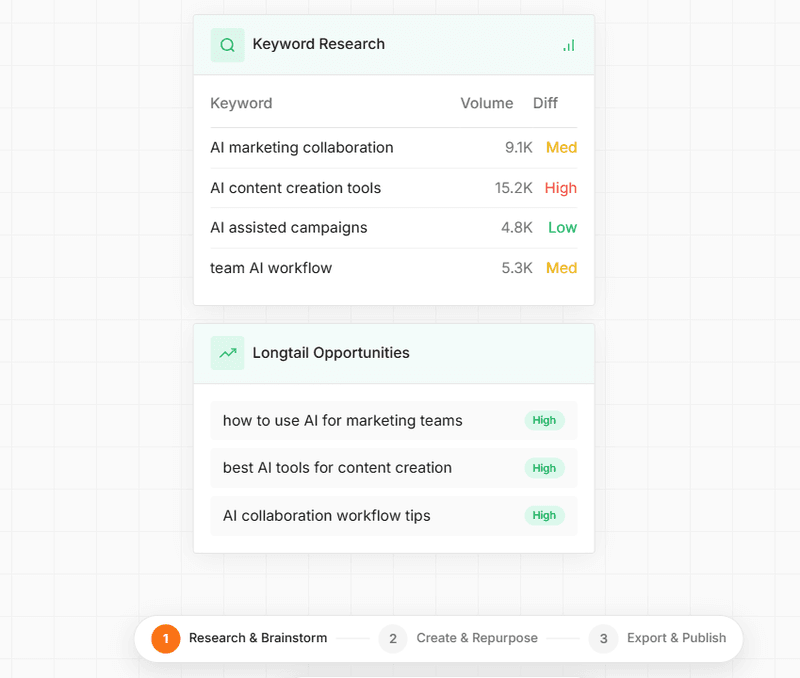
Look for phrases like: “Best [software] for [use case],” “[tool] pricing vs competitors,” “how to choose [solution type],” or “[service] for enterprise teams.” These are examples of content formats that resonate with prospects and indicate the buyer is already deep in the decision-making process.
Prioritize keywords that align directly with your revenue goals from Step 1. Each keyword should map to a clear outcome, whether that’s demo bookings, trial sign-ups, lead generation, or product sign-ups.
In other words … Pick keywords based on what you want the reader to do after they land on the page.
For example:
- If the goal is demo bookings → Target comparison or “best tool for [business type]” keywords
- If the goal is lead generation → Target “request a quote,” “service provider,” or “agency” keywords.
- If the goal is product sign-ups → Target “buy,” “pricing plans,” or “start using” keywords.
- If the goal is trial sign-ups → Target “free trial or “try [tool]” keywords.
The keywords should attract exactly the kind of buyer or subscriber who is ready to take action based on their specific needs.
Once you have high-intent keywords, the next step is to understand how buyers phrase their questions in real-world scenarios.
Step 3: Research BOFU AI searches
Research the AI queries the target audience is likely searching.
B2B buyers in the BOFU stage are asking very specific questions in AI search tools to ensure they find the right solution to their pain points. These are usually conversational and 10+ words.
For example, they might ask:
- “How does this platform compare to [competitor] in terms of security, pricing, and long‑term TCO for medium-sized businesses?”
- “What’s the best enterprise‑grade solution for [specific problem] that integrates with our existing CRM and ERP systems?”
- “What problems do advanced users typically report after using this software for 6–12 months in a B2B environment?”
Below are six ways you can uncover these. 👇
6 ways to find real-time queries people use in AI tools
There’s still no way to uncover the AI prompts people use when searching in tools like ChatGPT, Gemini, and Claude.
But you can get pretty close with these methods:
1. Use the “People Also Ask” and autocomplete feature in Google: Google’s People Also Ask section and autocomplete suggestions can offer insights into user questions.
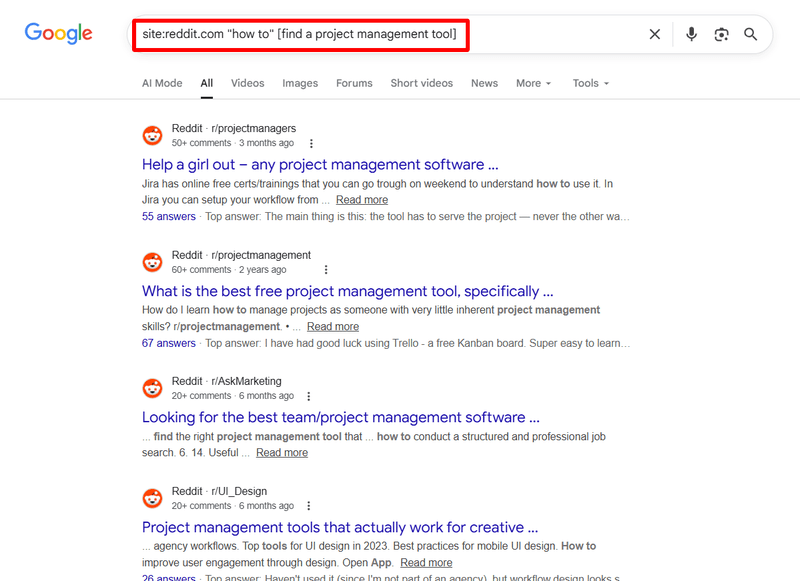
2. Search in forums and community platforms: Reddit and Quora provide examples of how people phrase their questions. Use search operators like site:reddit.com “how to” [topic] to find conversational queries.
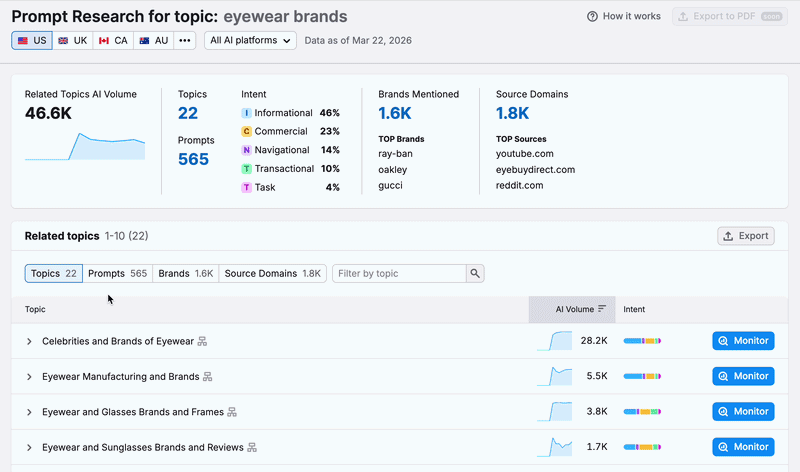
3. Invest in specialized AI/LLM visibility tools: Platforms that currently track AI search include AnswerThePublic, Profound.ai, and Nightwatch. Semrush also has a Prompt Research Report tool that helps you discover high-performing keywords for SEO and AI chat. Leveraging these keywords can significantly improve the conversion potential of your long-form content while also enhancing its credibility.
4. Research queries in Google Search Console: Use regular expressions to filter for longer, conversational queries that align with your audience’s interests. (Select the Queries tab in the table at the bottom of the Performance report.)
Check out this tutorial if you need help: How to Find AI Search Prompts in Google Search Console.
5. Analyze related questions in AI tools: In Perplexity or ChatGPT, ask a topic-related question and look at the related questions or follow-up suggestions provided by the tool. You can also ask the tool to generate a list of possible queries a user might type in to get the target website as an answer.
6. Sales and support team interviews: Ask internal teams for the exact questions buyers ask before they buy, or during support interactions. For example: “Can we integrate X with Y without breaking anything?” Or “What’s the onboarding process like, and does it include custom support?”
When you have your query list, head to the next step.
Step 4: Plan your BOFU content clusters and schemas
Grab your notes from Steps 1, 2, and 3 to plan the specific content assets you’ll be creating for your topic clusters.
Based on your notes, these might be:
- Written demo walkthroughs
- Comparison guides
- Product listicles
- Product pages
- Pricing pages
- White papers
- Case studies
Every asset needs a clear angle that ties the information to a specific outcome. The easiest way to see this in action is to look at how a single idea can drive engagement. The story behind Airborne Beer is a good example. Instead of listing historical facts, the content uses a single narrative as the central hook, then builds context around it to nudge the reader toward a specific experience.
This is the same principle behind effective content clusters. One core idea or story can anchor multiple supporting pieces, each covering a different angle while pointing toward the same outcome. This way, you are structuring content around one unifying concept that keeps the reader moving toward a defined action.
Once that core concept is defined, align your blog topics and subtopics with the keywords you pulled in Step 2. Hierarchy matters, so craft H2 question headings based on the queries you pulled in Step 3. (I’ll show you how to write blog posts based on all of these in Step 6.)
Then plan your content cluster structure. 👇
Pillar pages (parent pages) should cover the main topic at a high level and act as the central hub for the cluster. These are usually your most important BOFU pages, like “Enterprise SEO Platform” or “Content Marketing Software for B2B Teams.”
Cluster pages (child pages) support the pillar with specific, intent-driven content. (These target your subtopics.) These go deeper into one angle, question, or use case.
Here’s an example of how to plan this:
Pillar page → “B2B Project Management Software”
Child pages:
- Case Study: "How [Business Name] Improved Project Delivery Time by 35% Using B2B Project Management Software”
- Decision-making guide: “How to Choose the Right B2B Project Management Platform”
- Comparison listicle: “10 Best B2B Project Management Tools Compared”
- Pricing Guide: "B2B Project Management Software Pricing Guide”
Each child page should link back to the pillar page, and the pillar should link out to all child pages. Child pages should also interlink. (More on this in Step 7.)
Next, plan your schemas.
For BOFU content, focus on:
- Review the schema if you include testimonials or case studies
- FAQ schema for your People Also Ask sections
- Product or Service schema for product pages
- Article schema for blog posts
Make sure to include an Author schema as well.
Add a Person schema inside your Article schema with their:
- Name, role, organization
- Expertise (knowsAbout)
- LinkedIn (sameAs)
Keep it identical across all posts. *Pro-Tip: Link the author name to one author page with bio + all articles.
Step 5: Plan calls to action (CTAs) that align with your goals and resonate with your audience.
Strategize calls to action to A/B test and add to your blog posts. Make sure they align with the sales goals from Step 1.
Here are some examples:
- “Talk to sales to explore the right solution for your needs."
- “Get qualified now. Request a tailored walkthrough.”
- “Sign up and start using the platform in minutes.”
- “Book a demo to see our video content in action.”
- “Start your free trial today.”
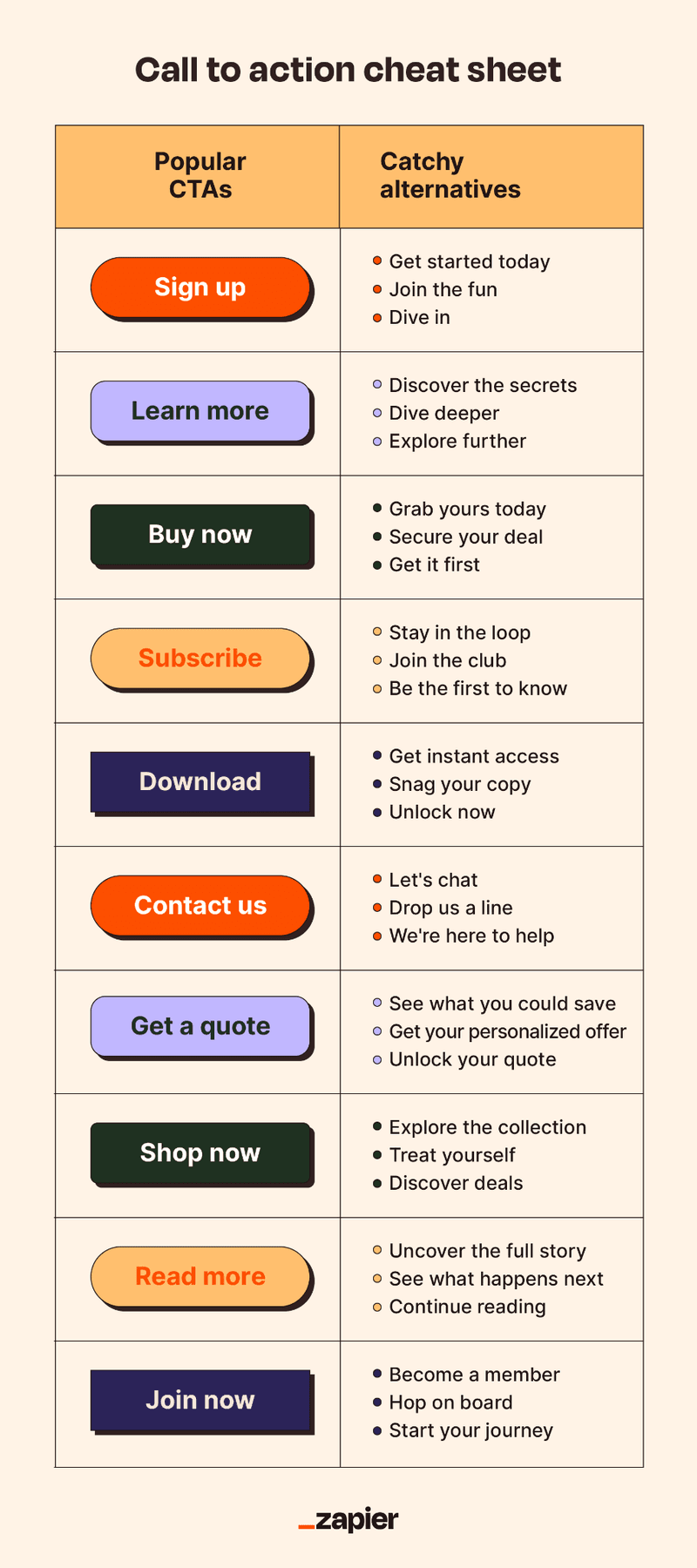
You can also experiment with more creative copy that resonates with the brand voice if that aligns with your content creation goals. (Or just to see which words convert best in your content strategy!)
Here are some fun examples you can test:
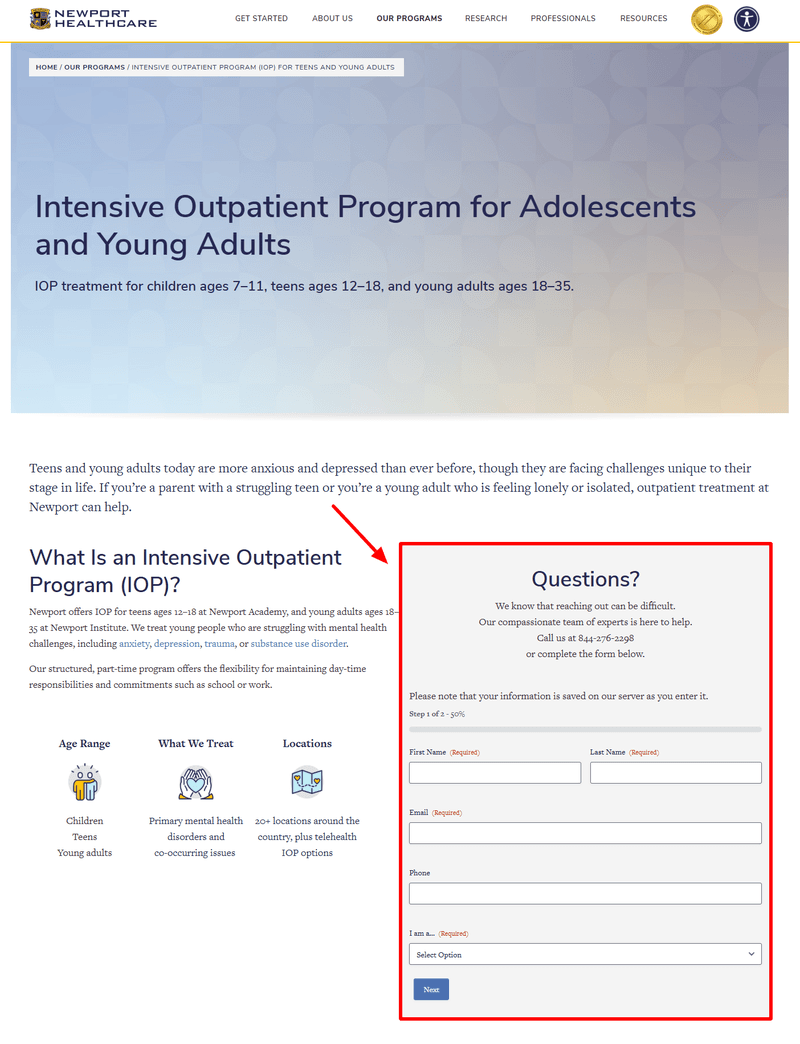
If the page is very high-intent, you can also experiment with adding a form-based CTA to enhance engagement.
Here’s a high-intent guide on IOPs for young adults. As soon as the reader lands on the page, they see a form-based CTA at the top right where they can submit their contact details to subscribe to the newsletter. When a website visitor is ready to buy or talk to someone now, a form like this is a practical and logical next step. 👇
Very important note: Make sure the back-end sales funnels are sharp and ready to go before publishing the calls to action in Step 6. (E.g., if a potential client books a demo call, they should immediately get a confirmation email and a follow-up from sales within 24 hours.)
The customer experience starts the moment they click the CTA link.
Once your conversion paths are defined, the next step is building content that supports them.
Step 6: Craft and publish your BOFU blog content
Create aligned briefs and assign them with due dates to your B2B writers to craft effective messaging.
In your briefs, specify the main target keyword (pulled from Step 2). And any related phrases you pulled from AI searches in Step 3. The main keyword should be in the title, metadata, and two H2 headings.
Make sure your writers optimize blog posts with semantic keywords aligned with the target keywords. They also need to format their pieces using proper headings (H2s, H3s, H4s).
➜ Structure is also very important. Have your writers start blog posts with an introduction, then a “highlights” section with a bulleted list. Then, two question-based headers (based on the AI SEO queries). Follow this with the main sections (main points about the target keyword) and subsequent points (subtopics as H3s and sub-subtopics as H4s).
To see how structure directly influences conversion, let’s have a look at how SoFi approaches topics like how to switch car insurance. Instead of covering the topic broadly, the article focuses on the key decisions the reader actually needs to make: when switching makes sense, how to compare providers, and how to avoid coverage gaps.

Each section resolves a specific concern and moves the reader forward.
That's the difference between conversion-focused content and general informational content. It reduces uncertainty in a sequence, which naturally leads to action without a hard sell.
End with a conclusion, FAQs based on the People Also Ask section, and a subject-matter expert author bio.
During editing and staging, have your editors naturally integrate the CTAs you planned. Experiment with three to five per blog post. Track these and use A/B tests to uncover which placements and CTA copy convert best.
For example:
- Add a CTA link after the introduction. Keep it friendly and casual. For example: “Want to explore tailored productivity options? Watch our demo.”
- Add a CTA link after sharing solutions to their problem in the main body. Position it as the go-to solution to their problem. E.g., “Save 20+ hours per week with our productivity templates.”
- Add a CTA link after the conclusion that focuses on a clear next step to help solve their problem.
For example:
- “Need help [solving this problem]? Book a free strategy call.”
- “Ready to [solve this problem]? Request a quote now.”
- “Looking for [solution]? Sign up for a free trial.”
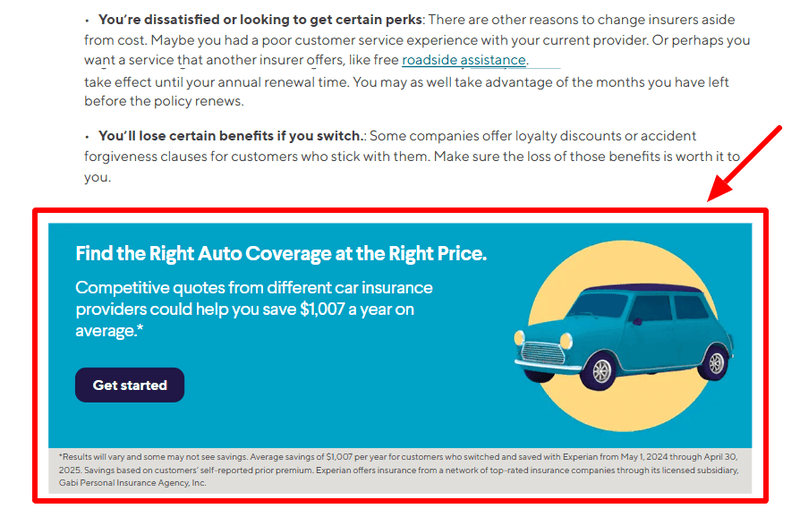
You can also A/B test two or more embedded CTAs. These are custom-designed, often box-shaped graphics that include action-oriented text and a button. Add one between CTA links one and two (after your question-based headers). And another one between CTA links two and three, roughly 350 words apart.
Here’s one that SoFi uses in the blog post above:
Step 7: Connect your clusters and add schemas
After you’ve published all BOFU pieces, connect clusters in a way that mirrors how buyers think and move through decisions.
Start with internal linking.
➜ The content pillars (also called “parent pages” or “pillar pages”) should link out to all supporting child pages (also called “cluster pages”). Each child page should link back to the parent page. Then, interlink relevant child pages where it makes sense contextually.
Here’s a visual example:
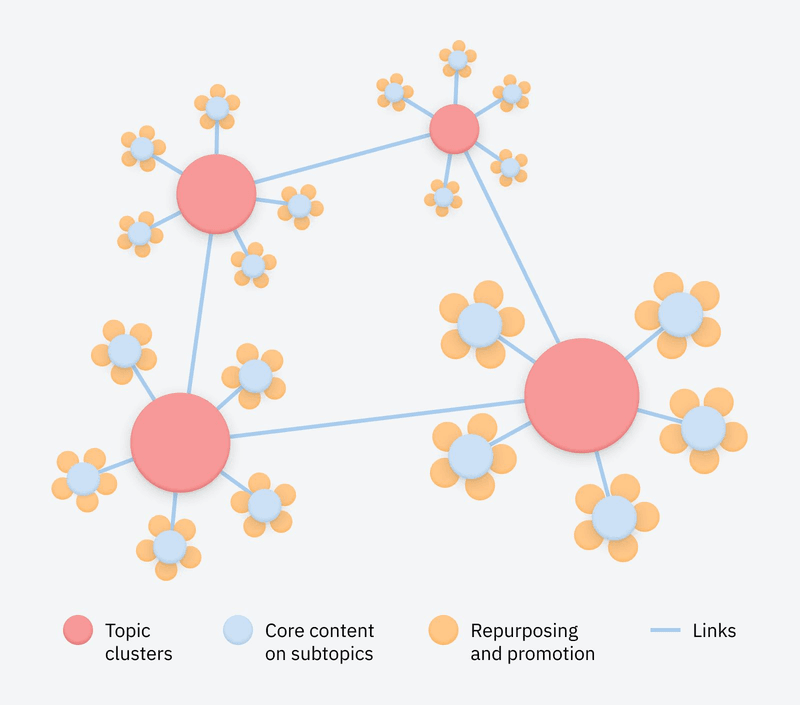
This creates a tight network that keeps users moving deeper into the content.
Once that structure is in place, layer in the Schema that you planned in Step 4.
Step 8: Distribute your BOFU content
Share the published BOFU content across all marketing channels, including email, social media, and niche B2B communities.
Experiment with repurposing, too. Repurpose snippets from each blog post and turn them into explainer videos, a podcast, infographics, and other valuable content. When distributing these, use your planned CTAs and link to your sales funnels. This gives ready-to-buy leads on different platforms a quick way to get in touch.
If you need help, StoryChief’s AI agent William can help you create repurposed rough drafts that serve as a comprehensive piece of content.
Finally, use guest posting to expand reach and put BOFU content in front of more decision-ready buyers. (Publish on industry-relevant sites where ideal clients already spend time, and link back to the high-intent pages or funnels as part of your content strategy.) Keep each piece aligned with the host site’s audience while still guiding readers toward a clear next step.
Implement these strategies to convert content into revenue starting today
And there you have it. This guide offers a practical, helpful approach to creating blog posts that convert.
From here, make sure to track the BOFU content and continue improving it. Use behavioral intelligence tools to learn how users interact with the content, where they drop off, and what drives conversions.
➜ Refine your strategy based on real data. Keep optimizing. Your content will start driving revenue.
If managing these workflows becomes complex at scale, centralized tools can simplify execution.
Need help centralizing your content workflow? StoryChief was built for B2B content agencies like yours. Try it for free now.